 Capacity Ledger
A Hundred Years of Reactors in Charles City
Cambrex broke ground on Thursday on a $120 million expansion at Charles City, Iowa, a century after a local veterinarian started making farm-animal medicine on the campus. The new plant adds 160,000 liters, which the company's own numbers put at a fifth to a quarter of everything already installed, and it lands on a site whose standing DEA bulk registration runs to twenty-two classes.
Cambrex has described the same Iowa project three times in twelve months, and the dollar figure has not moved off $120m once.
The liters have.
In October 2025 the company said the money would lift large-scale capacity at Charles City by 40%, to nearly a million liters. In March 2026, engineering studies closed, the new plant was 140,000 liters and worth 20%.
On Thursday, standing in front of the hole, it was 160,000 liters and about 25%.
Projects usually move the other way between the study and the shovel.
"What is already on the ground at Charles City that makes 160,000 more liters worth building?"
A Hundred Years on 11th Street
The company dates the site to 1926, when a local veterinarian started making medicine for farm animals on the campus.
The National Register, which lists his old office at 500 Gilbert Street, has Dr. Joseph E. Salsbury opening a Charles City practice in 1923 and quitting general work in 1930 to make poultry medicine full time. That building is the Floyd County Museum now.
Cambrex bought the chemicals business out of Solvay Animal Health in 1991, which is how a company founded on bulk pharma intermediates ended up owning a century of Iowa process plant.
Thursday's ceremony drew Senator Chuck Grassley and Lieutenant Governor Chris Cournoyer. The expansion runs to 4Q 2028 and takes the campus to about 400 people.
Charles City Area Development's Timothy Fox credits the plant as the main reason manufacturing wages in Floyd County run roughly 20% above the other north central Iowa counties.
Claudio Russolo, chief operating officer and incoming chief executive, called it "an important milestone in our continued investment in U.S. manufacturing," then put the site in plainer terms for the local radio: the largest independent API manufacturing site in the whole country.
Tom Loewald, the chief executive Russolo replaces on November 6, said the same thing in the 2025 release. Independent here carries the CDMO sense of a site with no pharma parent above it; Permira has owned Cambrex since 2019.
A Fifth to a Quarter
The October 30 release gives two numbers that do not quite sit on the same base, and the gap between them is useful.
Take the 25% literally and the site holds 640,000 liters today. Take "nearly one million liters" as the finished figure and subtract the addition, and it holds 840,000.
So what broke ground on Thursday is somewhere between a fifth and a quarter of what is already there (chart below).
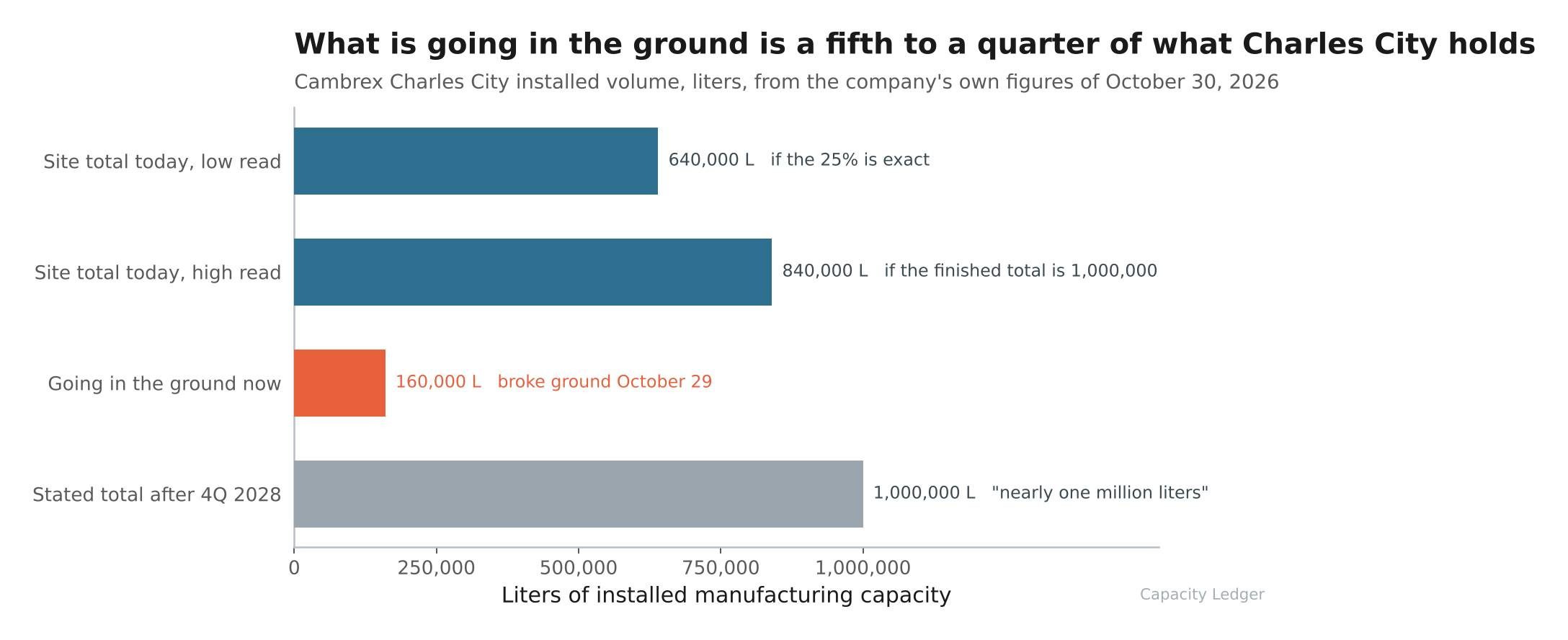
The March release lands inside that bracket from a different direction: 140,000 liters described as 20% of large-scale capacity puts the large-scale fleet near 700,000. Different denominator, same neighborhood.
For scale, Cambrex put total site capacity at roughly 107,000 gallons in 2017, which is about 405,000 liters. Nine years on, with one expansion since completed and another now in the ground, the campus is on track to carry close to two and a half times that.
What the money buys is specific: large-scale and mid-scale reactors, Hastelloy agitated filter dryers, upgrades to existing suites. The stated targets are controlled substances, highly potent actives, and commercial-scale liquid phase peptide manufacturing.
Twenty-Two Classes on 11th Street
Reactors are the easy half. The registration is the half you cannot pour concrete for.
On June 22 Cambrex Charles City filed its bulk manufacturer application with DEA, published August 26 as Docket DEA-1746. The objection window closed on October 26, three days before the groundbreaking. The list runs to twenty-two basic classes:
- Fifteen opioids, from codeine, oxycodone and hydrocodone through oripavine and thebaine to methadone and fentanyl.
- Three stimulants: amphetamine, lisdexamfetamine, methylphenidate.
- Two precursors, ANPP and phenylacetone, both Schedule II in their own right.
- Two Schedule I entries, gamma hydroxybutyric acid and synthetic tetrahydrocannabinols.
A separate importer application, filed the same day, covers six more classes, psilocybin among them, for formulation development and clinical trial support.
Check the 2025 filing and the twenty-two classes come back in the same order. The registration is a renewal, which is the point: this is a standing franchise, maintained year after year, and the 2028 reactors are being built inside a fence that already holds it.
Final Thoughts
The easy read on a groundbreaking is the capital number, and $120m against a site heading for nearly a million liters is a reasonable price for volume.
The harder thing to buy is everything the new plant is being bolted onto. A hundred years of permits, a twenty-two class bulk list that ran its objection window out last Monday, an HPAPI suite, forty-five acres of Iowa that has been making pharmaceutical chemistry since the Coolidge administration, and a county wage structure that keeps operators in town.
Peptides at commercial scale are the newest thing on that list, and the liters went up rather than down.
Plenty of people can build a reactor. The waiting list is for somewhere to put it.
Thanks for reading.