Why a Paraffin Unit Lifted a Geopolitical Force Majeure
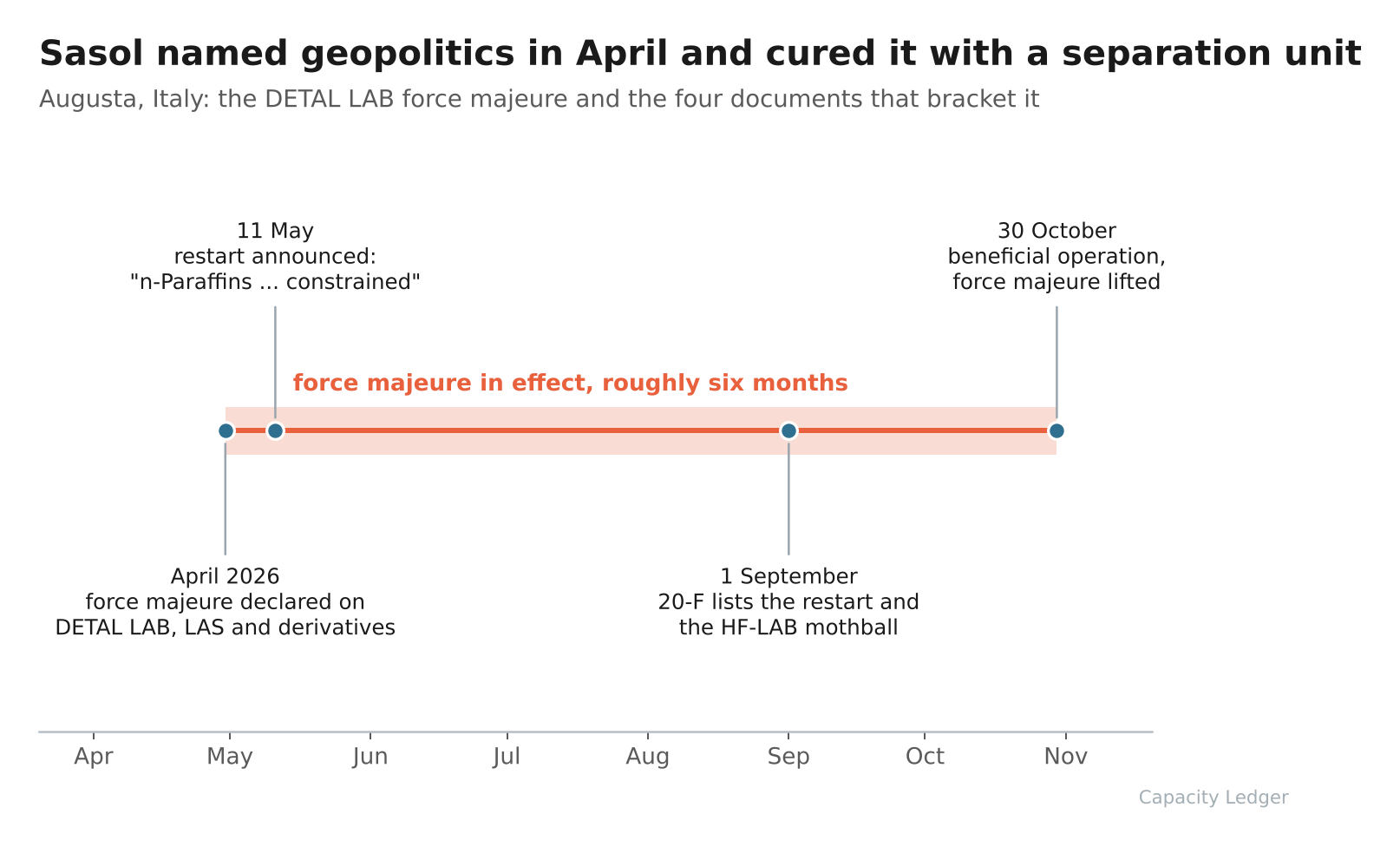
Sasol declared force majeure on DETAL LAB and LAS in April and blamed geopolitical tensions at its Italy and Germany sites. This morning it lifted that force majeure by restarting a molecular-sieve separation unit in Sicily. When the cause is a conflict and the cure is a kerosene splitter, the constraint was feedstock the whole time.
On 13 September this desk read two lines in a Sasol filing and got the direction wrong. Today the company published the line that corrects us, so we are going to spend this morning on it.
The two lines sat in the Form 20-F that reached the SEC on 1 September.
One said Sasol was restarting the ISOSIV unit at Augusta, in Sicily, the molecular-sieve plant that pulls linear paraffins out of a kerosene cut. The other said it had mothballed the HF linear alkyl benzene asset at the same site.
We read that as a chain cut in half. Front end coming back, back end going dark, and the recovered tonnes heading off to somebody else's alkylation plant.
At 09:06 Central European Time this morning, Sasol said what the restart was for.
It lifted force majeure on DETAL LAB, LAS and downstream derivatives based on DETAL LAB.
"If a producer mothballs an alkylation plant and restarts the unit that fed it, which route is still running?"
The one with the other catalyst.
And the dates around that lift are the part worth your morning, because the cause Sasol named in April and the cure it delivered today are not the same kind of thing (chart below).

The rest of this brief is for subscribers.
The capacity math, the trade-flow read, and what it means for the products you buy.
$50 a month, or $400 a year.
Already a subscriber? Sign in