 Capacity Ledger
A Sourcing Manager's Guide to the Organic Chemical Gap
Wednesday's September trade report named gold and crude oil in both of its industrial-supplies paragraphs and no chemical line at all. Organic chemicals exports rose $217m on the month while imports fell $499m, and across nine months the US surplus in that one line has gone from $4.96bn to $8.18bn on an import book that shrank 10 percent.
Census and BEA put the September trade figures out at 8:30 Wednesday morning. The write-up reaches inside industrial supplies twice, once for exports and once for imports, and both times it names the same two things: gold and crude oil.
Five chemical lines sit in that same category. One of them did something neither gold nor oil did.
Organic chemicals exports rose $217m in September, the largest increase of any non-energy line in industrial supplies. Imports fell $499m, the third-largest decline in the entire category, behind only nonmonetary gold and crude oil.
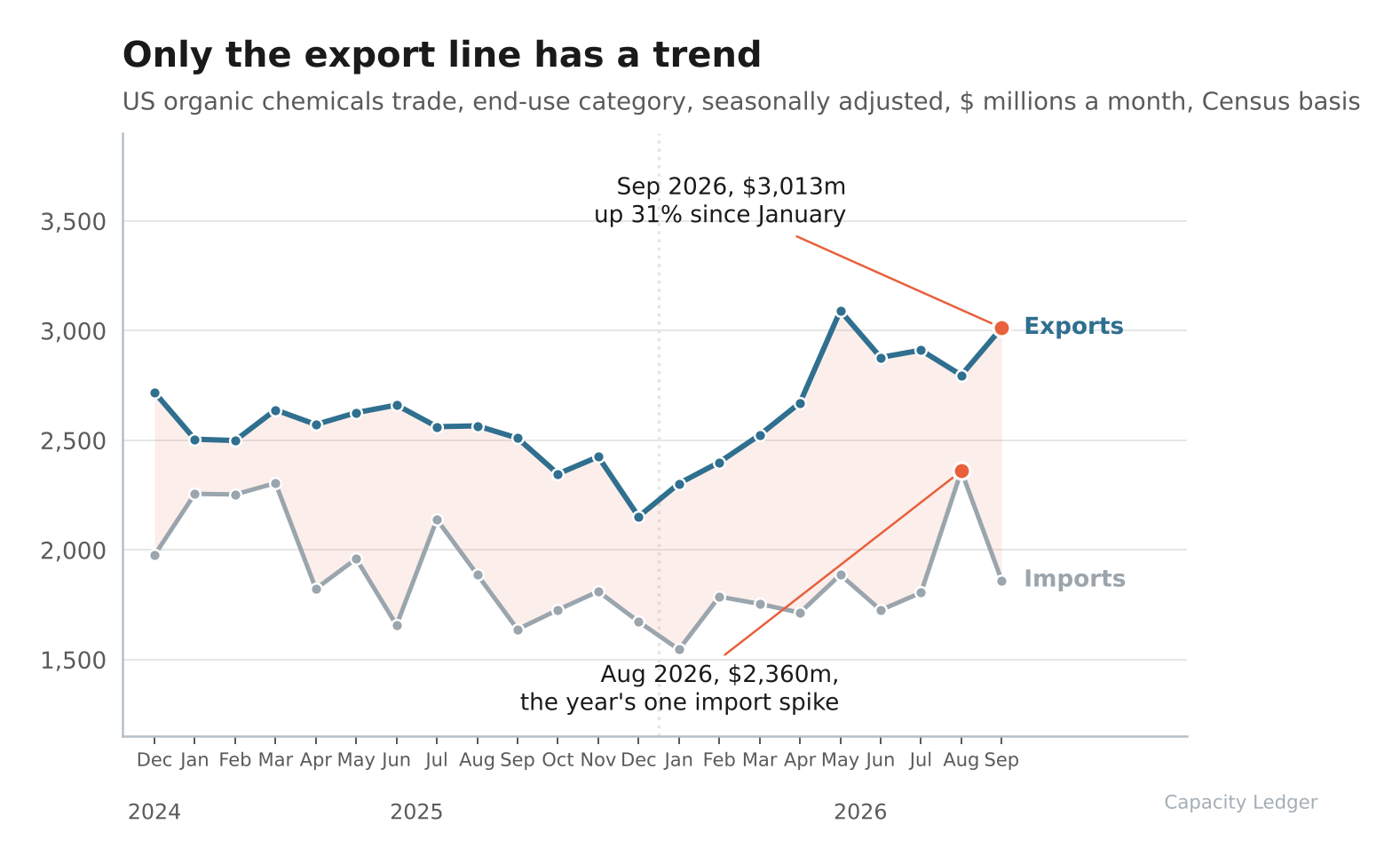
Same product book, both halves, one month, opposite directions (chart below).
"What does your supplier do with the ton if you don't buy it?"
Nine Months of It
September is no one-off.
Through September, US organic chemical exports run $24,616m against $23,227m in the same stretch of 2025, up 6.0%. Imports run $16,439m against $18,267m, down 10.0%.
That puts the nine-month surplus at $8,177m against $4,960m. Up 65%.
The monthly path is the part worth keeping. Exports have gone from $2,303m in January to $3,013m in September, a 31% run, after drifting down through all of 2025.
Imports have averaged $1,827m a month across the same nine months, and September printed $1,861m, which is the average.
One line has a trend. The other has a range.
August is the exception and it earns a note. Imports broke out to $2,360m, some $473m above the next-highest month of the year, and September handed back $499m of it.
Something pulled a month of material forward. Whether October repeats it is the first thing to check on December 8, when the next report lands.
Five Lines, Five Different Answers
Okay, so the wider frame. Census files five chemical lines under industrial supplies, and they do not agree with each other.
Measured as the change in each line's nine-month trade balance against 2025:
- Organic chemicals: +$3,217m. The biggest of the five, and most of it is the import side falling rather than exports rising.
- Other chemicals: +$1,422m, on imports down 7.2%.
- Plastic materials: +$1,025m, almost all of it export growth.
- Fertilizers, pesticides and insecticides: +$420m, on a line that is still a $2,663m net import.
- Inorganic chemicals: +$363m, with imports up 3.9% and the US still a net importer by $1,041m.
Add them and the five lines run a $40,177m surplus through September against $33,730m last year, an improvement of $6,447m. Organic chemicals is 49.9% of that on its own.
For scale: the Census-basis goods deficit narrowed $65,209m over the same nine months, so those five chemical lines account for about a tenth of it. Pharmaceutical preparations moved far more than any of them, and Census files that line under consumer goods, which puts it outside this count.
What It Changes at the Table
The caveat first, once. End-use data is value, and the release says so in its own footnote: "adjusted for seasonality but not price changes."
None of this counts tonnes.
What it does count is dollars crossing the border, and the two halves of one product book have moved in opposite directions for nine months. A pure price story moves them together.
So, three things to carry into the next negotiation:
- Your import alternative got $1.8bn thinner. Same product definition, nine months, 10% less of it. If your fallback quote comes from offshore, the pool behind it has not grown in a single quarter of 2026.
- Your supplier's alternative got $1.4bn wider. A domestic producer with a growing export book has less reason to need your order, and that is where pricing power on an intermediate shows up well before any utilization number does.
- Check which half of the chemistry you buy. If your line is inorganic, none of the above holds. Imports there are up 3.9% and the US is still short by $1,041m through September.
Final Thoughts
A trade number is a lagging read on a plant decision somebody made months ago, and nine months of end-use dollars will never tell you which reactor is running or which grade went long.
It does tell you which direction the ton is pointed.
For American organic chemicals this year the answer has been out, steadily, against an import side that never once grew. If you are setting first-quarter volumes, you are setting them across from a seller who has somewhere else to put it.
Thanks for reading.