 Capacity Ledger
Bodio Swapped Part of Its Coke for Forest Residue
Imerys has been graphitizing carbon in the same Ticino valley since 1917. On October 8 it said the SU-NERGY line there now runs partly on biomass residue and entirely on low-carbon power, with a cradle-to-gate target under 0.1 kg of CO2e a kilogram. The number is modeled and the product is at sampling, and the customs record already shows what that lane is worth.
Imerys dates synthetic graphite at Bodio to 1917.
The plant sits in a Ticino valley and the process it runs has not changed in principle since. Pack a carbon feed into a furnace, hold it near 3,000 degrees C, and wait two or three weeks while the carbon finds its layers.
The conventional feed is petroleum coke and coal tar pitch, and needle coke carries a premium precisely because it graphitizes cleanly.
You can read that feed off what the plant had to build. Bodio has run a dedicated SO2 treatment plant since 2019, because the sulphur riding in on the raw material leaves as sulphur dioxide.
It took 70 percent off emissions in its first year.
On October 8, Imerys Graphite and Carbon Switzerland said it had swapped part of that feed for biomass.
"What does it take to change what a graphitization furnace eats?"
The swap, and what the company will actually say about it
The release is careful, and it rewards reading at that resolution. The new generation of the SU-NERGY line comes from "partial replacement of fossil raw materials with biomass-based alternatives," run on 100 percent low-carbon electricity at Bodio, through a process the company describes as catalyst-free.
The word doing the work there is partial. No source published this month puts a share on it.
The biomass is at least specific. Imerys's own exhibitor material describes the input as biomass-derived raw materials "such as forest residues from biorefineries," which is a byproduct stream rather than standing timber, and which is the part of this that should interest anyone who has watched a coke-based feed chain price.
Four grades carry the line, and they reach well past batteries:
- AGS6L, AGS10, AGS44 and AGS75, all made at the Bodio site, which is IATF and ISO certified.
- Sold into lithium-ion anodes and other energy storage, fuel cells and electrolyzers (polymer bipolar plates in particular), powder metallurgy, conductive polymers, and friction materials including brake pads.
Frank Wittchen, who runs the Graphite and Carbon division, told ChemAnalyst in August that more low-carbon products were coming "in the next few months."
This is that.
The number, and what kind of number it is
Imerys is targeting a cradle-to-gate climate impact below 0.1 kg CO2e per kilogram, stated against ISO 14067.
Where it gets interesting is the footnote, which the company prints itself. That figure is modeled, built from primary process data on the closely aligned SU-NERGY AGS and KS series rather than measured on the product being announced.
An updated calculation follows "after full commercial validation." The material is available for sampling today.
So: a qualification-stage product carrying a modeled footprint. The number will move.
The claim with production behind it is the older one. The first SU-NERGY generation, launched in 2025, carried up to 60 percent lower CO2 than conventional synthetic graphite, cradle-to-gate, and that is the figure a buyer can ask a supplier to stand behind this quarter.
What the customs record says about the lane
US imports of artificial graphite enter under HS 3801.10, duty-free in the 3801.10.50 "Other" breakout. In 2025 the US took $546.3 million across 141,584 tonnes of it.
Switzerland shipped 1,836 tonnes, 1.3 percent of the weight, at $7,608 a tonne against an all-origin average of $3,859. That premium has held in all five years back to 2021, between 1.58x and 2.04x (chart below).
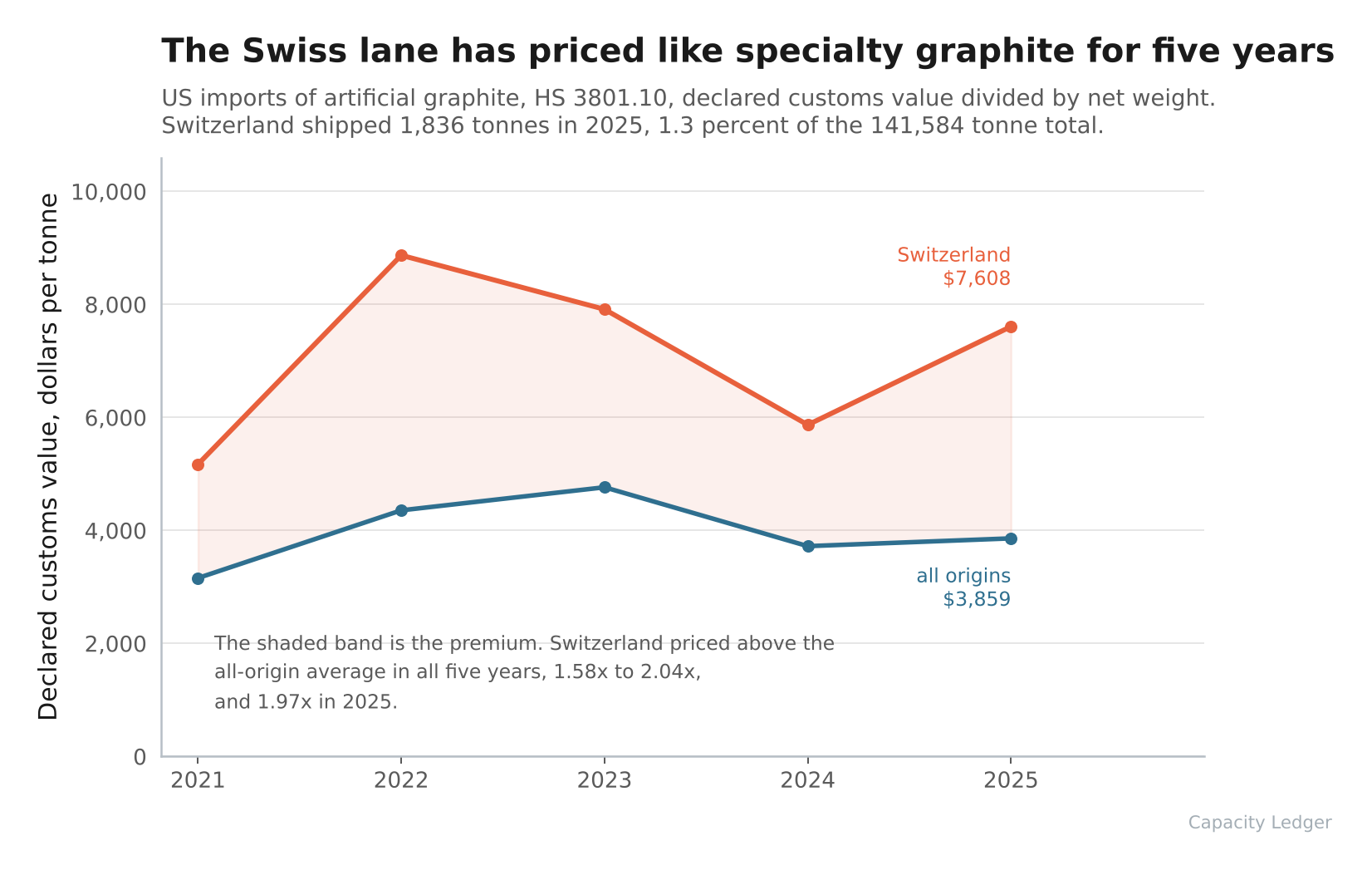
Read that as a price band and nothing finer. HS 3801.10 is a six-digit heading with no plant detail in it, so the customs data never says whose tonnes those are. What it does say is that graphite leaving Switzerland for a US buyer prices like a specialty powder, and that is the context a feedstock change at Bodio belongs in. Changing the feed on a commodity anode line is a cost argument. Changing it on a line that sells at twice the average is a product argument, and the qualification work is the whole job.
Wittchen frames the European end of it the same way, around a localized supply chain and the Critical Raw Materials Act. The division's own next step sits at the same site. In that same interview, Bodio is named as where Imerys plans to produce anode active materials with ShanShan, the Chinese anode maker it partnered with in October 2025. No capacity has been published for that work, and nothing found this week confirms its status.
Final Thoughts
A 109-year-old graphitization line changing what it eats is a slower story than a plant opening, and a more durable one. The furnace, the two-to-three-week cycle and the SO2 plant all stay where they are.
What moves is the carbon going in.
Whether the sub-0.1 number survives commercial validation is the open question, and Imerys has at least put the modeling caveat in its own release rather than leaving a buyer to find it. The answer lands with the updated calculation. Until then the thing worth watching is narrower and more useful: whether four grades out of a Ticino valley qualify into real recipes, and what a biorefinery residue stream does to a feed chain that has run on petroleum coke since the furnace was built.
Thanks for reading.