 Capacity Ledger
Chennai Spent Seventeen Years Getting to a Tire Silane
Momentive's Chennai plant opened in 2009 to make silicone softeners, an agricultural adjuvant, a foam additive and a headlamp hardcoat. On October 7 it started making NXT P97, the bio-based mercapto silane that goes into silica tread compounds at 79 percent renewable carbon. The release carries no tonnage and no investment figure, and the thing a compounder actually needs is in the datasheet instead.
Here is what Momentive's Chennai plant was built to make, in the words of the company's own 2012 expansion release: Magnasoft and Silsoft additives for personal care and textiles, Silwet for agriculture, Niax additives for polyurethane foam, and SilFORT hardcoats for automotive lighting and glazing.
Softeners, an adjuvant, a foam additive, a headlamp coating. Four silicone families, and not one of them a tire chemical.
The plant opened in 2009 on more than 15 acres, with an application development centre attached and a designation to run as a zero-discharge site.
On October 7 the same site started making NXT P97 silane.
"What actually has to change on a mixer line when the coupling agent moves to a new plant?"
What the release says, and what it leaves out
Momentive announced the start-up on a Niskayuna, New York dateline. The company calls Chennai a regional hub for manufacturing, technical expertise and customer collaboration across India, IMEA and Asia-Pacific, and frames the move as supply reliability for a tire market it describes as one of the world's fastest growing.
Chris Pappas, its global marketing leader for tire silanes, calls India "one of the world's most dynamic tire manufacturing markets." Balaji B., regional leader and head of sales for IMEA, puts it as demand "for partners that offer both innovative materials and deep technical expertise."
Here is the part we went looking for and did not find.
There is no tonnage in that release. No investment figure, no headcount, no line count, no start-up curve.
We read all three Momentive releases that touch this site going back to 2012, and none of them has ever published a capacity number for Chennai. Treat that as the normal condition for a specialty site: a silane line serving a named customer list never gets the nameplate announcement a cracker does.
What a coupling agent swap actually costs
The datasheet is where this gets useful.
NXT P97 is, in Momentive's own words, "another family member of Momentive's mercapto silanes for Tire and Rubber applications." The published properties are ordinary: clear liquid, pale yellow, specific gravity 0.976 at 25 degrees C, flash point 110 degrees C closed cup.
Then the datasheet says this:
"Adjustments may be required when replacing standard silanes to provide sufficient green rubber processability and achieve the full performance benefits of NXT P97 silane. As an example, a vulcanization package containing TBzTD instead of DPG and at least one sulfenamide accelerator may result in sufficient scorch safety and ensure the required crosslink density."
Read that as a buyer and it stops being a product note. Swapping the coupling agent moves DPG out of the cure package and TBzTD in, and keeps a sulfenamide to hold scorch safety and crosslink density (chart below).
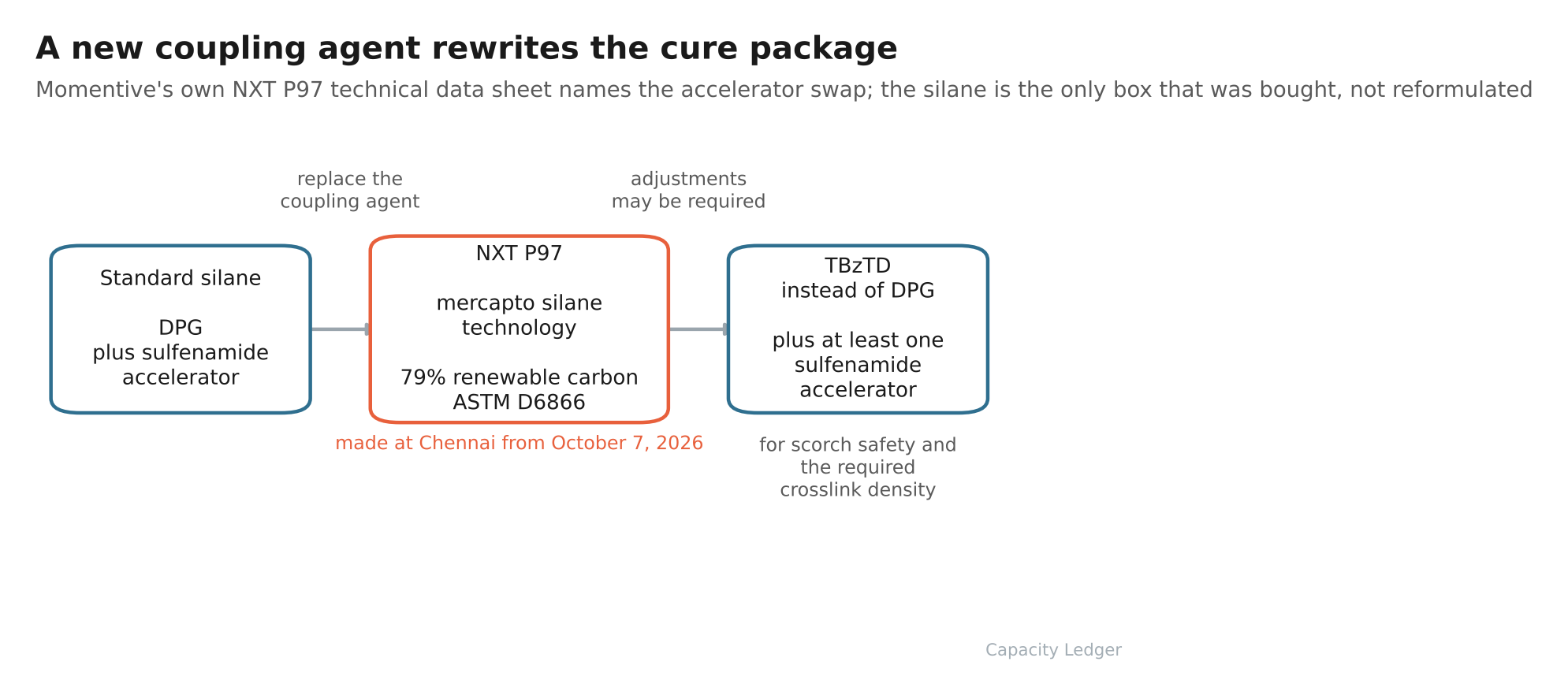
The silane is the only box on that line you purchase. The rest of it is a reformulation, a mixing trial, and whatever your qualification protocol says about a changed cure system.
Which is why a plant address matters here. A tread compound that has been through that work moves suppliers slowly, and a producer who shortens the lead time on the qualified grade is selling the qualification as much as the molecule.
The 79 percent renewable carbon is certified under ASTM D6866, a measurement standard, which matters in a market where bio-content now gets audited.
The rest of the silane line
NXT P97 is one position in a portfolio Momentive has been splitting by tire type rather than by chemistry:
- NXT, the passenger-car family, called out for EVs specifically, where tread wear and rolling resistance are both under pressure from vehicle mass.
- NRX, launched recently for silica-filled natural rubber in heavy-duty truck and bus radial treads.
- FXP silanes, sold a step upstream to the people making functionalized SSBR and BR.
- The SilQuest portfolio alongside all of it.
FXP is the one to notice: the company sells into both ends of the same tread recipe, the polymer producer and the compounder.
Chennai is also the second Asia supply move of 2026. In February the company named a joint venture with Jiangxi Hungpai to produce and distribute silanes and specialty tire additives in Asia, with no location and no capacity attached to that one either.
Seventeen years on the same fifteen acres
None of this involved a new site.
A plant that opened in 2009 to make textile and personal care silicones added an application development centre, then a hardcoat line, then a foam additive line, and has now qualified a certified bio-based tire silane on the same ground. Momentive is owned by Korea's KCC Corporation, which took majority control in 2020 and bought out the last minority holder in May 2024, so the capital behind that arc changed hands twice while the acreage did not.
Seventeen years is a long time to arrive at a different industry's chemical. It is also about how long a specialty site takes to accumulate the permits, the utilities, the analytical capability and the trained operators that make the next product cheaper to add than to build.
Final Thoughts
We spent yesterday on the other half of this system. The US silica import book for the first seven months of 2026 came to 92,979 tonnes, two thirds of it Chinese material landing at $1.38 a kilogram against an all-origin average of $2.21, and the read there was that the cheap tonnes and the qualified tonnes are different tonnes.
The coupling agent is where that split gets expensive. A silica tread is specified with one in it, which is what "silica-reinforced tread compound" on that datasheet means, and it is the component whose substitution drags the accelerator package along behind it.
So a tire silane quietly starting up on a seventeen-year-old silicone site in Chennai hands a second qualified address to a molecule that is genuinely annoying to requalify. This industry tends to notice that about two years late.
Thanks for reading.