 Capacity Ledger
Conroe Can Make the Ester Now
Oleon's Texas site has blended lubricant since 2023. The esterification unit that went fully operational in September gives North America its own specialty-ester plate, and the federal rule that would pull hardest on it is written but not switched on.
Oleon has had a plant at 701 Conroe Park W Dr since 2023. For three years it was a very good set of tanks: blending, filling, packaging, warehousing, logistics, ISO 9001 and RSPO on the wall, bulk trucks out the gate.
What it could not do was run a reaction.
That changed in September, when the site's esterification unit was commissioned and went into full operation. Oleon cut the ribbon on October 15 and announced it the next day.
"What does a blending site actually gain the day it can esterify?"
The molecule. Everything upstream of the blend tank stops being somebody else's shipment.
What a Reactor Adds to a Tank Farm
Oleon is an oleochemical producer, which it describes as converting natural fats and oils into fatty acids, glycerine, esters, dimers, technical oils, specialty oleochemicals and biodiesel. Esterification is the step where the fatty acid meets a polyol and becomes the base oil itself.
Look at what Conroe says it will now make and you can read the grades off the list:
- Environmentally acceptable lubricants, which in Oleon's book means things like RADIALUBE 7563, a trimethylolpropane trioleate (CAS 1335202-94-2) with a flash point at or above 300 C and a pour point at or below -39 C.
- Hydraulic and drilling fluids, where the saturated complex esters run out to ISO VG 1000.
- Electric vehicle fluids and thermal management, the newest and least settled of the ester end-uses.
- Rheology modifiers and emulsifiers, the industrial-ingredient half of the same chemistry.
That is a reactor's product list, and it is the first one Oleon has run in North America: the company's own site names seven plants, Ertvelde and Oelegem in Belgium, Emmerich in Germany, Compiègne in France, Port Klang in Malaysia, Itupeva in Brazil, and Conroe.
Six of those are somewhere else.
Nobody Was Short of Blending
Here is where it gets interesting for anyone buying this chemistry. The United States was never short of lubricant blending capacity, and the trade data is blunt about it.
Take HS 340399, the line that catches lubricating preparations carrying no petroleum oil, which is where a synthetic ester formulation lands. In 2025 the US brought in 31,506 tonnes and shipped out 119,740 tonnes, a ratio of 3.8 to one, and the line has run outbound every year since 2020 (chart below). The widest the import share of two-way trade has ever gotten is 30.3 percent, in 2024.
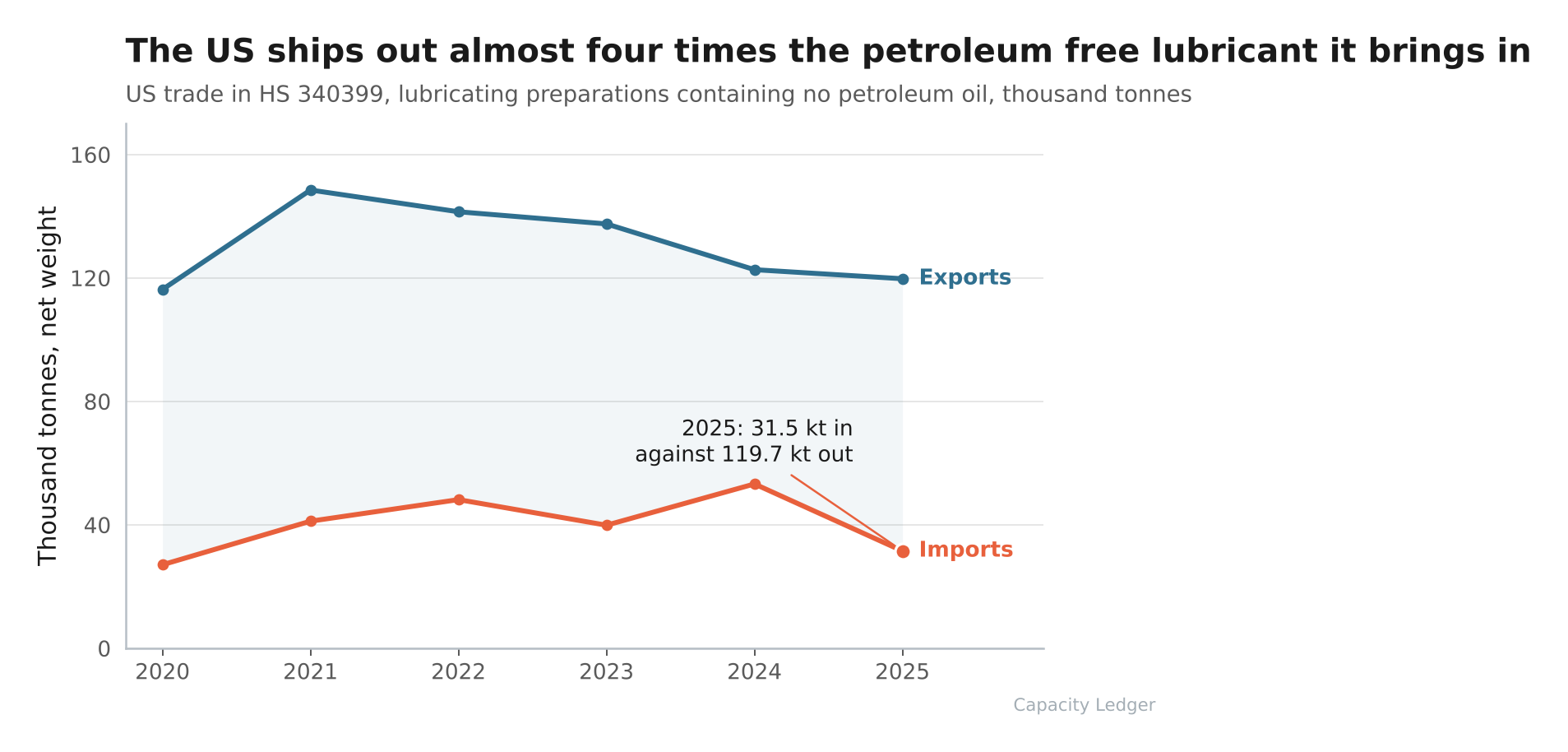
So a new set of blend tanks in Texas would have been a logistics story.
Okay, so what moved? The step in front of the blend tanks.
Base esters are a different trade book and a much thinner domestic one, and a buyer who wants a TMP trioleate with a US origin has had a short list to work from.
Conroe is now on it.
The Rule That Is Written and Not Switched On
The demand side of the EAL half of that product list is sitting in the Federal Register right now, finished and waiting.
EPA's Vessel Incidental Discharge National Standards of Performance published at 89 FR 82074 on October 9, 2024, effective November 8, 2024, codified at 40 CFR part 139, covering non-recreational, non-Armed-Forces vessels 79 feet and above. The subject population is approximately 82,000 vessels. At 40 CFR 139.6(e) the rule requires environmentally acceptable lubricants at oil-to-sea interfaces unless technically infeasible, and 40 CFR 139.2 defines an EAL as a lubricant or hydraulic fluid, including any oil or grease, that is biodegradable, minimally toxic and not bioaccumulative.
Now the part that matters to your 2027 planning: none of it bites yet.
The federal standards become effective only once the Coast Guard's implementing, compliance and enforcement regulations under CWA section 312(p)(5) are final, effective and enforceable, and until that day the 2013 VGP stays in place. A Federal Register search this morning turns up no Coast Guard rule doing that.
So the requirement that puts a biodegradable ester into eighty-two thousand stern tubes, thrusters and deck cranes is drafted, numbered, and parked.
Final Thoughts
Oleon has not published a tonnage for the Conroe unit, and neither has anyone else. No capacity, no investment figure beyond the more than $50 million the city says has gone into the site since 2022, no reactor count.
That is the one number we would take over every quote in the release, and this desk will log it the day it appears.
What is already on the record is enough to be worth your attention. A European oleochemical producer spent three years turning a Texas warehouse into a plant, in the order it said it would: blending first, the reaction second. The chemistry that comes out of it answers a federal standard that exists in full text and has no enforcement date. Whoever holds a US ester plate when that date lands will have had a very ordinary-looking September.
Thanks for reading.