Fifteen Days' Notice to Change Your Anhydride Origin
INEOS idled its three Hull acetyls plants on Tuesday, and two of them had already stopped. The acetic acid has a transatlantic route that already runs. The acetic anhydride has 45,357 tonnes of American export book and a DEA filing attached to every drum.
Two of the three plants had already stopped producing by the time INEOS said anything about it.
That is the tense of Tuesday's release. INEOS is idling all three of its world-scale plants at Hull, and the third is "due to come off line in a few days."
Almost 4,000 jobs sit behind the three units.
Jim Ratcliffe put the reason on the record in one sentence: "with gas prices now 12 times the level in the US and 8 times that of China, we just cannot compete." The Saltend plants burn gas for energy and consume it as feedstock, so the spread hits them twice.
INEOS calls these Europe's last remaining world-scale acetyls units. That is the company's own characterisation, and the qualifier is doing work, so take it as written rather than as a claim that the continent has nothing left at any scale.
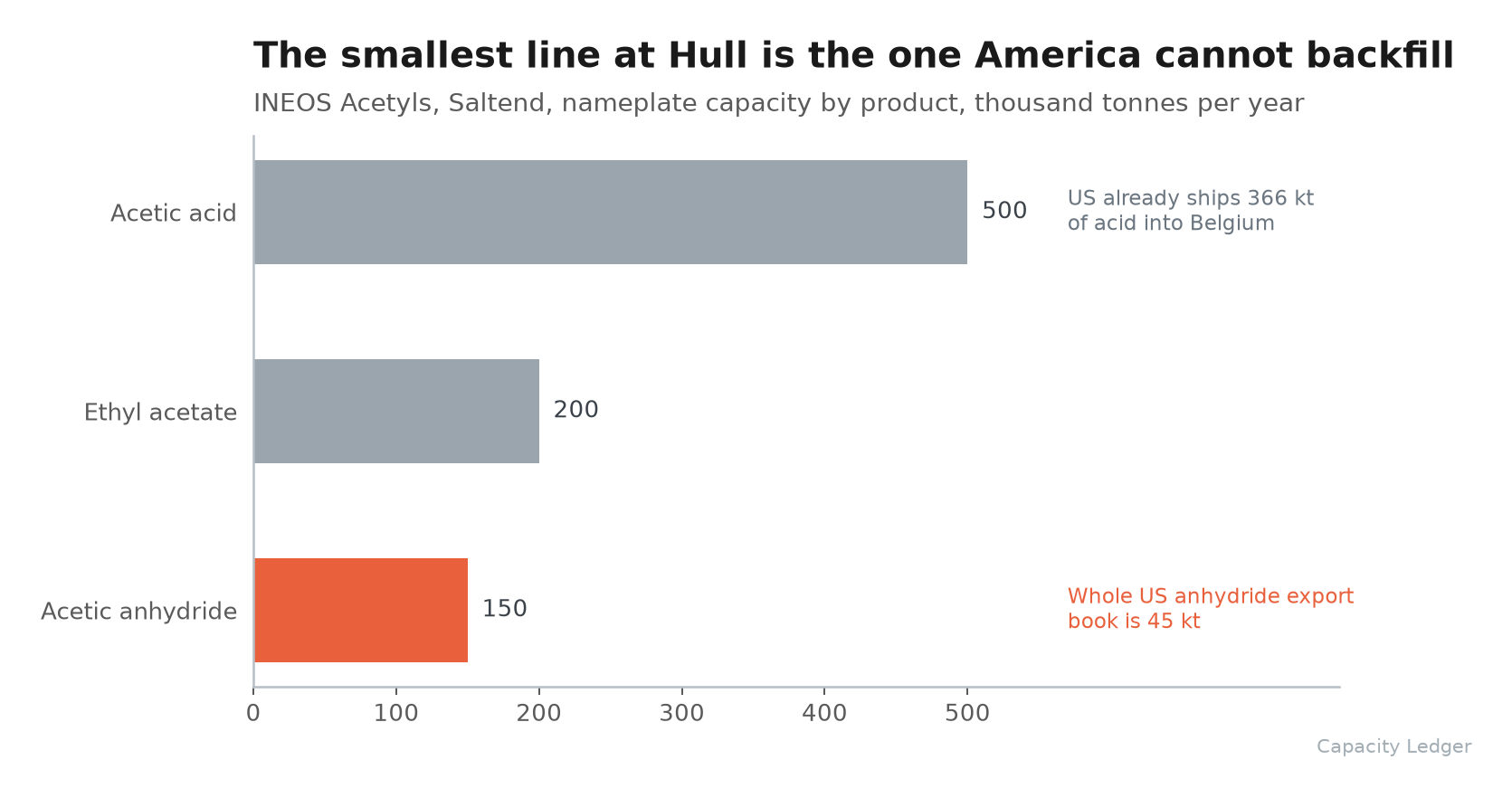
What the site actually is: 500 kt/yr of acetic acid, 200 kt/yr of ethyl acetate, and 150 kt/yr of acetic anhydride, run by 340 people on the 370-acre Saltend Chemicals Park at the mouth of the Humber. Call it 850,000 tonnes of nameplate going quiet at one address.
"Which of the three do you actually have to solve this quarter?"
One of them. The smallest one, as it happens (chart below).
The Acid Already Has a Boat
America shipped 846,206 tonnes of acetic acid in 2025, and 365,664 tonnes of that went to Belgium alone.
That single lane is 73 percent of Hull's entire acid nameplate, and it was running before anyone at Saltend touched a valve. Antwerp is where the US acetic acid position meets European demand, and the deepwater route, the terminals, and the customs practice are all in place.
So the acid costs European buyers money and patience while the flow rebalances. The tonnes exist.
Ethyl acetate is the middle bar. Two hundred kilotonnes of ester is real volume, and we did not pull the trade flows behind it this week, so we are not going to tell you where it gets replaced.

The rest of this brief is for subscribers.
The capacity math, the trade-flow read, and what it means for the products you buy.
$50 a month, or $400 a year.
Already a subscriber? Sign in