 Capacity Ledger
Forty-Eight Million Pounds Out of South Pittsburg
Colonial Chemical publishes its own running pounds-shipped counter, and it just put two new reactors behind amphoterics and imidazolines rather than behind the sugar chemistry that won it an EPA award. The customs line its imported competition arrives on prices the same six digits at fifty-one cents a kilo and at nine dollars twenty-four.
Privately held chemical companies do not usually tell you how much they ship.
Colonial Chemical posts the number on its own website and keeps it current. 48.2 million pounds shipped year to date through August 2026, out of South Pittsburg, Tennessee.
Call it 21,863 tonnes in eight months on our conversion, running at roughly 32,800 tonnes a year.
There is a second counter next to it, and for anyone who buys surfactants it is the more useful of the two: 22,840 PO product lines shipped in the last 36 months. That works out to about 634 order lines a month.
"What does an American surfactant house actually sell, when the same customs line lands eighty thousand tonnes a year on the dock?"
What Comes Out of South Pittsburg
The plant sits at 225 Colonial Drive, in a town of a few thousand people on the Tennessee River. The company also lists sites at Birmingham, Rotterdam and Dammam, and says it serves all of North America plus more than 50 countries.
The catalogue is the thing to read. Suga and Poly Suga are the alkyl polyglucoside chemistries; alongside them sit sultaines, betaines, the Colateric amphoterics, ColaFax phosphate esters and a line of imidazolines.
Those go out into personal care, household and industrial cleaning, lubrication and metalworking, oil and gas, and vehicle care.
So: five end markets, six-hundred-odd order lines a month, one site in Tennessee doing the making. That is a short-run house with a wide book, and the 22,840 figure is what that looks like when a company decides to publish it.
The sugar chemistry is the part with a federal paper trail. In June 2021 EPA named Colonial a Green Chemistry Challenge Award winner for Suga Boost surfactants built from functionalized alkyl polyglycosides, describing them as plant-based, biodegradable, free of known carcinogens and endocrine disruptors, and performing as well as or better than the petroleum-based alternatives. Colonial was one of five winners that year, against a program history of more than 1,800 nominations and 128 awarded technologies.
Two Reactors, and They Went for the Amphoterics
Here is where it gets interesting. The award chemistry is not where the new capacity went.
On September 22, 2025 the company announced two new reactors plus expanded production space at South Pittsburg, operational in late Q4 2025, lifting overall surfactant production capacity by 15 percent. The release names the chemistries: amphoteric and imidazoline-based.
David Anderson Jr., the company's president, framed it as reliable supply and consistent quality rather than as a new chemistry play, which is the honest description of what an amphoteric expansion is.
Betaines and sultaines are the mildness workhorse in cleaning formulations. Imidazolines are the corrosion-inhibitor backbone in metalworking fluids and oilfield chemistry.
Neither is exotic. Both are the kind of product a formulator reorders on a schedule, which is exactly what fills 634 order lines a month.
Then the same direction again, three months later. Effective January 1, 2026, Colonial handed national distribution of its metalworking and lubricant-additive surfactants to Advanced Chemical Concepts, with Daniel McCaul, the company's vice president of sales, citing logistics reach as the reason. Capacity in the industrial chemistries, then a distributor pointed at the industrial market.
One Line, Eighteen Prices
Now the market that capacity lands in.
The United States imported 80,877 tonnes of non-ionic organic surface-active agents in 2025, worth $263.0 million, under HS 3402.42. We pulled the annual detail this week and the 50 partner rows reconcile exactly to the reported world row, so that book is complete rather than sampled.
What it costs depends almost entirely on where it came from (chart below). Türkiye shipped 2,829 tonnes at $0.51 a kilogram, France 1,945 tonnes at $9.24.
That is an eighteen-fold spread inside one six-digit code, around an all-sources average of $3.25.
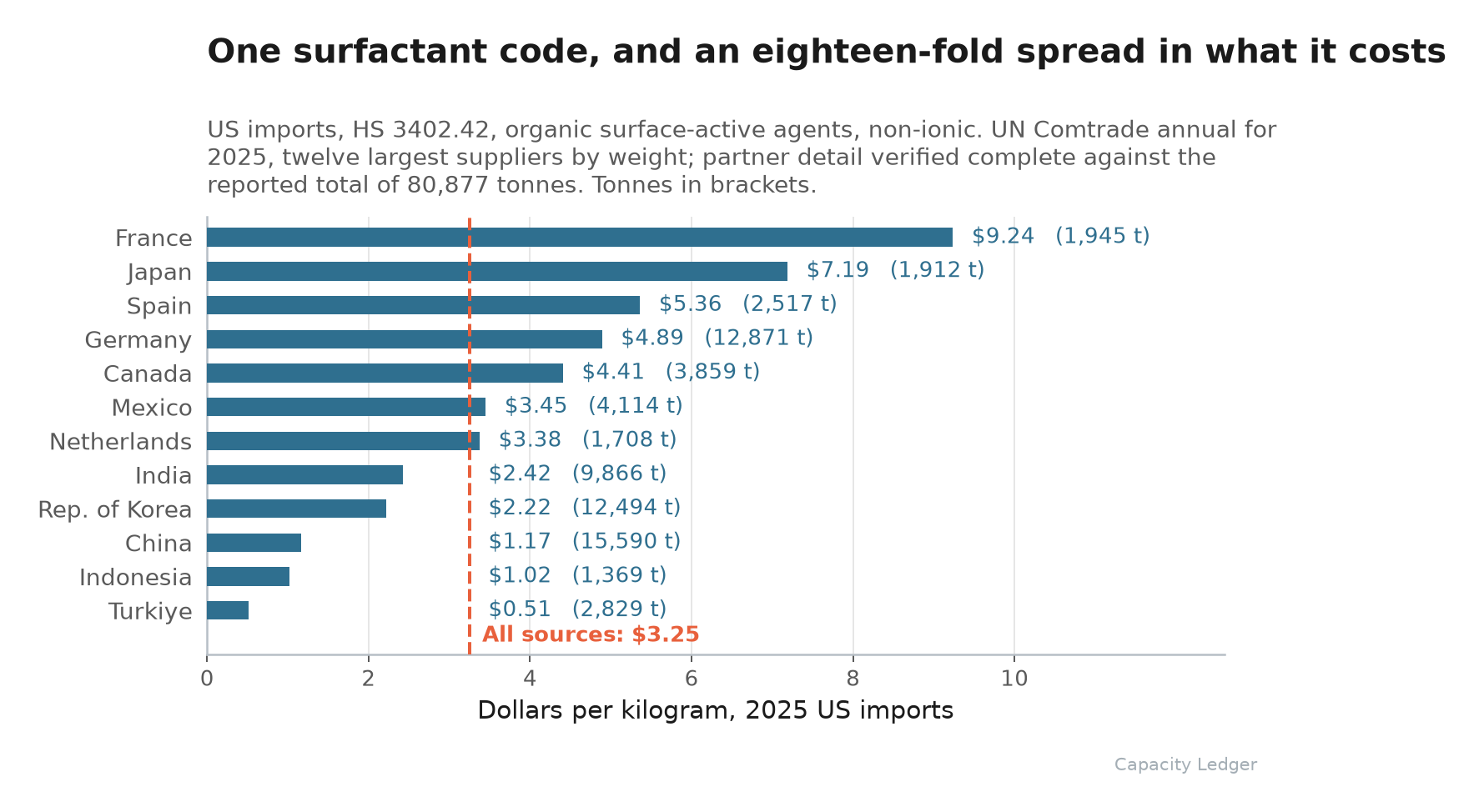
The tonnage sits at the cheap end. China alone brought in 15,590 tonnes at $1.17, and China, Korea and India together account for roughly 47 percent of the weight on this line while paying nowhere near the average.
Colonial's 48.2 million pounds covers every chemistry the company makes and every market it sells into, so it is not the same measure as one customs line. As a scale check it still lands: a single Tennessee site ships something on the order of what the whole country imports under 3402.42 in a year, and it does it in short runs across five end markets.
Final Thoughts
The interesting decision here is the one that looks least glamorous. A company holding an EPA award for renewable sugar-based surfactants spent its last capital increment on betaines and imidazolines, then wired a national distributor into metalworking and lube additives.
That is a read on where reorder volume actually lives, and it is a read you can only make by watching what a private company builds rather than what it markets. The chart says the rest. A six-digit code that prices from fifty-one cents to nine dollars is not one market, and nobody with a plant in Tennessee is trying to win the fifty-one-cent end of it.
Thanks for reading.