 Capacity Ledger
How a Worn Forklift Wheel Gets Back to Its Isocyanate
Covestro opened a chemical recycling pilot plant at Leverkusen on September 16 that breaks end-of-life Vulkollan into purified building blocks and recovers more than 90 percent of the material by mass. The elastomer dates to February 1950, can only be cast by a licensed processor, and in the United States that means a short list of addresses.
A worn forklift wheel is one of the harder objects in industrial chemistry to do anything useful with.
It was cast for exactly the opposite outcome: high load, low heat build-up, and no intention of ever coming apart.
On September 16 Covestro opened a plant at Leverkusen whose whole job is to take those wheels apart on purpose.
"What does it take to give a licensed material a return leg?"
This desk has mostly met Covestro on the TDI and MDI side of the house. The elastomers business runs on a different isocyanate and a much shorter customer list, and that turns out to be the interesting part.
A February 1950 Molecule That Still Needs a Licence
Vulkollan traces to an Angewandte Chemie article published in February 1950, co-authored by Otto Bayer, who had invented polyurethane in the first place.
Seventy-six years later the recipe is still closed.
Solid Vulkollan is Desmodur 15, Vulkollan polyols and a glycol; swap the glycol for water and you get the cellular grades. Covestro's own wording is that it "can only be manufactured by licensed processors."
Desmodur 15 is naphthalene 1,5-diisocyanate, and NDI sits a long way upstream of the isocyanates most buyers handle:
- the ring system starts as naphthalene, nitrated through to 1,5-dinitronaphthalene alongside the 1,8-isomer
- reduction of that gives 1,5-diaminonaphthalene, the direct precursor to the diisocyanate
What comes out the far end runs continuously at 80 C, takes 120 C for short stretches, and shrugs off UV, ozone, greases and oils. Covestro says many of its customers have held a licensed cooperation for more than 40 years.
What the Pilot Plant Closes
Covestro put the money up on December 12, 2024, a double-digit million euro figure, and guided roughly a year to technical completion. The plant opened on September 16, 2026.
The route is chemical rather than mechanical. Instead of grinding scrap into filler, it breaks end-of-life material down into purified monomers that go back in at known and proven quality.
Covestro puts the recovery at more than 90 percent of the material by mass, and the carbon footprint at up to two thirds below virgin fossil-based material (diagram below).
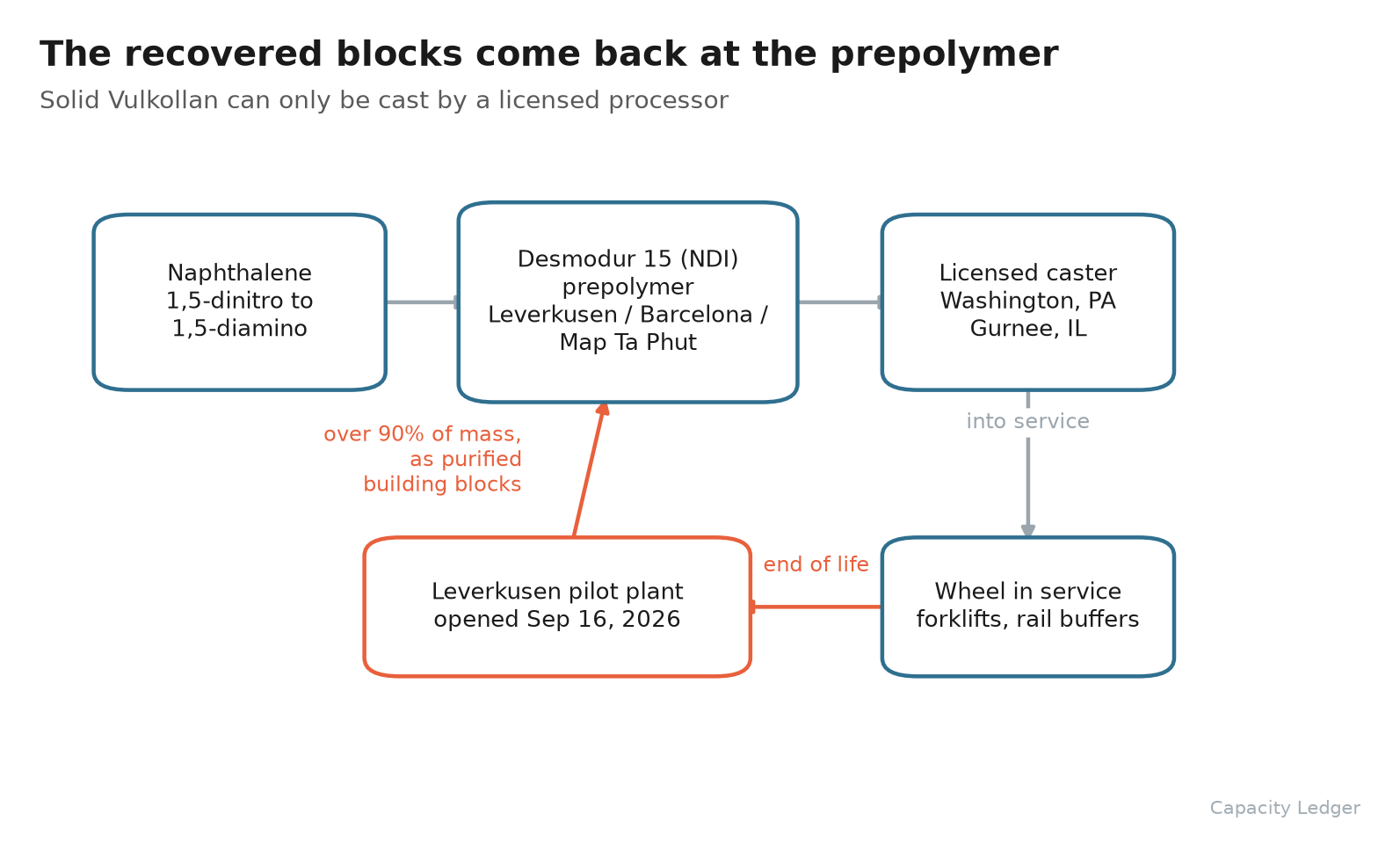
Where it gets interesting is what the plant is for beyond Vulkollan. Covestro intends to run selected specialty cast elastomers and thermoplastic polyurethanes through the same pilot, test different waste streams, and generate the data an industrial-scale unit would need.
Thomas Braig, who heads the elastomers business, calls it "a key step in our pre-industrialization journey."
The American End Is a Short List of Addresses
Buy a Vulkollan part in the United States and you buy it from a licensed caster. The public list is short:
- Pleiger Plastics, 498 Crile Road, Washington, Pennsylvania. Founded in 1986 and, by its own account, one of the first molders in the country to process the material. Squeegees, wheels, rollers, check valve balls, membranes, rods, sheets, tubes and bumpers.
- Gallagher Corporation, Gurnee, Illinois, in custom polyurethane parts since 1965, cast molding solid and cellular wheels, rollers and bushings.
- Millennium Elastomers, which says Covestro selected it as a US partner on liquid cast polyurethane expertise and "rigorous process and facilities audits."
Pleiger's own site is a useful record of what a licence is worth in floor space: 7,500 sq ft of office and lab in 1992, 12,000 sq ft of factory in 1997, 7,200 sq ft of warehouse in 2002, and a 15,600 sq ft expansion finished in 2013, on the more than 8 acres it bought for that job.
Now, the part of the announcement that does not come with a number attached is the logistics.
Covestro says it is developing collection and return systems with customers, recyclers, waste collectors and logistics partners, and for now the chemistry happens at the Leverkusen pilot. So the return leg for an American fleet runs back through the same short list of casters that sold the parts, which is the one population in polyurethane where somebody actually knows every address.
Final Thoughts
Most circularity work in polymers fights a collection problem with millions of participants, which is why so much of it stays a pledge.
Vulkollan is the other shape of problem. A licensed material, a countable set of processors, industrial customers who replace wheels on a maintenance schedule, and parts heavy enough to be worth freighting.
The three sites Covestro names for the prepolymer are in Germany, Spain and Thailand, so an American caster's raw material has always come from somewhere else. What changed this month is that the worn part is now worth something on the way back, and it is worth something at the prepolymer, which is the only node in this chain where a purified building block has anywhere to go.
Thanks for reading.