How Gladbeck Outlived Its Own Closure Notice
INEOS said a year ago it would permanently close its 1954 phenol site in the Ruhr. On the same date this year it deferred the restart meant to replace it, so Gladbeck keeps running and 680,000 tonnes stay cold at Antwerp.
On 17 June 2025, INEOS Phenol announced its intent to permanently stop production at Gladbeck, in the German Ruhr, on the grounds that European energy and carbon costs had made the site impossible to run. Jim Ratcliffe called it "the consequence of Europe's total lack of energy competitiveness and the blind devotion to carbon taxation."
Exactly one year later, on 17 June 2026, the same business told staff at Doel that the plant meant to replace Gladbeck is not restarting on schedule.
So Gladbeck keeps making phenol.
"If a closure is triggered by another plant starting up, what is the ledger supposed to count?"
The Swap That Didn't Happen
Gladbeck opened in 1954. INEOS publishes it at over 650,000 t/a of phenol and 400,000 t/a of acetone, with 279 people directly employed and more than 1,500 jobs supported around it. The June 2025 release gave its reasons without decoration: elevated European energy costs, CO2 taxation, downstream phenol and acetone customers that had already left the site, and a plant needing significant future investment.
Doel is the other half of the trade. INEOS has owned it since 2001, publishes it at 680,000 t/a, calls it the world's largest phenol plant, and staffs it with about 150 people.
It is not running.
The restart was set for late 2027, and that date is what made the Gladbeck notice legible: stop the 1954 asset, start the big one on the Scheldt, serve Europe from Antwerp. The June 2026 note moved the timing and left the intent standing. "The economic conditions required for a restart have not yet been sustainably reached," it said, adding that all necessary investments are being made to maintain Doel and preserve the option to restart. Gladbeck now continues production beyond 2027 and remains the primary production hub for regional demand.
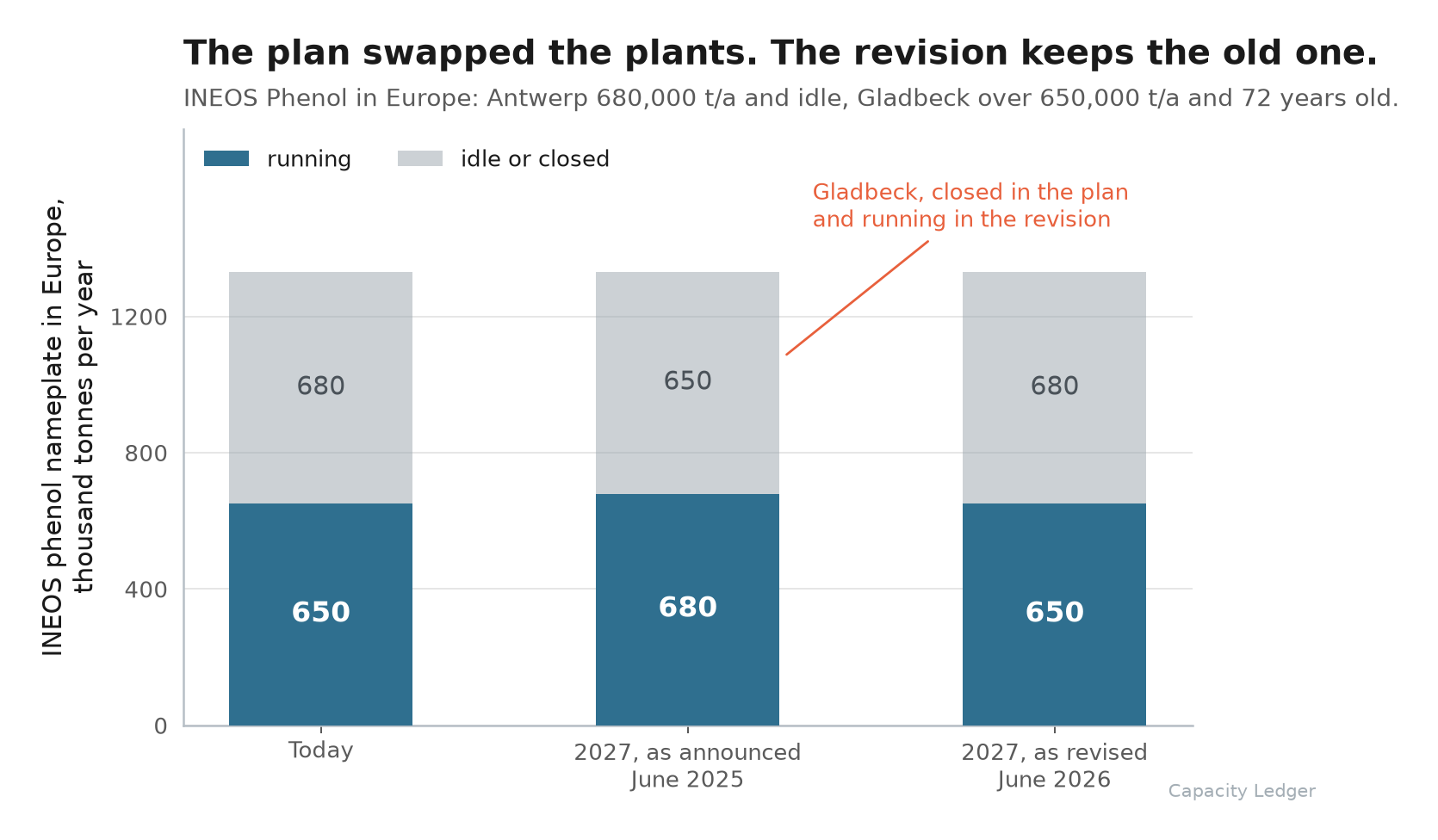
Run both announcements through the ledger and the net is nothing (chart below). Europe gets 650,000 t/a of running INEOS phenol capacity in 2027, the same number that runs today, and 680,000 t/a stays cold in either version.
The plan would have delivered 680,000. Thirty thousand tonnes of arithmetic, and an entirely different plant in an entirely different country.

The rest of this brief is for subscribers.
The capacity math, the trade-flow read, and what it means for the products you buy.
$50 a month, or $400 a year.
Already a subscriber? Sign in