 Capacity Ledger
Why the Adhesive Stays in Maryland
Syensqo just broke ground on 30% more structural adhesive capacity at a Maryland plant it has run since the Cytec days, in the same quarter its composite business posted the best numbers in its history. The siting decision was made years ago by somebody else's qualification file.
Most chemicals get bought on a specification. Aerospace structural adhesive gets bought on a name.
A bonded joint on a commercial airframe is qualified as a system: the adhesive, the primer, the surface prep, the cure cycle, the substrate it all sits on. Swap the film and you have not changed a raw material, you have opened a qualification on every program that joint appears in.
So a producer of that adhesive facing a demand ramp has one cheap move and one very expensive one. The cheap move is to build where the qualification already lives.
In the second week of July, Syensqo broke ground on exactly that at Havre de Grace, Maryland.
Thirty Percent, and No Other Number
The expansion adds over 30% of capacity at the site for structural adhesives and surfacing products, alongside the bonding materials and primers that go with them, into commercial aerospace, defense, propulsion, space, advanced air mobility and automotive.
That percentage is the entire disclosure. No tonnage, no area, no dollar figure past "multi-million," no completion date.
Anyone who read the Ledger's first edition on August 1 will recognize the shape of that. Removals arrive with tonnages and additions arrive with dollars, and here is a third variant that tells you even less than either.
Rodrigo Elizondo, who runs Composite Materials, gave the reason plainly. The investment will "strengthen supply reliability, improve efficiency and support our ability to meet growing customer demand for adhesive, bonding and primer materials."
Supply reliability, first in the list. That is a supplier telling its customers it does not intend to be the constraint.
The Ramp Is Real
Three weeks after the groundbreaking, Syensqo printed the quarter that explains it.
Composite Materials grew 18% organically year on year in the second quarter. CFO Christopher Davis called it the strongest quarter on record since the inception of Syensqo, driven by civil aerospace and "higher build rates across key commercial aircraft programs."
Aerospace is now more than 20% of group net sales and around 35% of the Materials segment.
Those build rates are a measured thing rather than a projection. Airbus handed over 351 commercial aircraft in the first half of 2026 against 306 a year earlier, and Boeing's own quarterly delivery releases add to 314 against 280 (chart below).
Between them that is 79 more airframes in six months, up 13.5%.
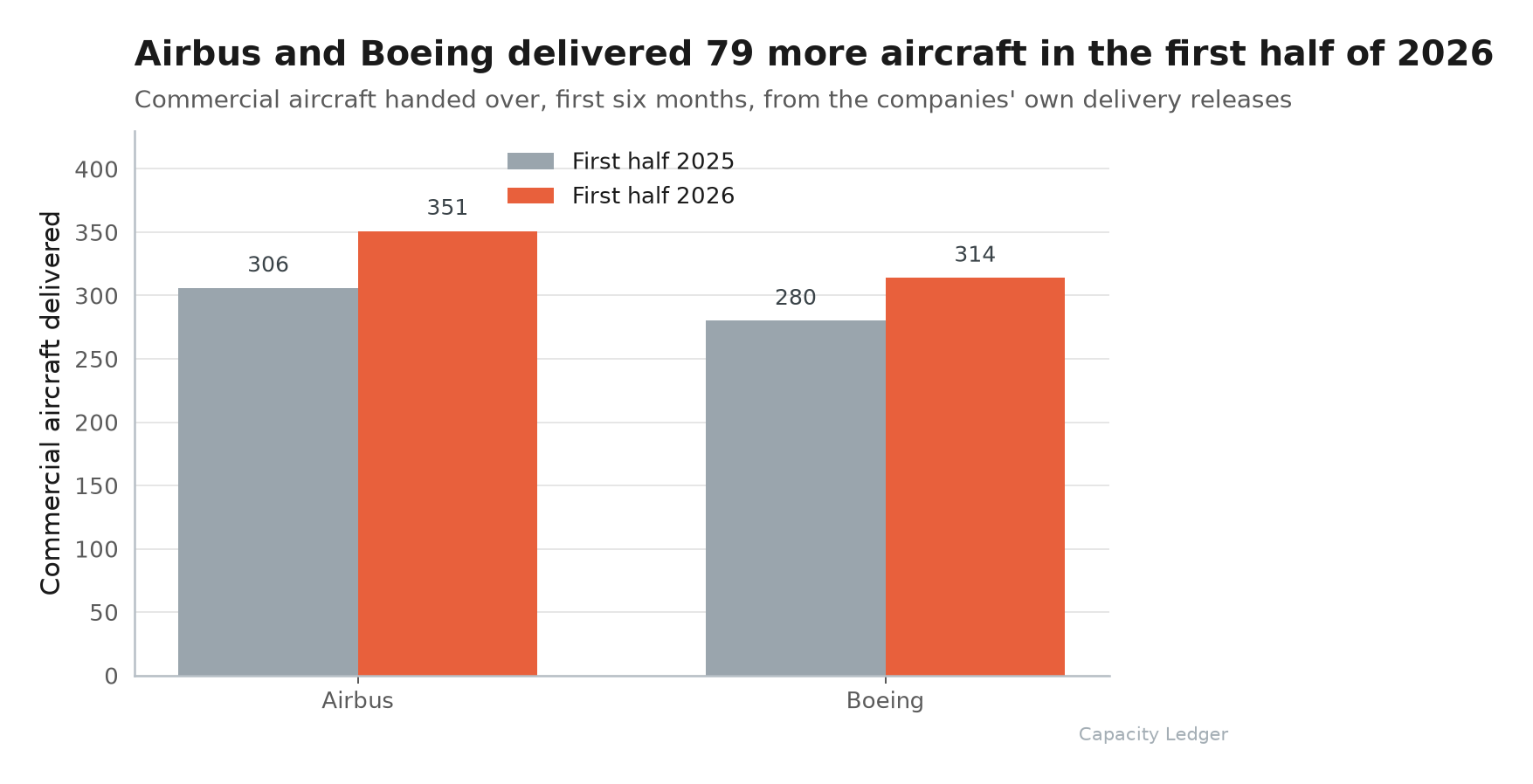
Now look at what the half-year totals hide. Airbus delivered 114 aircraft in the first quarter, twenty-two fewer than the year before, on Pratt & Whitney engine shortages, and then put out 237 in the second.
The airframers do not run at a rate. They run at whatever their tightest supplier allows and then catch up in a hurry, which means a materials supplier sizes its lines for the surge quarter.
Why It Had to Be Maryland
Syensqo has been busy on the contract side of this. A renewed multi-year agreement with Boeing in March covering primary and secondary structures, interiors and surfacing, then a new multi-year supply agreement with Airbus reported on July 31, covering prepregs, RTM resins, adhesives and primers across commercial aircraft, space and defense, and helicopter programs.
CEO Mike Radossich told the quarterly call the company has "presence on virtually every major aerospace platform," and that "the majority of our business is secured through long-term contracts."
Put those two sentences next to a demand ramp and the siting decision writes itself.
Havre de Grace is the legacy Cytec Engineered Materials adhesives plant, in Solvay's hands since the $5.5bn Cytec acquisition closed in December 2015 and Syensqo's since the split. Decades of platform qualification files point at that address.
A greenfield adhesive line somewhere cheaper would be a new source of supply, and every program it touched would have to say so in writing.
So the capacity went inside an existing fence, which is precisely what Eastman did at Kingsport in the spotlight we ran on July 31. Different chemistry, same arithmetic: when capital is tight and requalification is expensive, the addition column fills up with more of what already exists.
Syensqo's own capital line says the same thing. Second-quarter capex was EUR 95m, down 16% year on year, against full-year guidance of roughly EUR 450m and an underlying EBITDA outlook raised to at least EUR 1.1bn.
That is a capital budget pointed at the plants that already work. Adding a third to one of them is the whole plan, and on this chain it is the right one.
Final Thoughts
We spend most of our days counting things that are going away, so it is worth sitting with what an addition looks like when the chain underneath it is genuinely tight. No new country, no new site, no announced tonnage.
A fence line on the Maryland shore moving out by a third, because the qualification cannot move at all.
Somewhere in the next two years a sourcing manager is going to ask why the second source for a surfacing film still does not exist, on a program that has been flying for a decade. The answer got published in July, and it came with one number in it.
Thanks for reading.