 Capacity Ledger
How Jhagadia Found Somewhere to Put Its Chlorine
DCM Shriram told the exchanges on September 30 that it had commissioned a 100 TPD aluminium chloride plant and the first 133 TPD line of a calcium chloride plant, both inside the fence at India's largest caustic soda complex. The filing is unusually blunt about why. Jhagadia makes roughly 1,972 tonnes of chlorine a day whether anyone has ordered it or not.
If you run a cell house, you do not get to choose how much chlorine you make.
Every tonne of caustic soda out of a membrane cell arrives with 886 kilos of chlorine attached to it. The electrolysis fixes that ratio and no amount of selling effort moves it.
So a caustic expansion is a chlorine expansion, and the only open question is where the chlorine goes.
On September 30 at 12 noon, DCM Shriram's company secretary answered part of that question in four paragraphs to Bombay and the NSE.
Two Plants, One Fence
The Regulation 30 intimation names two units commissioned that day "near to our Caustic Soda facilities in Jhagadia":
- An aluminium chloride plant at 100 TPD, commissioned and ramping to market, taking the company's total aluminium chloride capacity to 250 TPD. High-purity anhydrous material, sold into domestic pharmaceutical and agrochemical formulators.
- A calcium chloride plant built as two lines, the first of them running at 133 TPD with the quality, in the filing's words, "well accepted in the market". The second line, of similar capacity, was expected during October.
Then the filing does something exchange filings almost never do, which is explain the chemistry:
"Aluminium chloride uses chlorine directly as a raw material, while calcium chloride uses hydrochloric acid, which is itself produced from chlorine."
Both units are chlorine sinks. The company said so on the record and called them "strategic downstream integration of chlorine, enhancing the flexibility and resilience of the overall Chemical business."
One wrinkle worth holding. The July investor deck carries the calcium chloride project as one line item at 225 TPD, while the September filing describes a 133 TPD line plus a second of similar size, which is 266.
Take the filing. It is newer, and it counts units as built rather than as sanctioned.
Where All That Chlorine Came From
Bharuch is the largest cell house in the country. 2,225 TPD of caustic across 25 electrolysers on four production lines, inside the Jhagadia GIDC estate, with 242 MW of captive coal and 44 MW of renewables behind it.
Most of that scale is recent. On May 3, 2024 at 10:00 am, the company filed the same kind of notice: an 850 TPD caustic expansion commissioned, "taking the total installed capacity to 2225 TPD at Bharuch", and with it the single largest caustic complex in India.
Run that 850 back through the cell and you get about 753 tonnes a day of chlorine that did not exist in April 2024.
Against that, the two units commissioned last month place roughly 165 tonnes a day, 80 of it into aluminium chloride and 85 into the first calcium chloride line (chart below).
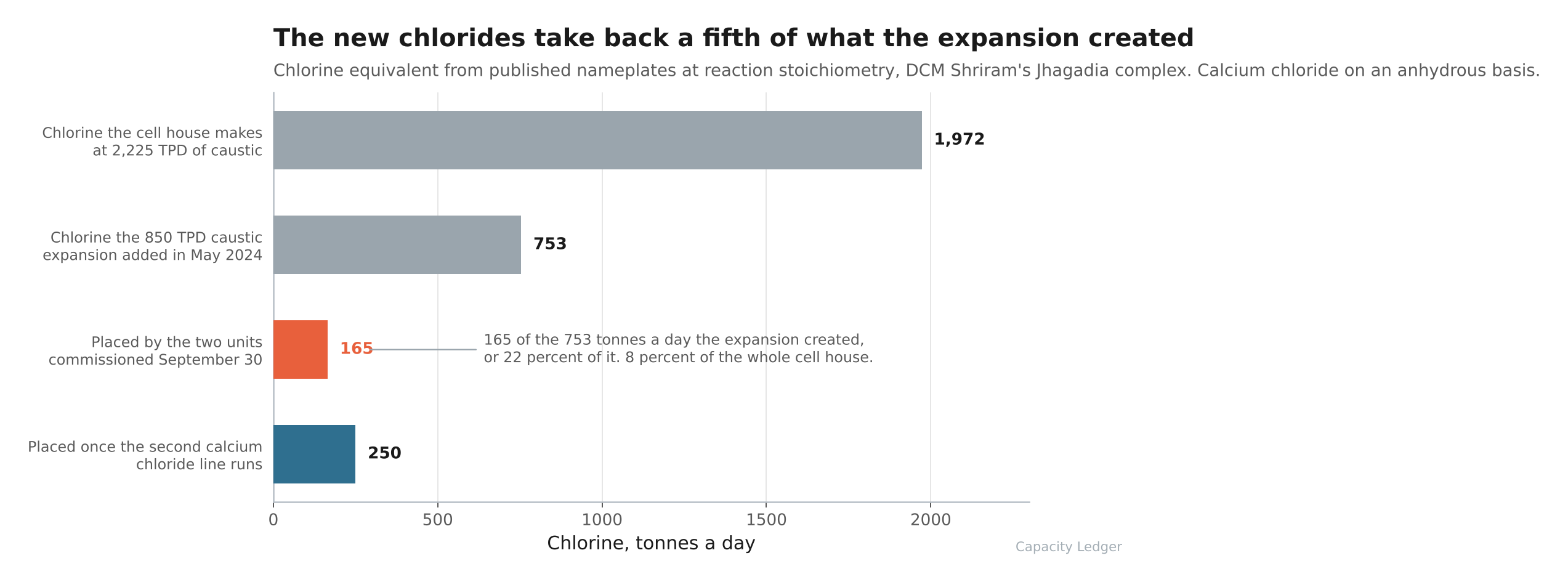
Call it 22% of what the expansion created and 8% of everything the cell house makes at nameplate. With the second line running it reaches about 250 tonnes a day, or a third of the expansion.
One caveat the arithmetic forces: calcium chloride sells as 74% flake, 94% prill and 35% solution, and we have computed on an anhydrous basis. If that 133 TPD is hydrated product, the chlorine draw is proportionally smaller.
The Sinks They Built First
What makes this a sequence rather than a one-off is the order of the capex list in the company's own deck. Read down it and the chlorine shows up at every line:
- 850 TPD caustic expansion at Bharuch, May 2024. The chlorine arrives.
- 120 MW of power at Bharuch, June 2024. The cells have to be fed before anything else matters.
- 52,500 TPA hydrogen peroxide, August 2024.
- 52,000 TPA epichlorohydrin, April 2026, the glycerine to ECH to epoxy chain and the heaviest chlorine consumer on the list.
- 100 TPD aluminium chloride and the first calcium chloride line, September 2026.
The forward integration behind it runs the same way. Hindusthan Specialty Chemicals was bought in August 2025 to take ECH into epoxy, Rs 101 crore is going into another 36 KTPA of formulated resins by Q2 FY28, and a salt works with 208,000 MTPA of installed capacity sits in the approval queue, which is the feed end of the same cell.
It shows up in the quarter. Caustic volumes in Q1 FY27 were flat at 197,544 MT and ECU realisation rose 6.6% to Rs 35,761 a tonne, while chemicals revenue climbed 33.2% to Rs 1,205 crore on the advanced materials the chlorine now feeds.
Caustic plants ran at 82% against an Indian industry sitting at 80%.
Final Thoughts
Nothing here is a new molecule. Anhydrous aluminium chloride has been the Friedel-Crafts workhorse since 1877 and calcium chloride is road de-icer and drilling brine.
Neither unit belongs in anyone's innovation deck.
What they are is somewhere to put a co-product the cell makes whether it is wanted or not, and the honest read on the chart above is that 165 tonnes a day leaves the problem standing. It moves about a fifth of one expansion's worth.
That is how the chlorine side gets fixed, though. In 80 and 100 tonne increments, each one a small plant on the fence, each one bought with capital that could have gone somewhere more glamorous.
Do it quietly for a decade and you have a cell house that can run at rate when caustic is paying. Skip it and you find out that caustic demand and chlorine demand are two different markets reading off one meter.
Thanks for reading.