 Capacity Ledger
How Long Does an Idled Plant Stay Restartable?
Greatham's chloride line sat dark for ten months, six of them with nobody in a position to spend money on it. It came back on August 20 under its old brand and its old grade codes, and what stands between it and 150,000 tonnes a year is a recruitment campaign.
If you buy titanium dioxide, your file since early last year has been all subtraction.
Tronox announced it was idling Botlek, 90,000 tonnes of chloride-route pigment in the Netherlands, on March 17 2025. Venator Materials UK went into administration that October, and its Greatham plant near Hartlepool, 150,000 tonnes of nameplate on Teesside, went dark in the fourth quarter.
Greatham started making pigment again in the week of August 17.
"What does it actually take to bring a chloride line back after it has been sitting?"
Ten months, in this case. And the interesting part is where they went.
Ten Months, Six of Them Waiting
Venator Materials UK Limited went into administration on October 22 2025, with Alvarez & Marsal appointed joint administrators. An asset purchase agreement had been signed a week before that, on October 15.
The plant was held in a maintained idle state while the transaction ground forward.
It completed on April 27 2026. LB Titanium UK, a wholly-owned subsidiary of LB Group of Jiaozuo, took the site and the associated pigment assets and stood up an operating company called Tioxide Materials.
So the clock splits in two (chart below).
Six months and five days from administration to completion, with the plant intact and nobody in a position to spend money on it. Then three months and twenty-four days from completion to first pigment, which the company describes as four months of commissioning, testing and maintenance.
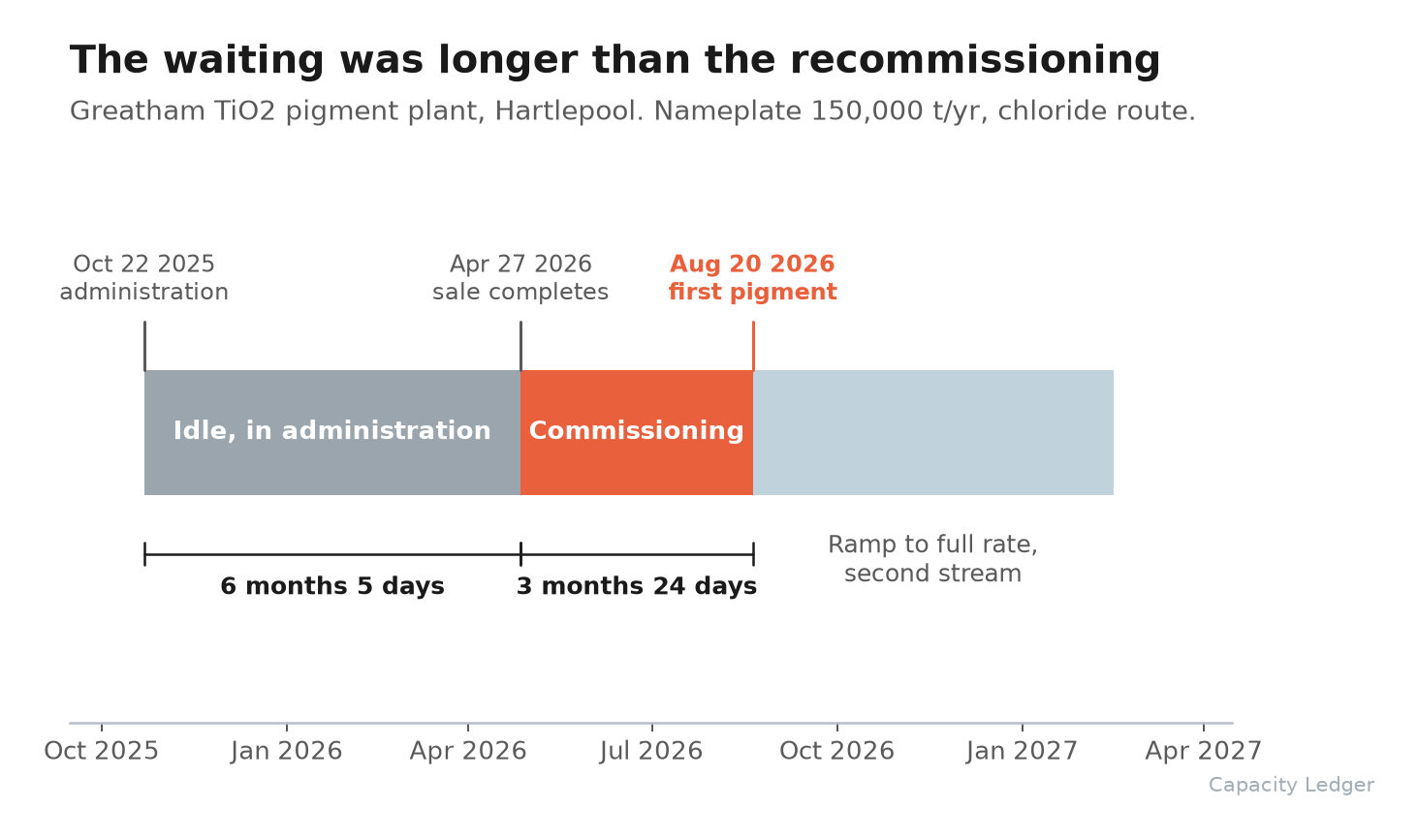
The recommissioning was the shorter half, and that is worth sitting with, because recommissioning is the part everyone worries about. A chloride line runs its oxidation step above 1,000 degrees C, and a cold one is not a machine you flip back on.
Greatham has been doing this since March 1972, when British Titan Products started the first commercial-scale chloride plant on the site at 30,000 t/yr. Three Icon units, in 1991, 2002 and 2009, got it to 150,000.
The Grade Codes Came Back
Here is the part that matters if you formulate.
The startup grade is Tioxide R-TC90, the decorative rutile that goes into interior gloss and semi-gloss, water-based and solvent-based alike. Managing director Karen Askwith says the plant switches to Tioxide TR81 in the near future, the durable exterior grade that powder, coil, protective and marine coatings specify.
The rest of the Greatham range follows over the coming months.
Those are the old codes. R-TC90 and TR81 have published datasheets under the previous owner, and they are the same grades in the same brand family, out of the same plant, with the same technical group at Wynyard behind them.
A returning supplier that ships you a new grade code is a requalification project. A returning supplier that ships you R-TC90 is a purchase order.
The material also leaves Greatham as UK-origin pigment, which settles a question some buyers are carrying right now: the Trade Remedies Authority opened an anti-dumping investigation into rutile titanium dioxide from China on March 3 2026 on Tronox Pigment UK's application, and imports of that product have been registered since March 27. None of that reaches a tonne made in Hartlepool.
The Gate on the Second Half
Single stream is what is running. Full rate needs the second stream, and Tioxide has said plainly what it is waiting on.
Recruitment (chart below).
The company announced 70 roles at completion and filled more than 60 of them inside twelve weeks, across finance, business services, operations, production, engineering and technical. In early August it opened a second phase of about 60 more, taking the total announced since April to nearly 130, at a site that already has more than 200 people on it.
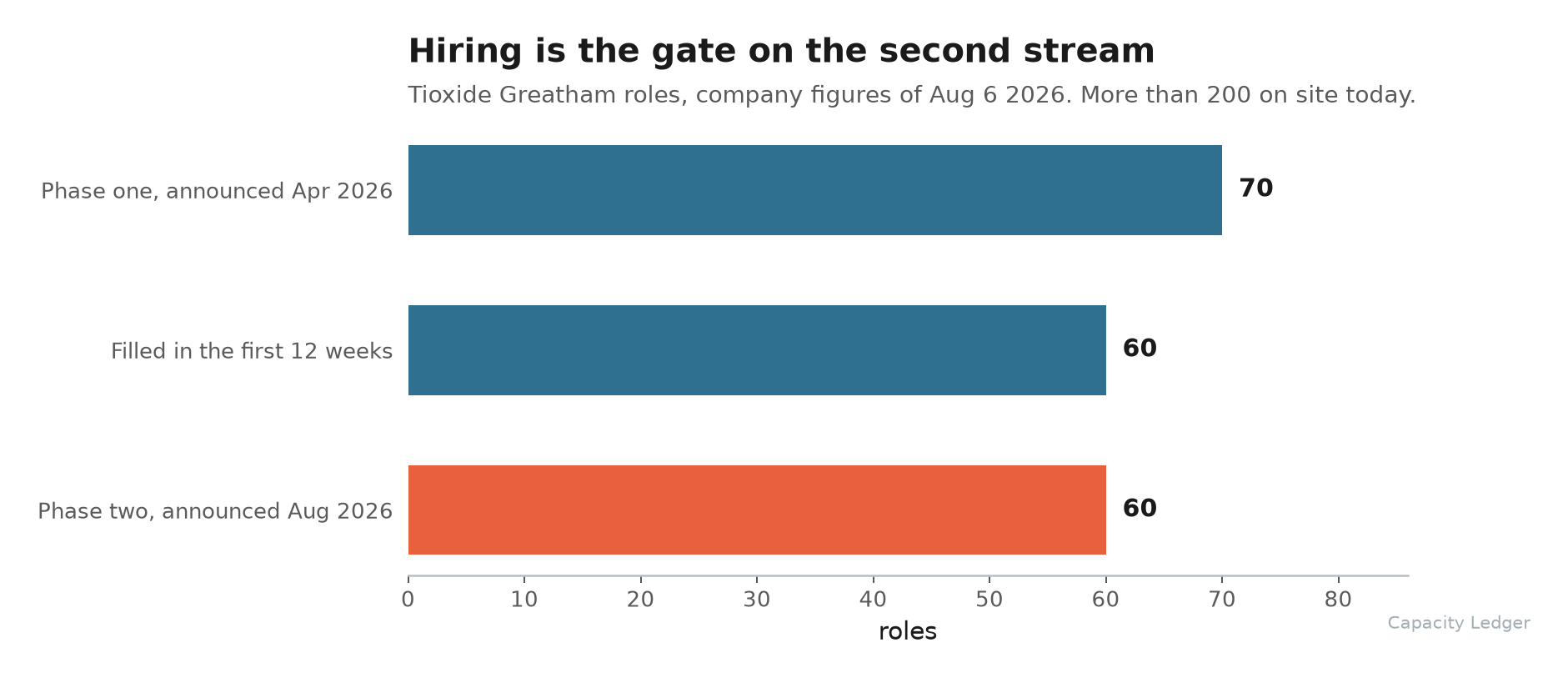
The technical hiring points at black-end processing units and the finishing plant, which is where you would point it if you were bringing a second oxidation stream up. Askwith's timing for that stream is early 2027, and the constraint she names is people.
Well worth noting how they got the first sixty. Returning staff came back, and Askwith credits the site's local reputation for the rest.
A plant that sat dark for ten months, in a town that had just been through the administration, refilled sixty roles in a quarter.
Final Thoughts
We spend most of our time on this desk writing the subtraction side, because that is where the documents are.
Closures generate WARN notices, 8-Ks and force majeure letters. Restarts generate one press release and then silence.
Greatham answers the restartability question as a set of conditions rather than a deadline. Somebody has to keep paying to hold the asset in a maintained idle state. The technical population has to still be reachable when the money arrives. And the grade codes have to survive the ownership change. All three held here, and the third is the one buyers should watch, because it is the difference between capacity coming back and capacity coming back to you.
Full rate in early 2027 is a claim, and it is unproven. First pigment out of a plant that was dark last month is already on a truck.
Thanks for reading.