Fifty More Days on Grade 1800
Commerce moved the PTMEG preliminary determinations to November 4 this morning, fifty days later than they were due, and the petitioner is the one who asked for it. The grade spandex runs on has no US producer and no non-subject import source anywhere in the Commission's record.
If you nominate polyether polyols quarterly, the notice that mattered to you this morning ran two pages and said almost nothing.
Commerce postponed the preliminary determinations in the four antidumping investigations on polytetramethylene ether glycol from China, Korea, Taiwan and Vietnam. They were due September 15.
They are now due November 4, and the shift is exactly 50 days (chart below).
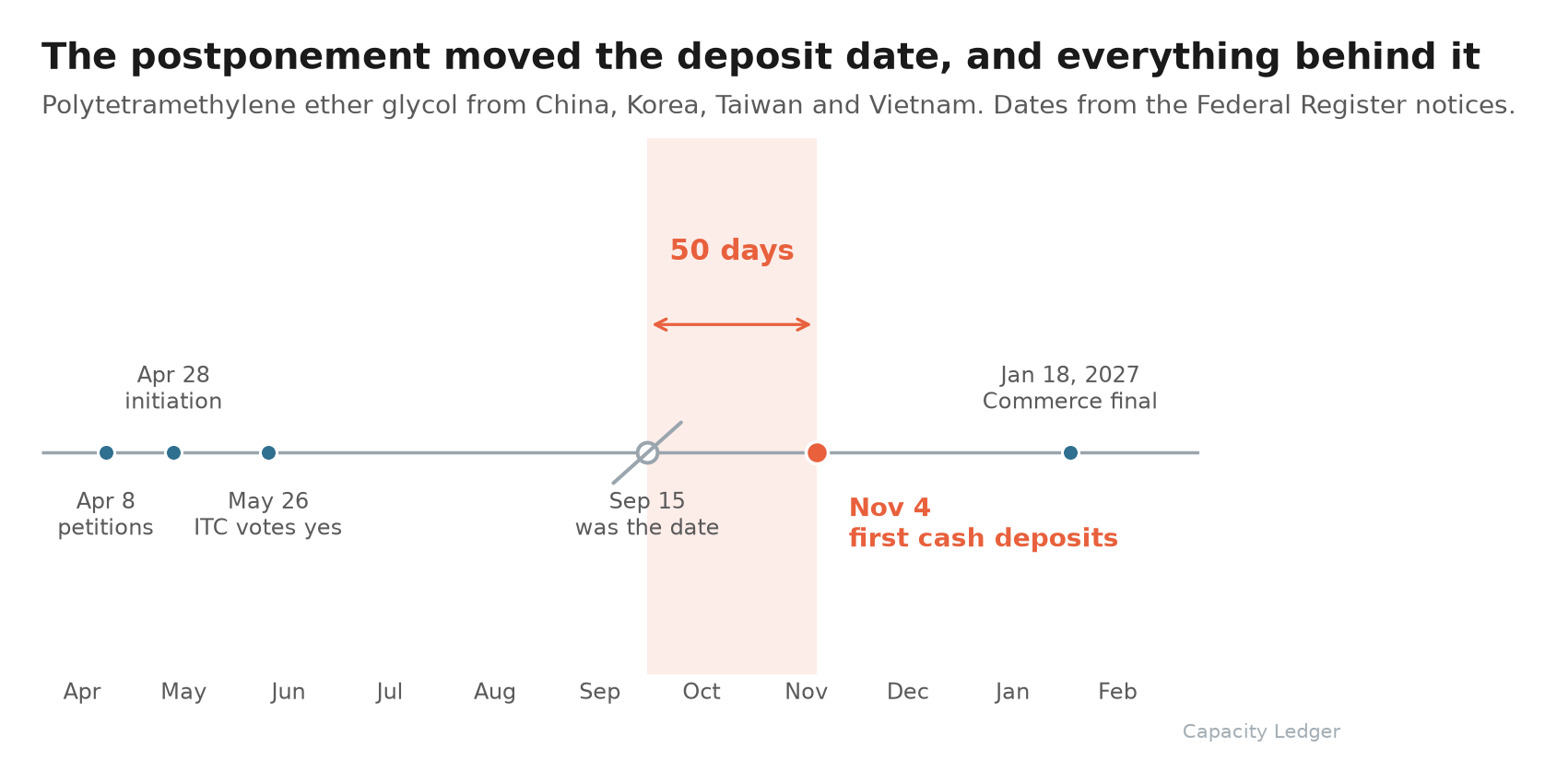
The request came from the petitioner, on August 20, so Commerce could "evaluate fully the initial questionnaire responses submitted by the mandatory respondents and solicit supplemental information as necessary."
Commerce grants those unless it finds compelling reasons to deny. It found none.
That is the whole notice. The interesting part is who the delay helps, because the grade sitting at the center of this case is not made in the United States at all.
"What is a fifty-day reprieve worth on a grade nobody here produces?"
The Grade BASF Doesn't Run
The petitioner is BASF Corporation, and at initiation it identified itself as the only producer of PTMEG in the United States. Support from 100 percent of the domestic industry, which is a short roll call.
Then read what the Commission put in its preliminary views in June. BASF "produced all types of PTMEG except Grade 1800 PTMEG in the United States during the January 2023 to December 2025 period of investigation."
Appendix E of that publication is blunter. Grade 1800 was never set up as a pricing product "as domestic producers have not manufactured any PTMEG of this grade since before 2023."
Grade 1800 is the spandex grade. The LYCRA Company told the Commission it is uniquely required for elastane fiber, that LYCRA uses nothing else, and that since it is not produced domestically, LYCRA imports every tonne it consumes.

The rest of this brief is for subscribers.
The capacity math, the trade-flow read, and what it means for the products you buy.
$50 a month, or $400 a year.
Already a subscriber? Sign in