 Capacity Ledger
How Many of the New Chemical Sites Are Plants?
BLS added 662 US chemical establishments to the count on Friday, the twelfth straight annual increase, and the sector employed 4,108 fewer people than a year earlier. Texas alone gained 147 addresses and lost 1,237 jobs.
If you keep a list of US chemical producers, it got longer on Friday.
The Bureau of Labor Statistics published first-quarter 2026 data from the Quarterly Census of Employment and Wages on Friday morning, and private chemical manufacturing (NAICS 325) came in at 26,248 establishments. That is 662 more than a year earlier, and the twelfth consecutive annual increase across the window the agency's open data covers, which starts in 2014.
Over the same year the sector employed 4,108 fewer people.
The divergence is neither new nor small (chart below). Since Q1 2014 the establishment count is up 59.7% against 12.4% on employment, and since Q1 2022 the count has added 3,396 units and the payroll has added 1,485 jobs.
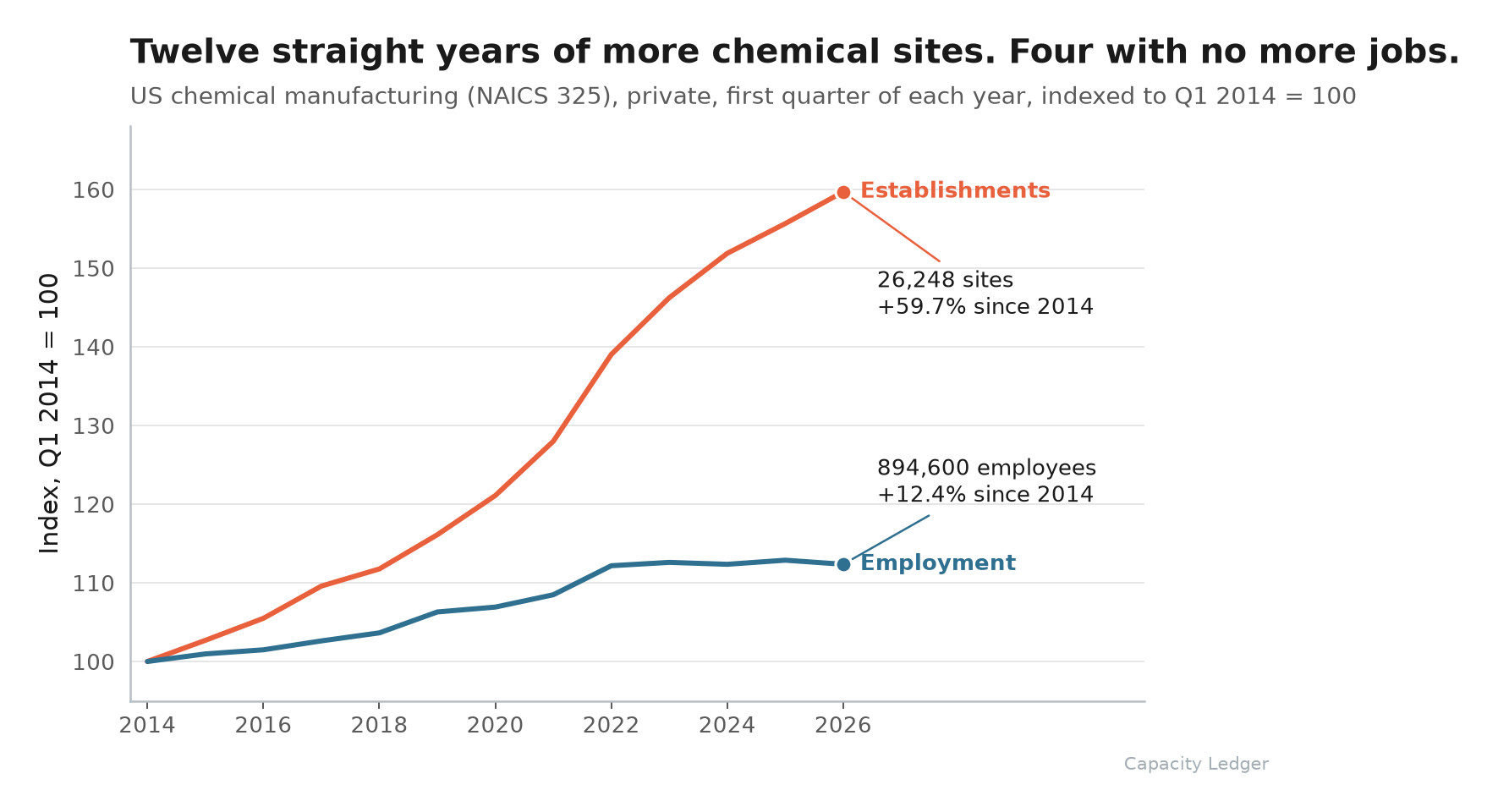
The arithmetic underneath is one number. The average US chemical establishment held 48.4 people in Q1 2014.
It holds 34.1 now.
Where the 662 Went
Six of the seven four-digit chemical industries added establishments and lost employment between Q1 2025 and Q1 2026. Only basic chemicals (3251) gained both.
One level down, the pattern gets blunt. Every one of the five largest establishment gainers inside NAICS 325 shed jobs:
- Pharmaceutical preparation (325412): +142 establishments, -1,924 employees
- Paint and coating (325510): +60 establishments, -838 employees
- Toilet preparation (325620): +54 establishments, -2,775 employees
- Plastics material and resin (325211): +54 establishments, -1,559 employees
- All other basic organic chemical (325199): +50 establishments, -564 employees
325211 is the one to sit with. Plastics material and resin ran 1,143 establishments and 57,322 employees in Q1 2016, which is 50.1 people per site.
A decade later it runs 1,670 establishments and 57,396 employees, so the same headcount across 527 more addresses at 34.4 people each.
Nobody built 527 resin plants.
Texas Went Both Ways at Once
Texas added 147 chemical establishments over the year, more than any other state, and lost 1,237 chemical jobs.
Pennsylvania added 15 and lost 2,425. Louisiana added 5 and lost 148, and West Virginia added 2 and lost 139.
Illinois is the counterexample worth naming, at +96 establishments and +196 jobs. So it can happen.
It mostly didn't.
What the Count Is Actually Counting
BLS says the quiet part on its own questions page. A QCEW establishment is a reporting unit, and when a multi-site employer switches from filing one consolidated return to filing worksite by worksite, the count jumps without a brick being laid.
The agency's own example is a chain that "reported as a single large corporation for years but now reports as having 50 locations."
Add the genuinely new small units, and you have the series. Toll blenders, packagers, contract formulation shops, quality labs and repack operations all carry a NAICS 325 code, and each one lands in the count with exactly the same weight as a cracker.
So the number is real and it does mean something. It counts addresses, and reaction capacity is a separate question that this series has never answered.
Worth saying that chemicals is not alone here. All private manufacturing went from 341,821 establishments in Q1 2016 to 403,603 in Q1 2026, up 18.1%, against +1.6% on employment.
Chemicals ran +51.4% on establishments over the same decade, and gave up 26.8% of its average site size against 13.7% for manufacturing as a whole. Roughly double, on both.
Final Thoughts
The useful move here is small. When a market study, a state economic-development deck, or your own supplier database tells you the number of US producers in your chemistry is rising, pull the employment line alongside it and divide.
If that ratio is falling inside your six-digit code, the new entries are handling and formulation, and the reaction capacity sits in about the same number of hands it did five years ago. The average chemical site now runs 34 people at an average weekly wage of $3,032, against $1,654 for the country as a whole.
That wage says the industry still runs real plants. The count says almost nothing about how many.
The next print lands December 2. On twelve years of evidence, it will be another increase.
Thanks for reading.