Twenty-Seven Percent, and Not One Molecule Changed
EIA's Wednesday release put Ohio industrial power at 10.21 cents a kilowatthour for the first half of 2026, against 8.00 cents a year earlier. Henry Hub moved 4.1% across the same window, so the fuel did not do this. The auction that did has already cleared two more delivery years, both at the cap.
If one of your suppliers runs a plant in Ohio, its electricity got 27.6% more expensive this year, and nothing inside the fence changed.
Same furnaces, same reactors, same shift pattern.
EIA published the number on Wednesday. Ohio industrial customers paid an average of 10.21 cents per kilowatthour across the first half of 2026, against 8.00 cents across the first half of 2025.
No state moved more. Only the District of Columbia went further, at +37.0%, and nobody smelts anything there.
This is also not a general increase. Across the twelve states that employ the most chemical manufacturing workers, the US industrial average rose 6.1%, and three states did nearly all of the moving (chart below).
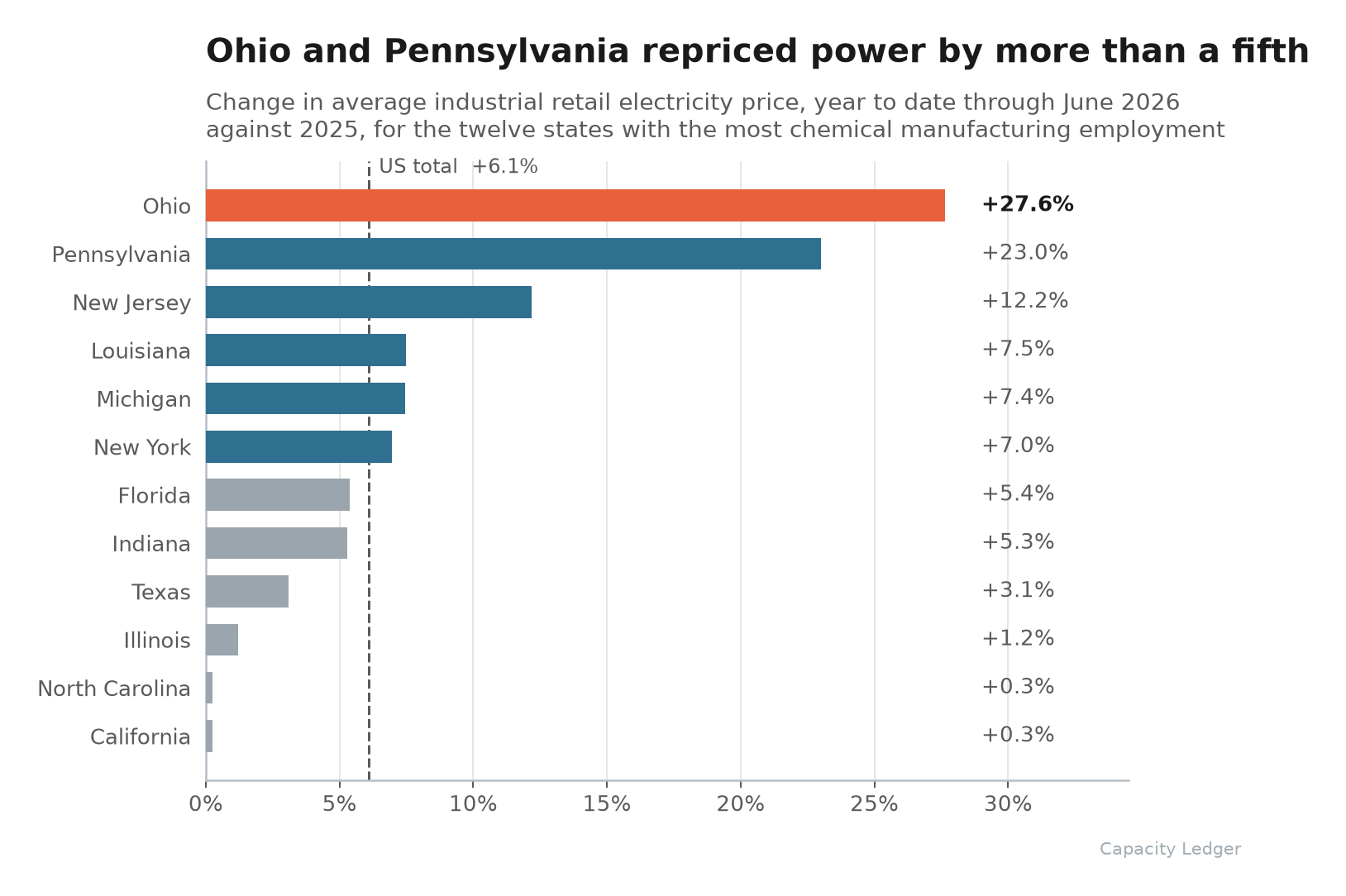
Pennsylvania came in at +23.0%, New Jersey at +12.2%.
Texas, which employs more chemical workers than any other state, went +3.1%. California and North Carolina went +0.3%.
"Why did the same twelve months cost Ohio twenty-seven percent and Texas three?"
The fuel did not do this
Henry Hub averaged $3.81 per MMBtu across the first half of 2026 and $3.66 across the first half of 2025. That is 4.1%.
Texas industrial power tracked the fuel almost exactly, at +3.1%.
Ohio tracked an auction.
The number was set in December
PJM procures capacity three delivery years ahead in a Base Residual Auction, and its delivery years run June 1 to May 31.
The 2025/2026 auction cleared at $269.92 per MW-day across the RTO. The 2026/2027 auction cleared at its cap, $329.17, and the 2027/2028 auction, run last December, cleared at its cap too, $333.44.
Ohio's four PJM zones are all in that last list at $333.44: ATSI, ATSI-Cleveland, DAY and DEOK.
Now look at what EIA is actually comparing. January through June 2025 sits inside the delivery year before the step, and January through June 2026 sits inside the $269.92 year for five months and the $329.17 year for one.
That is the whole 27.6%. Five months of the first increase, one month of the second.

The rest of this brief is for subscribers.
The capacity math, the trade-flow read, and what it means for the products you buy.
$50 a month, or $400 a year.
Already a subscriber? Sign in