 Capacity Ledger
How One Weekly Number Reprices Every Drum You Buy
US on-highway diesel printed $6.285 on September 14, the highest in the thirty-two years EIA has published the series. The surcharge tables keyed to it stepped two days later: 41.0 percent on the Department of Energy's own matrix, 54.80 percent at one LTL carrier.
The US retail on-highway diesel price printed $6.285 a gallon for the week of September 14. EIA has published that series every week since March 1994, and this is the highest value in it, the first print above six dollars, and 8.2 percent clear of the June 2022 record of $5.810.
You read some version of that last week. Here is the version that shows up on your freight invoice.
The Department of Energy keeps a public fuel surcharge matrix, one row per week, keyed to exactly that number. The September 14 row took the less-than-truckload surcharge to 41.0 percent and the truckload surcharge to $0.81 per mile, effective Wednesday, September 16.
AAA Cooper, pricing off the same index in the same week, published 54.80 percent on LTL.
"Which line in your delivered price moved this month, and did anybody in your building agree to it?"
A dime on the pump is a point on the surcharge
Pull all thirty-eight published 2026 rows of the DOE matrix and the table gives up its arithmetic immediately. The LTL percentage is the diesel price minus $2.174, times ten, rounded to the nearest half point.
That reproduces every row of the year with no exceptions. The truckload column is the same move divided by 5.0 miles per gallon, and it hits 37 of the 38 rows to the cent.
So the base price comes off before anything else happens.
That subtraction is what leverages the whole thing. At $6.285 with a $2.174 base, the elasticity is 1.53, so a ten percent move at the pump is a 15.3 percent move in what you pay.
Run it across the year and the two lines come apart badly (chart below). Diesel is up 80.8 percent since the week of January 5.
The LTL surcharge went 13.0 percent to 41.0 percent, which is 3.15 times, and the truckload rate went $0.25 to $0.81 per mile, which is 3.24 times.
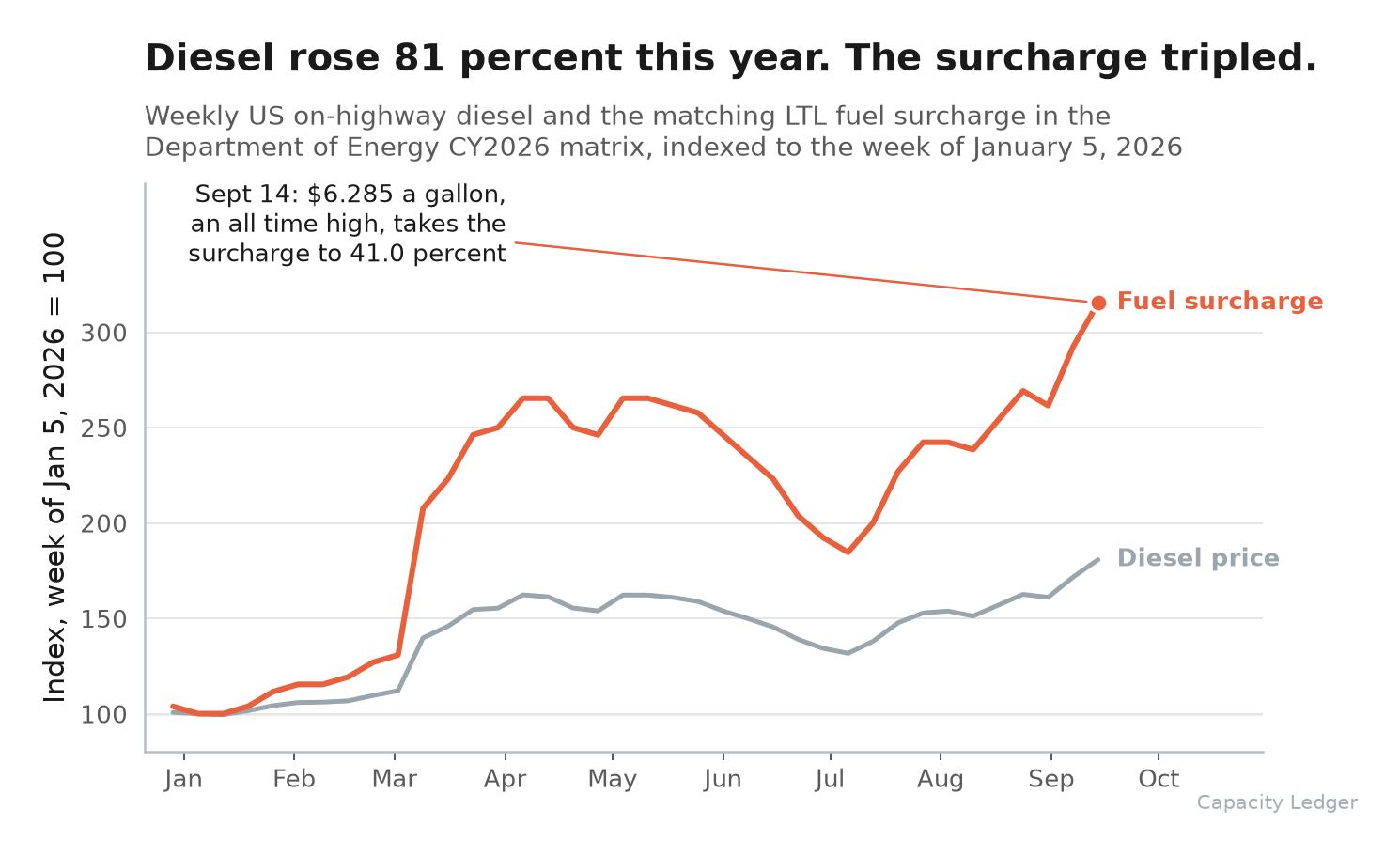
The ten weeks since the July 6 low did most of it: diesel +37.3 percent, LTL +17 points, truckload +72.3 percent.
Which part of your book actually moved
Put a number on it. A 500-mile lane at Wednesday's $0.81 carries $405 of fuel surcharge.
The same lane in the first week of January carried $125.
On a 45,000-pound load, that is $18.00 a ton today against $5.56 a ton in January. Call it $12.44 a ton of pure escalation, with nothing about the molecule changed.
Now, whether $12.44 a ton matters is a ratio you can finish yourself, because you know your own delivered prices. Here is the shape of the answer:
- The surcharge is indexed to weight and distance and has no opinion about value. Two identical drums riding the same trailer pay the same number whatever is inside them.
- So the escalation is regressive across your book. It is a rounding error on the high-value half and a visible percentage on the bulk, low-value, long-haul half.
- LTL is the worse exposure of the two, because 41 to 55 percent lands on a linehaul that is already expensive per pound on small parcels.
- None of it went through a negotiation. The table stepped on Wednesday whether or not anyone opened the contract.
Where it gets interesting is the timing mismatch. Your product price probably resets quarterly, or on a formula with a lag.
The freight line under it resets every Wednesday, off a number published the Monday before.
Final Thoughts
The supply side says to budget for this rather than wait it out. US distillate stocks stood at 107.9 million barrels on September 11, 13.1 percent below the five-year average for that week of the year.
East Coast distillate hit 19.3 million barrels on August 28, the lowest reading in a weekly series that starts in 1990.
Heating season loads onto that.
The next national print lands September 22 and sets the rate effective September 23. Sourcing teams spend a great deal of energy on the product line of a delivered price and comparatively little on the line beneath it, which this year has moved three times as fast and required no one's signature.
Thanks for reading.