Only One Chemical Industry Is Actually Full
August put US synthetic rubber at 57.4 percent of capacity, the emptiest manufacturing industry the Federal Reserve publishes. The artificial and synthetic fibers line next door ran at 92.7, the fullest. Both are inside the 71.7 percent everyone quotes for chemicals, and the difference between them decides which of your fourth-quarter contracts has any leverage in it.
The emptiest factory floor in American manufacturing this August belonged to a chemical plant.
Synthetic rubber ran at 57.4 percent of capacity. Of the 57 series in the Federal Reserve's August G.17, exactly one printed lower, and it was metal ore mining.
Now the other end of the same sector. Artificial and synthetic fibers and filaments ran at 92.7 percent, and exactly one series printed higher, oil and gas extraction.
So chemical manufacturing holds the fullest industry in the country and the emptiest one at the same time, and both of them are folded into the 71.7 percent this desk charted on Saturday.
"If the sector prints 71.7, which of your suppliers is actually tight?"
Three Lines, Thirty-Five Points
The G.17 publishes a utilization rate for chemicals and for three industries inside it. We listed every series header in the flat file to be sure that is all of them.
August 2026:
- Artificial and synthetic fibers and filaments (32522): 92.7
- Plastics material and resin (325211): 82.9
- Chemicals, the whole thing (325): 71.7
- Synthetic rubber (325212): 57.4
All of manufacturing ran at 75.7. The chemical aggregate sits four points under the sector it belongs to while containing lines 35 points apart from each other (chart below).
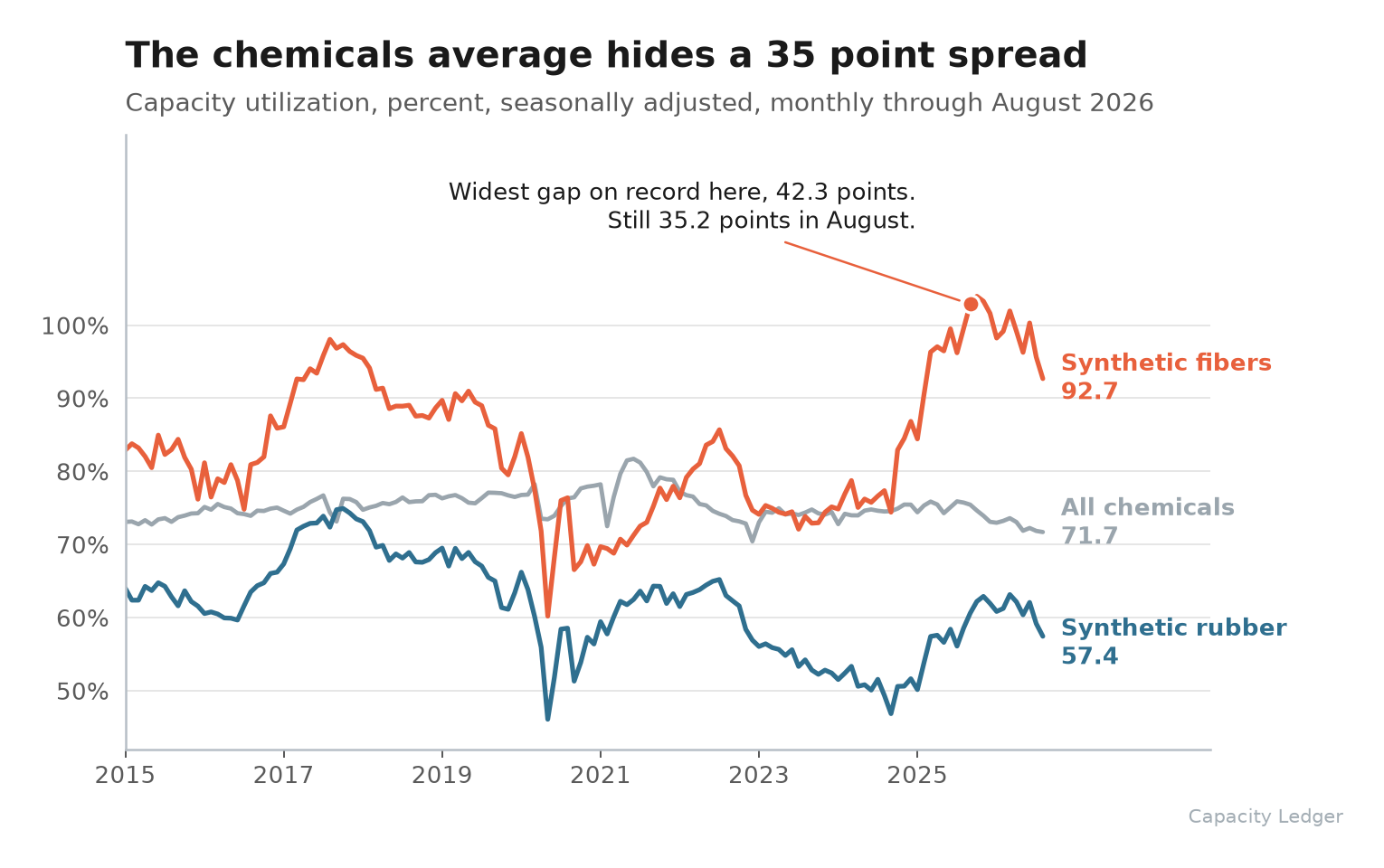
The widest that top-to-bottom gap has ever been, in a series that starts in 1972, was 42.3 points in September of last year.

The rest of this brief is for subscribers.
The capacity math, the trade-flow read, and what it means for the products you buy.
$50 a month, or $400 a year.
Already a subscriber? Sign in