 Capacity Ledger
If Cincinnati Is the Only APG Plant, Why Is Germany Gaining?
BASF inaugurated its expanded alkyl polyglucoside capacity in Ohio on Tuesday and published no number for it. Hamilton County published three: $70.5 million, a 20,000 square foot addition, and a payroll floor. Meanwhile the customs line the plant sells into put on 25,333 tonnes in a single year.
BASF inaugurated the expanded alkyl polyglucoside capacity at its Cincinnati site on Tuesday. The release carries no tonnage, no percentage and no investment figure.
The Hamilton County Board of Commissioners has all three, and has had them since March 2024.
That gap is the useful part of this story.
BASF has described itself since 2023 as the sole producer of APGs in North America, and it has now expanded this plant twice in eight years, in 2018 and again this week.
It has never once published a capacity number for it. What is on the record instead is a county incentive file, a set of trade names, and a customs line anyone can pull.
"If this is the only place in North America that makes the stuff, why is the import book growing this fast?"
What Este Avenue Actually Makes
The site sits at 4900 Este Avenue, straddling Cincinnati and St. Bernard, and it has been on that ground since 1885. Emery was founded in the city in 1840, Henkel ran the operation from 1989 to 2001, Cognis held it after that, and BASF acquired the company in 2010.
What comes out of it now is sugar chemistry. Alkyl polyglucosides are non-ionic surfactants built from glucose and a fatty alcohol, which is why BASF describes them as made from 100 percent natural and renewable feedstocks and readily biodegradable under OECD 301.
The commercial names are worth knowing if you buy any of this:
- Glucopon and Plantaren, the personal care and home care workhorses
- Agnique PG, the agricultural adjuvant line
- Disponil APG, the industrial formulations grade
The applications BASF lists alongside this week's expansion run to five: personal care, home care, industrial and institutional cleaning, industrial formulations, and agriculture. The 2018 release listed three.
The Numbers Are in the Enterprise Zone File
Here is what the county has that the press release does not.
The project is $70.5 million and a 20,000 square foot addition. Under the Enterprise Zone Agreement, BASF committed to take full-time employment at the site from 31 to at least 40, and payroll from $3.1 million to at least $3.8 million. The commissioners approved a 10-year, 75 percent exemption on the property improvements. The signing party is Care Chemicals, the BASF SE subsidiary, and the project manager on the record, Mike Feldman, told them the expansion would create at least twice the jobs the agreement asked for.
Now, none of that is a nameplate. A square footage and a headcount do not convert into tonnes of Glucopon, and we are not going to pretend they do.
What they do give you is the shape of the thing. Forty people and twenty thousand square feet is a specialty line, not a commodity train, and a ten-year abatement on improvements is a county betting that the line stays loaded for a decade.
Why the Line Grew While Ohio Was Building
The 2023 announcement said the expansion would come on stream in 2025 and that its purpose was to add local supply points and reduce cross-regional volume flows. The plant was inaugurated in October 2026.
So what did the customs line do in the meantime? It went the other way, and hard (chart below).
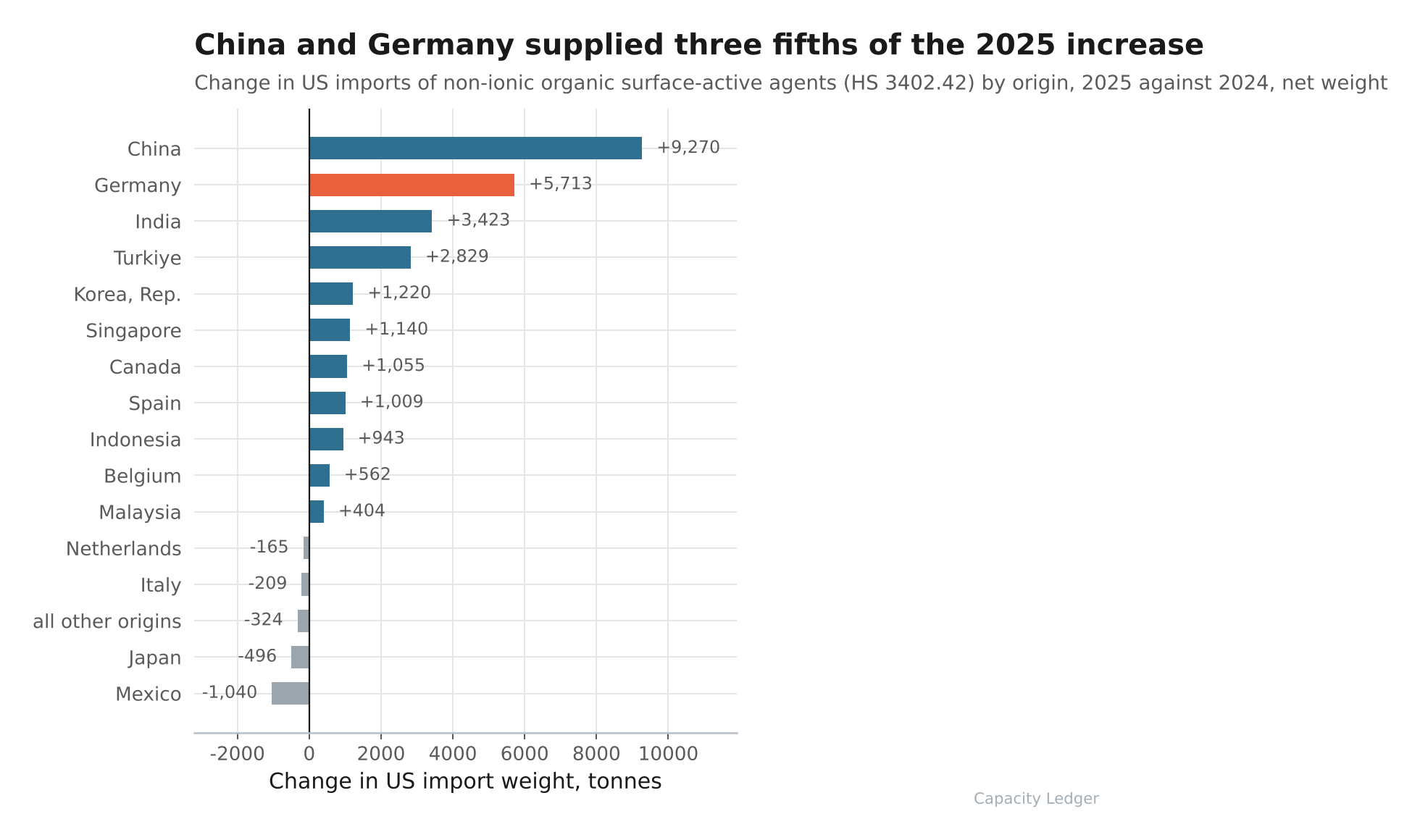
US imports of non-ionic organic surface-active agents under HS 3402.42 ran 80,877 tonnes in 2025 against 55,544 in 2024. That is +25,333 tonnes, or 45.6 percent, in one year.
We pulled the annual detail this week and the partner rows reconcile exactly to the world row in both years, so that book is complete rather than sampled.
China supplied +9,270 tonnes of the increase and Germany +5,713, which is 59.1 percent of the whole move between them. Germany's own book rose 79.8 percent.
Okay, so does that make the sole-producer line wrong? No, and this is the part worth carrying away.
3402.42 covers every non-ionic surfactant on the schedule, and alkyl polyglucosides are one family inside it. Ethoxylates of all kinds enter on the same six digits, which is why the subheading splits into an aromatic break at 4 percent, a fatty-substance break at 4 percent with three statistical suffixes under it, and a catch-all at 3.7 percent. The tonnes that arrived in 2025 came in at $1.17 a kilo from China against $4.89 from Germany and $3.25 across all sources. A book whose average price fell while its weight rose by half is a book that grew at the cheap end.
Which is the honest answer to the question in the title. The German tonnes and the Ohio reactors sell into different ends of the same six digits, the import line grew underneath both of them, and a plant that puts capital into the specialty end of a market behaving like that is reading it correctly.
Final Thoughts
We read this same customs line from the other direction five weeks ago, from South Pittsburg, Tennessee, where a privately held surfactant house publishes its own pounds-shipped counter and the imports arriving on its six digits price anywhere from fifty-one cents a kilo to nine dollars. The line looks completely different depending on which plant gate you stand at.
Cincinnati is the better vantage point for one reason: it is old, it is specialized, and it has been expanded twice by an owner that publishes nothing about its size. A site that has been in continuous operation since 1885 and still gets capital in 2026 is telling you something about the durability of sugar surfactants that no press release is willing to put a number on.
The county file will have to do.
Thanks for reading.