If Everyone Is Closing Plants, Why Is Capacity Still Rising?
US chemical capacity utilization fell to 72.1% in June, the weakest print since the December 2022 freeze. The closures are real, and the Fed's capacity line has still gone up every month for almost six years.
You have read a closure announcement most weeks this year.
BASF is cutting roughly 100 of about 200 jobs at McIntosh, Alabama, and stopping the lines there that make specialty chemicals for plastics and automotive by the end of the first quarter of 2027.
AGC has proposed ceasing production at Hillhouse, 190 staff, by the end of this year. Another Alabama site surfaced last week with 80 more.
We keep the file on these for a living, so ours is thicker than yours.
Then on July 17 the Federal Reserve published the June industrial production data, and the capacity line for chemical manufacturing went up again.
"If the industry is rationalizing, why has the capacity number never gone down?"
The Ratio Nobody Wants To Explain
Chemical manufacturing (NAICS 325) ran at 72.1% of capacity in June. A year earlier it was 75.1%.
In the last five years exactly one month printed lower, December 2022, and that was the week Gulf Coast plants were shutting for a freeze.
Weak demand is the easy half of that. Production sits at 101.6 on the Fed's index, 2.5% under its July 2025 peak and down 1.3% year on year.
The denominator is the half nobody puts on a slide.
The capacity index for chemicals reached 140.9 in June, up 2.8% year on year, and it has risen in every month since September 2020. That is 70 consecutive monthly increases, running straight through the entire closure wave.
Measured from January 2019, US chemical capacity is up 9.5% and production is up 3.5% (chart below).
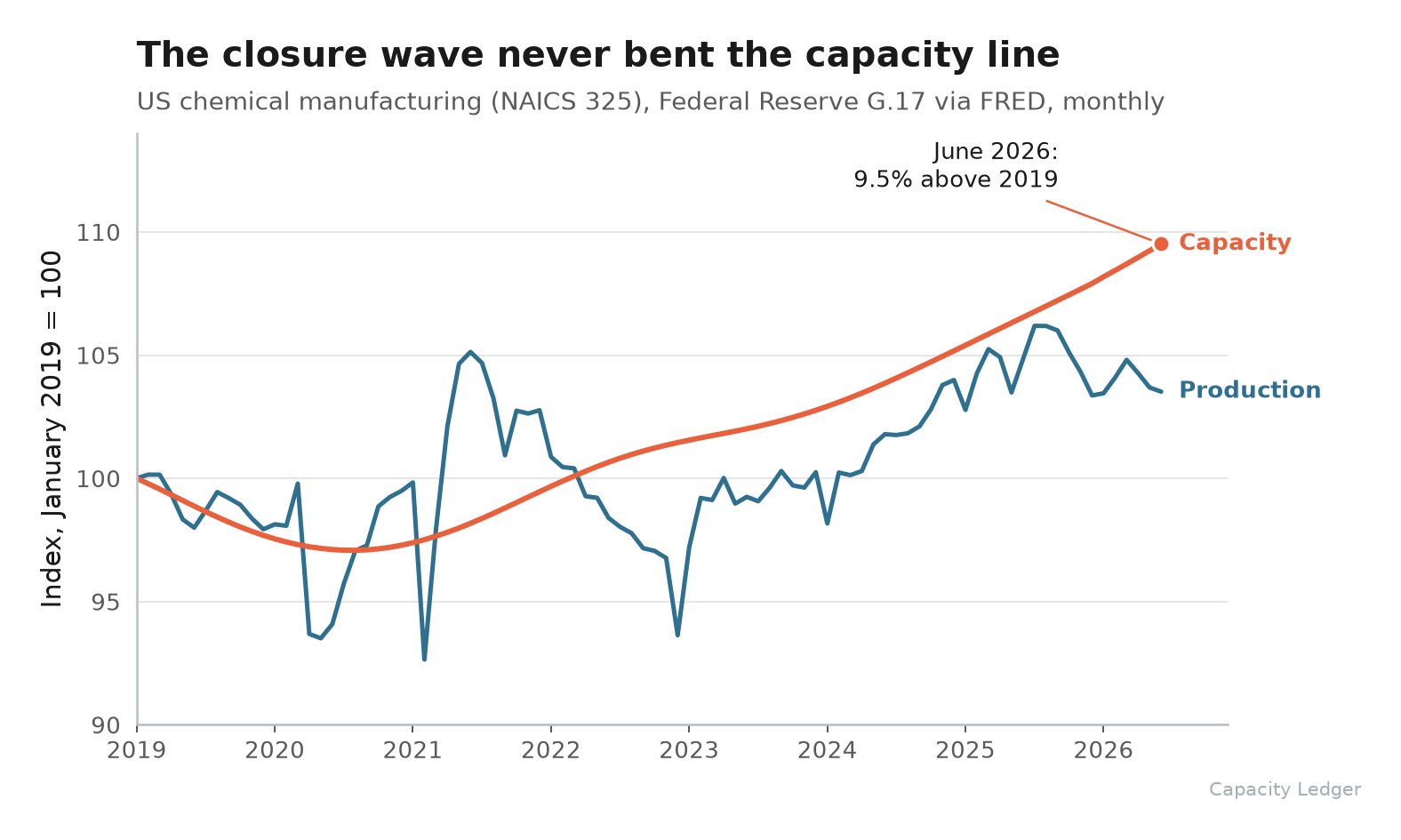
Utilization is just production index / capacity index. Put June through it, 101.6 over 140.9, and you get the 72.1 the Fed published.

The rest of this brief is for subscribers.
The capacity math, the trade-flow read, and what it means for the products you buy.
$50 a month, or $400 a year.
Already a subscriber? Sign in