Why the Ethane Advantage Stops at Benzene
The Hormuz reopening lasted three weeks on the water. US crackers run on ethane and never touched Middle East naphtha, which is exactly why the aromatics half of your book is the exposed half.
On July 7, the EIA published a press release under the headline that it was raising its global oil production forecast after the opening of the Strait of Hormuz.
Crude production and trade flows back to near pre-conflict levels by year's end. Most shut-in barrels back by the first quarter of 2027.
The agreement it was built on lasted one more day.
Overnight into July 8, US Central Command struck more than 80 targets inside Iran, in response to Iranian attacks on three commercial vessels transiting the strait. One of them was a Qatari LNG carrier hit by a projectile off the Omani coast, engine room on fire.
So the reopening you may have penciled into your Q4 assumptions is currently worth about ten ships a day.
Three Weeks of Traffic
IMF PortWatch counts AIS-broadcasting crossings at the world's chokepoints, and its Hormuz series is the cleanest public read on whether the strait is actually working.
Before the crisis, the typical day was 88 commercial vessels. After the June 17 memorandum, traffic recovered to an average of roughly 25 a day through late June and early July, a quarter of normal and enough to make the reopening story look real.
In the week of July 13 to 19, the average was 10 (chart below).
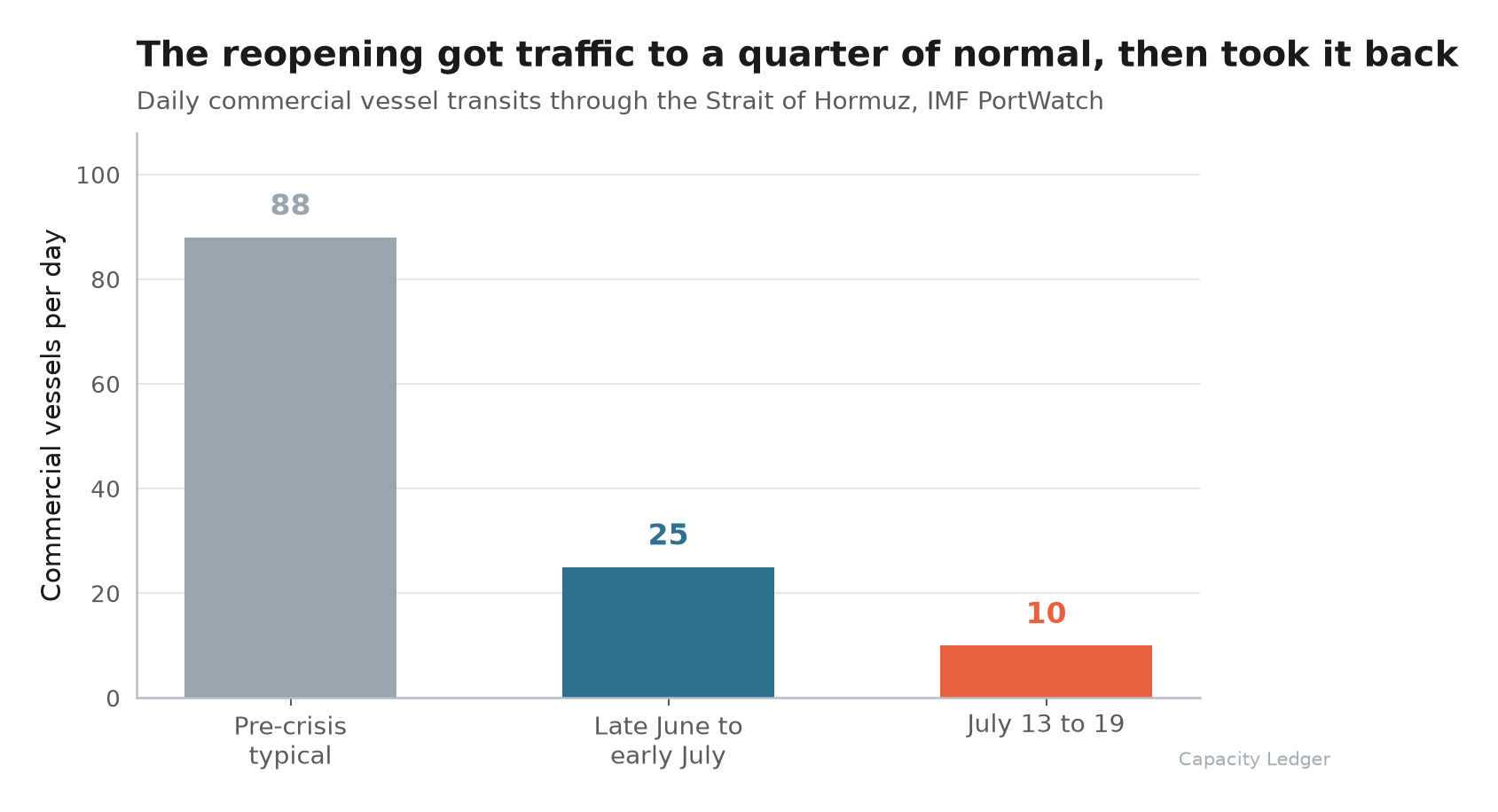
July 19 itself was 15 vessels, against roughly 88 on a normal day. That is 17% of pre-crisis throughput, and it is the most recent count PortWatch has published, since it releases weekly on Tuesdays with about a two-day lag.
Which puts the strait at 148 days effectively closed as of this morning.
The Half of Your Book That Is Fine
Here is the part that has been reported to death, and it is still true.
North American crackers overwhelmingly feed ethane pulled out of natural gas. Europe, Asia and Latin America crack naphtha out of refineries, and Middle East naphtha is what stopped moving.
Japan imports more than 60% of its naphtha, with about 70% of that coming from the Gulf, which is why Asian operating rates started falling in March and never fully came back.
LG Chem took its Yeosu and Daesan naphtha crackers to a floor of 60% of capacity. Yeochun NCC cut output and declared force majeure on the grounds it could not physically take delivery of feedstock.
Petrochemical Corporation of Singapore declared on disrupted naphtha, and Chandra Asri followed.
Meanwhile US Gulf Coast crackers were already running above 90% utilization before any of this started, and the feedstock shock handed them a wider cost advantage on top.

The rest of this brief is for subscribers.
The capacity math, the trade-flow read, and what it means for the products you buy.
$50 a month, or $400 a year.
Already a subscriber? Sign in