 Capacity Ledger
If the Accelerator Surge Was in June, Why Does the Clock Start in August?
Commerce found critical circumstances on Chinese CBS on Friday and reached the suspension of liquidation back ninety days, to August 8. We pulled the customs line, and the surge is one month: June, the largest Chinese month on that line since August 2024. The three-month window the massive-imports test measures closes on August 7.
If you buy Chinese rubber accelerator, the month that decides what you owe is June, and nothing about June looked unusual while it was happening.
Commerce found critical circumstances on Friday and reached back ninety days. We went and pulled the customs line to see what ninety days actually catches.
"How much of the surge does the reach back reach?"
None of it.
One Month Did All of It
US imports under HS 2934.20 from China ran at 957 tonnes a month from January through May of this year, inside the band the line had held all year. June came in at 2,301 tonnes (chart below).
That is 2.4 times the five-month average and the largest Chinese month on this line since August 2024.
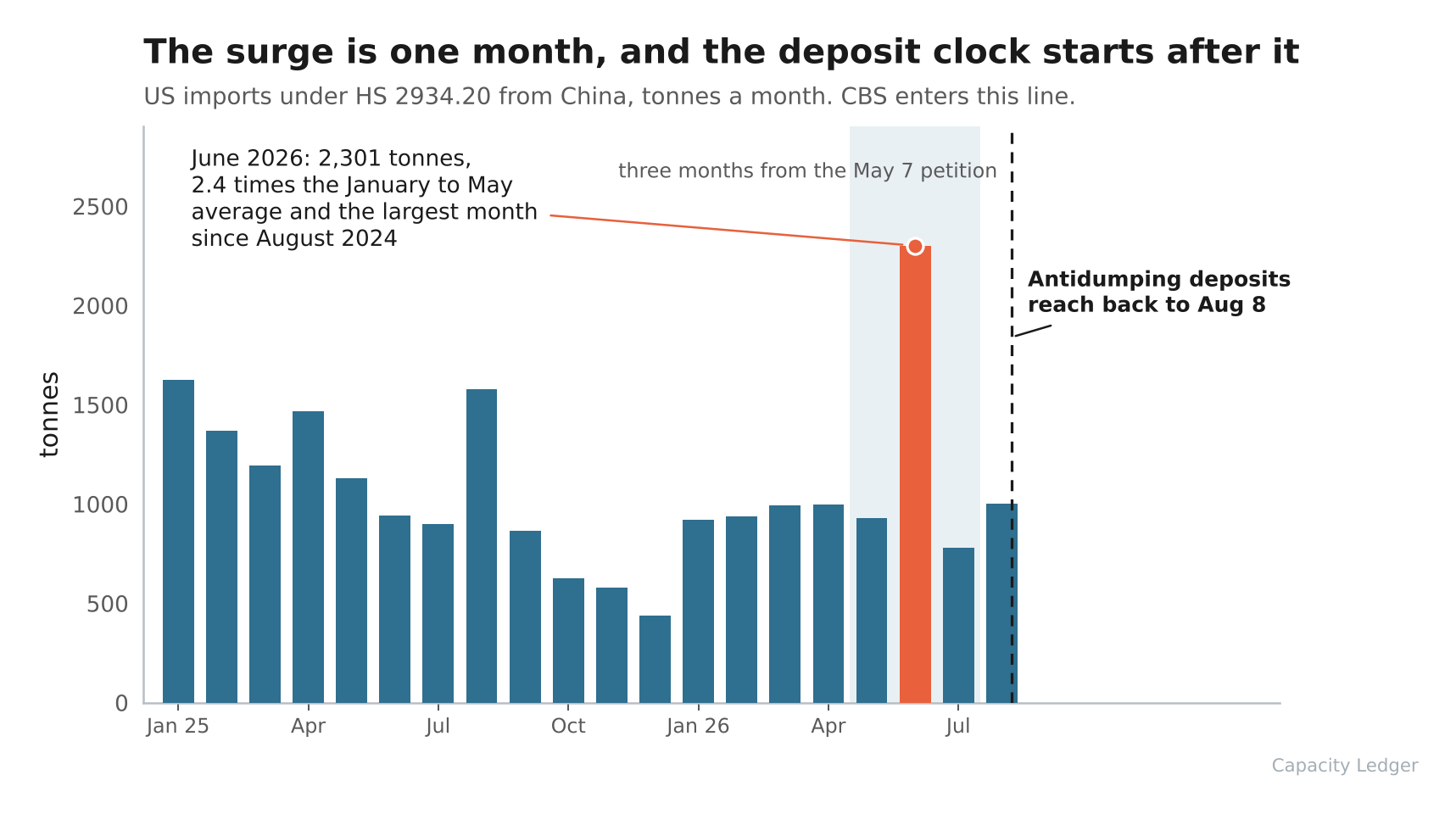
June is also the only month of 2026 in which China was the largest reported origin on the line. Belgium led the other seven.
Then it was over. July fell to 780 tonnes, under the pre-petition run rate, and August came back to 1,001.
One month, and nothing on either side of it.
The Window Closes on the 7th
Section 733(e) needs the imports to have been massive, and 19 CFR 351.206(h)(2) puts a number on massive: at least 15 percent above an immediately preceding period of comparable duration. Paragraph (i) sets the measuring window as the period beginning when the proceeding begins and ending at least three months later.
LANXESS filed on May 7. So the shortest window the regulation describes runs to August 7.
Run the test on the customs line.
February through April gives 2,930 tonnes and May through July gives 4,011, which is +36.9 percent. Widen both sides to four months and it is +30.1 percent.
Whichever window you pick, the finding clears the threshold twice over. The data says Commerce is right.
Here is the catch. Friday's notice suspends liquidation ninety days back from publication, and publication was November 6, so the date is August 8.
The window that produces the finding closes on the 7th. The deposit that answers it opens on the 8th.
They do not overlap by a day.
The countervailing half does a little better. Published October 8, its reach back lands on July 10, which picks up the last 29 days of the measuring window and none of June at all.
Price June at the stacked 389.26 percent both halves now carry and the month is worth about $28 million in deposits that nobody is collecting. Some fraction of that cargo is subject CBS, and we cannot tell you which fraction, for the reason below.
What the Line Will and Will Not Tell You
HS 2934.20 covers the whole benzothiazole family. TBBS, MBTS, MBT and the morpholine sulfenamide each have their own eight-digit US line, and CBS enters 2934.20.8000, the residual one.
The ten-digit split sits behind DataWeb, so treat the series above as a ceiling on CBS rather than a count of it.
Two things make it usable anyway:
- Comtrade reports the June weight. July and August both carry the estimated flag, so the month the argument rests on is the one the data is firmest about.
- Commerce reached its finding on data this desk cannot see. Its comparison periods and volumes live in the Preliminary Decision Memorandum, and the published notice carries neither.
And the substitution has already started where you would expect it. India shipped 224 tonnes on this line in July and August together, against 150 tonnes across the whole first half of the year.
Final Thoughts
Critical circumstances exist to take the profit out of shipping ahead of a duty. Ninety days measured backwards from whenever Commerce happens to publish is a crude way to do it, and this case shows how crude.
Run the clock from the October 28 signature date instead of the November 6 publication and you get July 30, which still misses June entirely.
So the cargo that triggered the finding is on one side of the line and everything the finding reaches is on the other, and what put them there was a publication date.
If you are reconciling entries this week, that is the useful read: your June drums are clean, your late-August drums are not, and your supplier had nothing to do with where the line fell.
Thanks for reading.