India's Citric Acid Case Has a Chinese Origin Problem
One petition, two countries, two preliminary determinations published this morning. The Canadian producer showed up and got a 0.00 percent dumping margin. The Indian respondent quit in June and took 151.73 percent, and the reason it quit is a CBP evasion case that says the merchandise was never Indian.
Two preliminary antidumping determinations on the same product went into the Federal Register this morning, out of the same petition, covering the same 2025 period of investigation.
One of them found no dumping at all. The other found 151.73 percent.
The gap has nothing to do with pricing.
Commerce examined exactly one company in each country. In Canada it examined Jungbunzlauer Canada Inc., which answered the questionnaires, and calculated a weighted-average margin of 0.00 percent. In India it examined Daffodil Pharmachem Private Limited, which filed a letter on June 29 withdrawing from the investigation, and applied the highest margin alleged in the petition as adverse facts available.
There were no calculations to disclose in the India case, because Commerce did not perform any. There will be no verification either, for the same reason.
"If the only Indian respondent walked out, what exactly is 151.73 percent a margin on?"
The answer is in a Customs file that predates the petition.
Zero Percent, and Still Paying
Start with Canada, because the Canadian result is the one that will get read wrong.
A 0.00 percent dumping margin means Commerce will not instruct CBP to suspend liquidation and will not require an antidumping cash deposit on Canadian entries. That is the whole of what it means. Canadian citric acid still enters this morning carrying a 16.50 percent cash deposit, because the countervailing investigation is a separate proceeding and it went affirmative on June 26 (chart below).
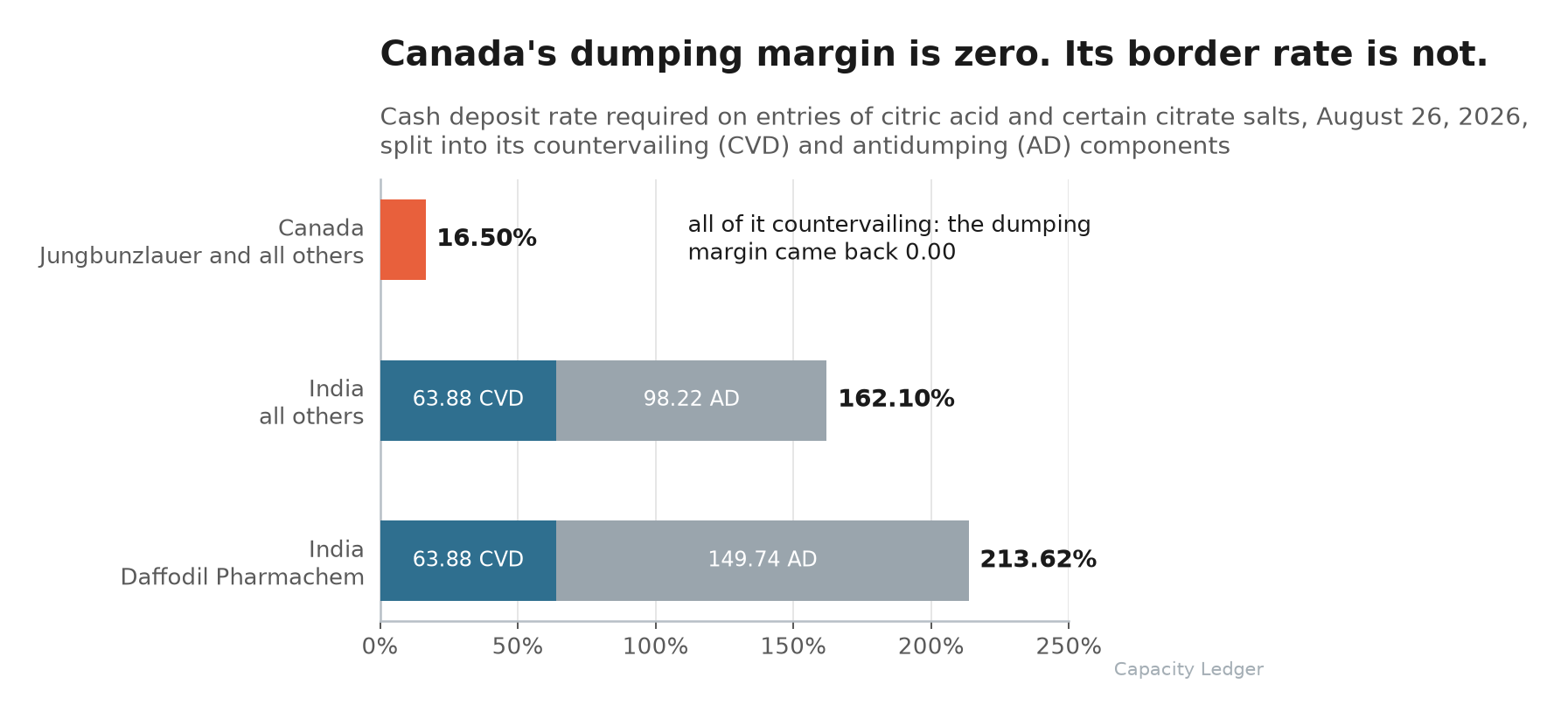
Same company, same period, same scope, two case numbers: A-122-877 found nothing and C-122-878 found 16.50 percent in subsidies. Neither one moves the other.
On the Indian side the two stack. Entries from Daffodil carry 63.88 percent countervailing plus 149.74 percent antidumping after the export-subsidy offset, so 213.62 percent at the border. Everybody else in India is at 63.88 plus 98.22, so 162.10 percent.
Note where that all-others number comes from. Because the only examined margin was built entirely on facts available, Commerce could not weight-average anything, so it fell back to the lowest dumping margin alleged in the petition.
An Indian producer that never sold a pound below fair value is now depositing at a rate ADM, Cargill and Primient wrote into a filing in January.

The rest of this brief is for subscribers.
The capacity math, the trade-flow read, and what it means for the products you buy.
$50 a month, or $400 a year.
Already a subscriber? Sign in