 Capacity Ledger
Charlotte Coats a Film North America Doesn't Make Yet
Asahi Kasei opened a wet-process separator coating line at the 40-year-old Celgard plant in Charlotte on August 20. The base film that line is built to coat will not be made on this continent until Port Colborne starts in 2027, and the company's own capital numbers say that ordering was the point.
The membrane plant in Charlotte opened in 1986, and the market it opened into was single-use lithium cells and blood oxygenators.
The microporous film patents underneath it had been granted out of Celanese's Summit, New Jersey labs in the late 1960s. Rechargeable lithium-ion was a decade away.
The US Army was buying monolayer polypropylene for lithium-sulfur dioxide cells, and that was the growth story.
Forty years and five Charlotte expansions later, on August 20, the same site opened a line that finishes a film it has never made.
"Why does the coating step reach North America a year ahead of the film?"
Two Hipores, one of them coated
Asahi Kasei sells its wet-process separator, Hipore, in two forms.
One is the polyolefin microporous base film membrane. The other is a coated membrane separator, made by applying ceramic and other coatings to that base film, and it is the version automotive cells want.
Charlotte, under the Celgard name, has been a dry-process house since 1986. Different stretch, different porosity structure, different customers.
What opened last Thursday is a coating line for the wet-process product. Asahi Kasei approved it in October 2023 as part of a ¥40bn program putting new coating lines inside three existing plants: Charlotte, Hyuga in Miyazaki, and Pyeongtaek in Gyeonggi. Together they add roughly 700 million m² a year of coating, taking the company to about 1.2 billion m², which by its own arithmetic means the addition is larger than everything it had.
Polypore put the Charlotte piece at about 100 new jobs when it announced construction. The site split of the capital and the capacity has never been published, so nobody outside the company knows what share of that 700 million square meters lands in North Carolina.
The coater got there first
Here is the part worth stealing for your own chain.
The base film for a wet-process separator is not made anywhere in North America.
Asahi Kasei's plant for that is Port Colborne, Ontario, a Honda joint venture with an initial announced investment of about ¥180bn, roughly CAD $1.56bn, for about 700 million m² a year. Commercial production is slated for 2027.
So the sequence runs: coating line live in Charlotte in 2026, film plant live in Ontario in 2027. The finishing step is regionalized first and the feedstock step follows.
The dates line up with that reading rather than against it:
- Commercial production at Charlotte begins in the second half of fiscal 2026, which on Asahi Kasei's April-to-March year means October onward.
- Toyota Tsusho America holds a capacity rights agreement giving it a preferential share of that Charlotte output, with deliveries beginning mid-2027.
- Port Colborne's first film is due the same year.
Charlotte spends the intervening quarters coating base film that came from outside North America, and by mid-2027 it has a supplier on the same continent.
What the capital says
Run the two projects per square meter and the ordering stops looking like a scheduling accident (chart below).
The coating program buys about 700 million m² of annual capacity for ¥40bn, or roughly ¥57 per square meter. Port Colborne buys about 700 million m² for ¥180bn, or roughly ¥257.
Same denominator, 4.5x the capital.
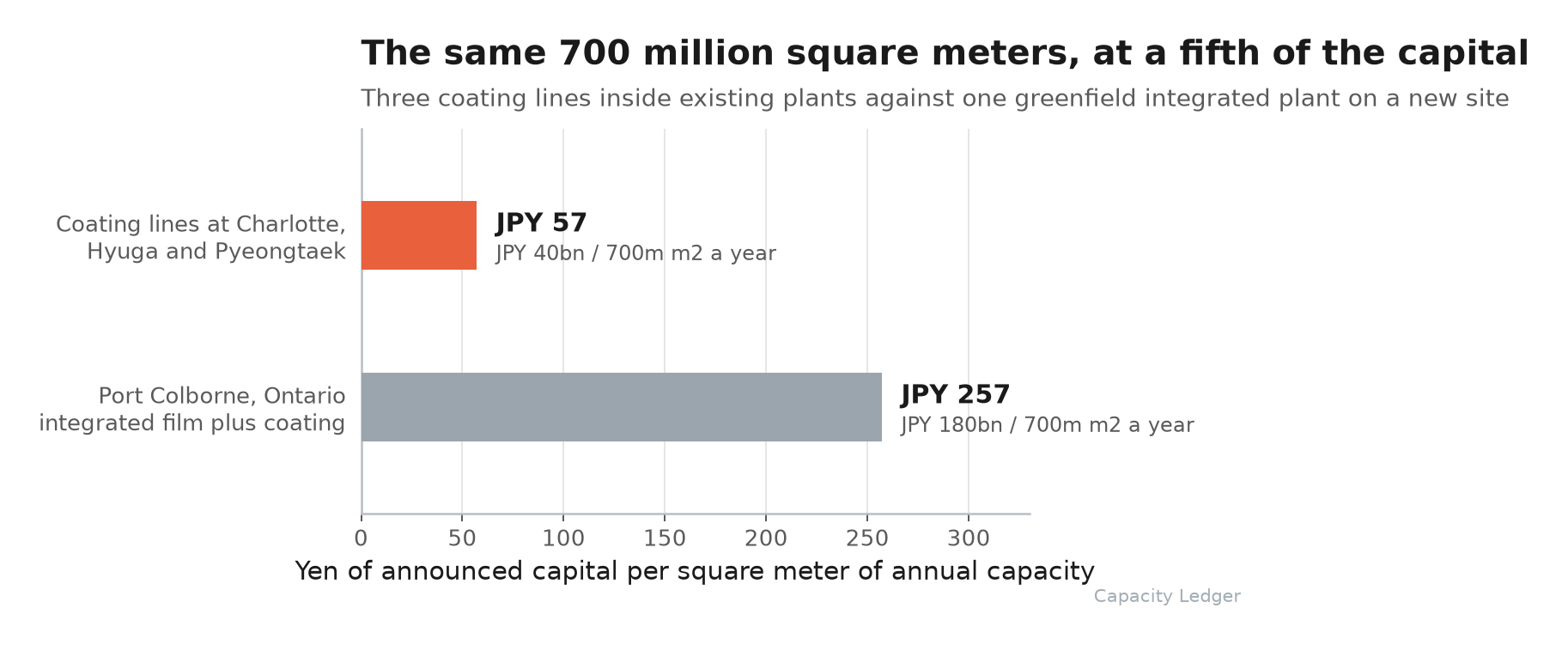
Three brownfield lines inside walls that already exist against one greenfield integrated plant on a new site is not a clean comparison, and it does not need to be. The gap is the whole point of the sequencing.
Coating is the cheap, fast, customer-specific step. It is where the ceramic slurry, the binder, the coat weight and the qualification package live, which is to say it is where a cell maker's spec actually gets met.
Base film is the capital-heavy, long-lead, largely spec-neutral step, and it can sit an ocean away while the qualification work happens next door to the customer.
Put the qualification step in the region first. Backfill the tonnage behind it.
Final Thoughts
Forty years is a long time to run one process, and the interesting thing about the Charlotte site is that its second process arrived as a finishing line rather than as a new plant. The building was already there, the workforce was already there, and what got added was the step closest to the customer.
That is a template, and it travels. Take any two-stage specialty chain where the upstream stage is capital-heavy and the downstream stage carries the spec: coatings, compounding, custom derivatization, prilling, granulation.
The same order works there, and the announced capital here says the near half of it costs about a fifth of the far half.
Whether the film shows up in Ontario on time is a 2027 question. The coater is running now.
Thanks for reading.