 Capacity Ledger
Killeen Thins the Resist, Plainview Cleans the Wafer
A Federal Register notice on September 10 prints the eight materials that go into semiconductor-grade photoresist thinner at Dongjin Semichem's plant in Killeen, Texas. The same Korean company runs 24,000 tonnes a year of electronic-grade sulfuric acid out in the Panhandle, and the two plants are the clearest public record anyone has of the US electronic-chemicals layer being built.
The Foreign-Trade Zones Board published a recipe on September 10.
Eight items, printed in the Federal Register: propylene glycol monomethyl ether acetate, ethyl 3-ethoxypropionate, gamma-butyrolactone, methyl 2-hydroxyisobutyrate, ethyl lactate, 2-propoxyethanol, and two specialty adhesives. One finished product comes out the other side, and the notice names it as semiconductor-grade photoresist thinner.
The plant is in Killeen, Texas.
"What actually has to move before a chip chemical counts as American?"
The notice is the most specific thing published about this plant
Dongjin Semichem Texas filed the notification on September 3, and the Board printed it a week later under docket B-110-2026. Public comment closes October 20.
Read it for what it is. Under 15 CFR 400.14(b) the authority the Board grants covers only the materials and the finished products named in the filing, so a production notification is a company telling the federal government, on the record, exactly what it intends to buy and exactly what it intends to make.
Almost nothing else about an ultra-high-purity blending operation is public at that resolution.
The finished thinner is duty-free. The eight inputs run from duty-free to 5%, and every one of them carries foreign status.
Killeen has been working toward this since 2022
Dongjin Semichem Texas picked the Killeen Business Park in December 2022: a $70 million first US plant, 91,000 square feet on a 42-acre site, production targeted for 2024. The announcement at the time said the plant would supply patented processing chemicals to Samsung's fab at Taylor, about an hour's drive southeast.
Then the expansion. On February 12, 2025 the Texas governor's office put a $2.4 million Texas Semiconductor Innovation Fund grant behind it, against 24 new jobs and more than $110 million of capital investment, for ultra-high-purity photoresist thinners "to be produced in Texas for the first time."
Six new buildings: storage, manufacturing, production and analysis, utilities, raw material tanks, waste treatment, offices, and a security building of its own.
Dr. Chun Hyuk Lee, vice-chairman and chief executive of Dongjin Semichem Co., Ltd., framed the grant as what moves the expansion forward. The September notice is what that looks like eighteen months later, in a docket.
The other Texas plant cleans what Killeen thins
Out in the Panhandle, at Plainview, the same company operates the production side of a joint venture called DSM Semichem, formed in September 2022 with Samsung C&T and Martin Midstream.
The split is published and clean. Samsung C&T handles client development and sales, Dongjin runs production and facility operations, Martin supplies raw materials and assets.
MYCON built it on 4.5 acres at 1920 TX-194, 21,910 square feet across five metal buildings plus an SO3 generation structure and the ELSA module, from September 2023 to May 2024. The ceremony was July 15, 2024, production began that August, and the plant is rated at 24,000 tonnes a year of electronic-grade sulfuric acid, the stuff that cleans a wafer without leaving anything behind.
In March 2025 the state added $7.87 million against 40 jobs and $176 million of total capital investment, to double the volume.
So: one operator, two Texas towns nobody associates with electronic chemicals, two completely different chemistries. A solvent blend and a mineral acid, both of which are sold on the contamination they do not contain.
The molecules are still arriving by ship
Here is the part the FTZ notice quietly settles. All eight inputs are foreign-status material, which means the blending, the filtration, the analysis and the qualification happen in Bell County while the solvents themselves are still made somewhere else.
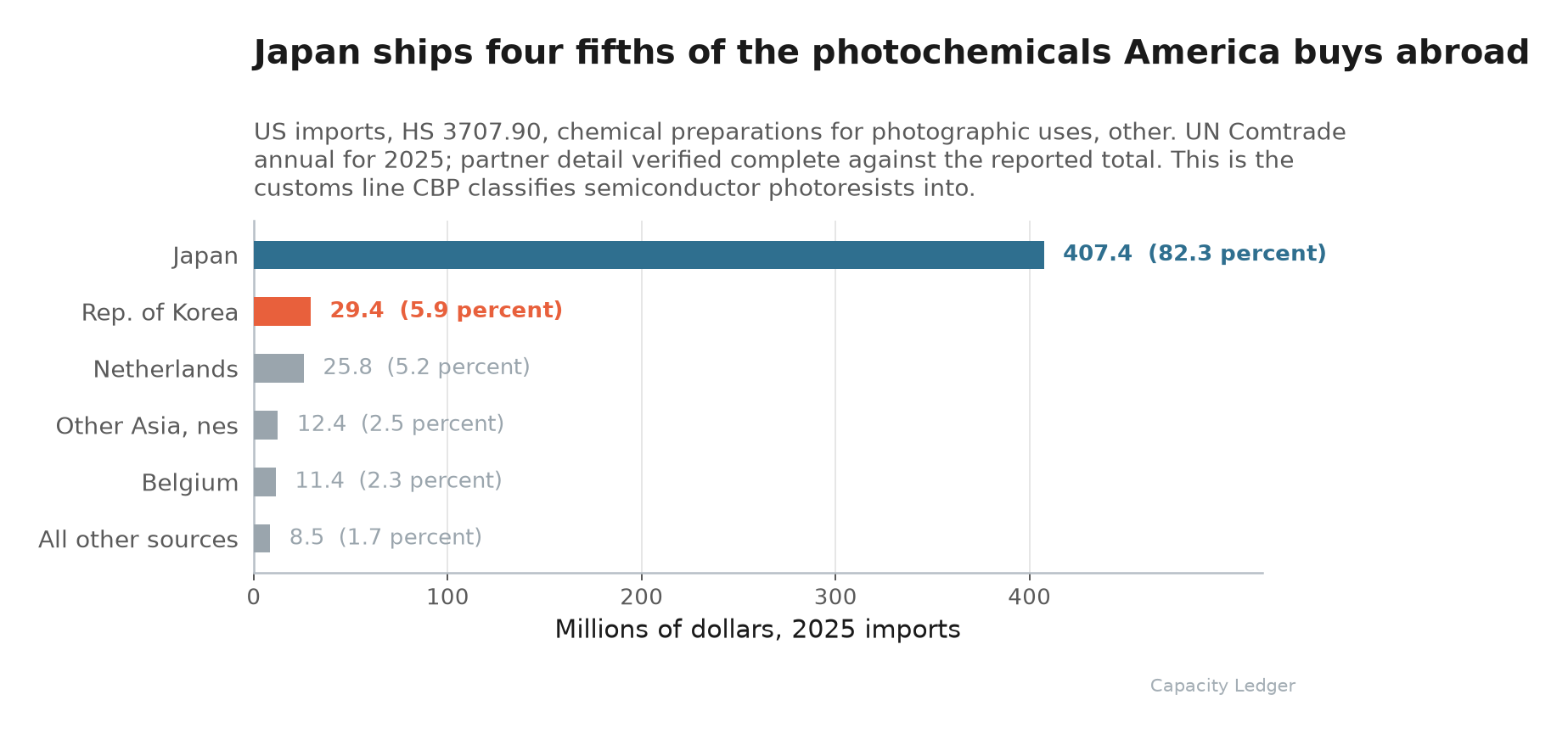
That is the normal shape of this industry, and the import data says why (chart below).
Of the $494.9 million of photographic chemical preparations the US imported in 2025 under HS 3707.90, the customs line CBP classifies photoresists into, $407.4 million came from Japan. That is 82.3%, and South Korea, second, supplied 5.9%.
Now the check worth doing before anyone calls a Texas plant import substitution. On the same line in 2025 the US exported $624.0 million, which is $129.1 million more than it bought.
In aggregate this country is a net seller of photochemicals. The gap has always sat in specific high-purity grades rather than in the tonnage.
Which is what makes the Killeen filing interesting to a buyer. The step that moved onshore is the one that sets the spec.
Final Thoughts
Dongjin was the first company in Korea to develop photoresist, and last November its KrF thick resist took a World-Class Product designation from Seoul's trade ministry on $185.9 million of export sales across 2022 to 2024. A company that spent decades localizing a material for one country's fabs is now doing the same job for another one's, in a town best known for the Army post next door.
Twenty-four thousand tonnes of acid and an unstated volume of thinner will never show up in a capacity table next to a cracker. Qualification is the unit that matters here, and qualification is slow, which is exactly why the eight-item list in a routine federal notice is worth reading.
When one of those eight lines stops saying foreign status, that is the next piece of this chain coming home.
Watch the Board's decision after October 20.
Thanks for reading.