What Else Came Out of Shell's Martinez Catalyst Plant
Shell filed a WARN notice on September 9 closing its Martinez, California catalyst plant on November 30, 64 jobs, permanent, with no press release and no statement. The county air permit says the site runs two trains of silver-based ethylene oxide catalyst and a second batch process whose product goes to Shell's own long-chain alcohol plants.
In June 2015 the Bay Area Air Quality Management District issued Shell Chemical an Authority to Construct at a small plant on Mococo Road in Martinez, California. The application was for new and replacement equipment on one of the site's two catalyst trains, and the district wrote down what it was for in plain language: to increase production capacity at that train.
The work pushed the plant's potential to emit carbon monoxide over 100 tons a year, which would have made it a Major Facility. Shell took a synthetic minor permit instead and accepted an enforceable cap.
That is how a company behaves when it expects a plant to keep running.
On September 9, Shell Catalyst & Technologies filed a WARN notice with California.
Type of action: Closure Permanent. Address: 10 Mococo Road. Employees: 64. Effective date: November 30, 2026.
There was no press release and there is no Shell statement. We could not find a single trade-press story on it.
"What actually stops being made at Martinez on November 30?"
Two Trains, One Recipe
The most detailed public description of the plant is not a Shell document. It is the district's own engineering evaluation for application 28712, the eighteen-page report that accompanied that synthetic minor permit, and it is specific in a way corporate copy never is.
"Shell Chemical LP currently operates a catalyst manufacturing plant in Martinez, CA," it opens. "The facility consists of two main batch processes: Ethylene Oxide (EO) Catalyst and RM-17."
On the EO side, the mechanism is five steps and the document walks all of them:
- Deionized water, solid silver compounds, oxalic acid and ethylenediamine are mixed into a silver slurry in vessel S-6010. A batch takes 900 to 3,600 minutes.
- Solid aluminum oxide pellets, the carrier, go into an impregnation vessel through a closed duct.
- A vacuum is pulled and the slurry is adsorbed into the pellets.
- The wet catalyst goes through a centrifuge and a vibrating-tray dryer.
- It is conveyed to blending, then packed into bulk bags, drums, or small tube packs.
Two trains, "similarly set up and operated with identical chemistries." The A-train, the one Shell paid to enlarge in 2015, takes 66.2% of the solution. The permitted maximum operating rates on the two dryers are 12,960 and 6,500 tons a year, so 19,460 tons of finished catalyst a year at the ceiling (chart below).
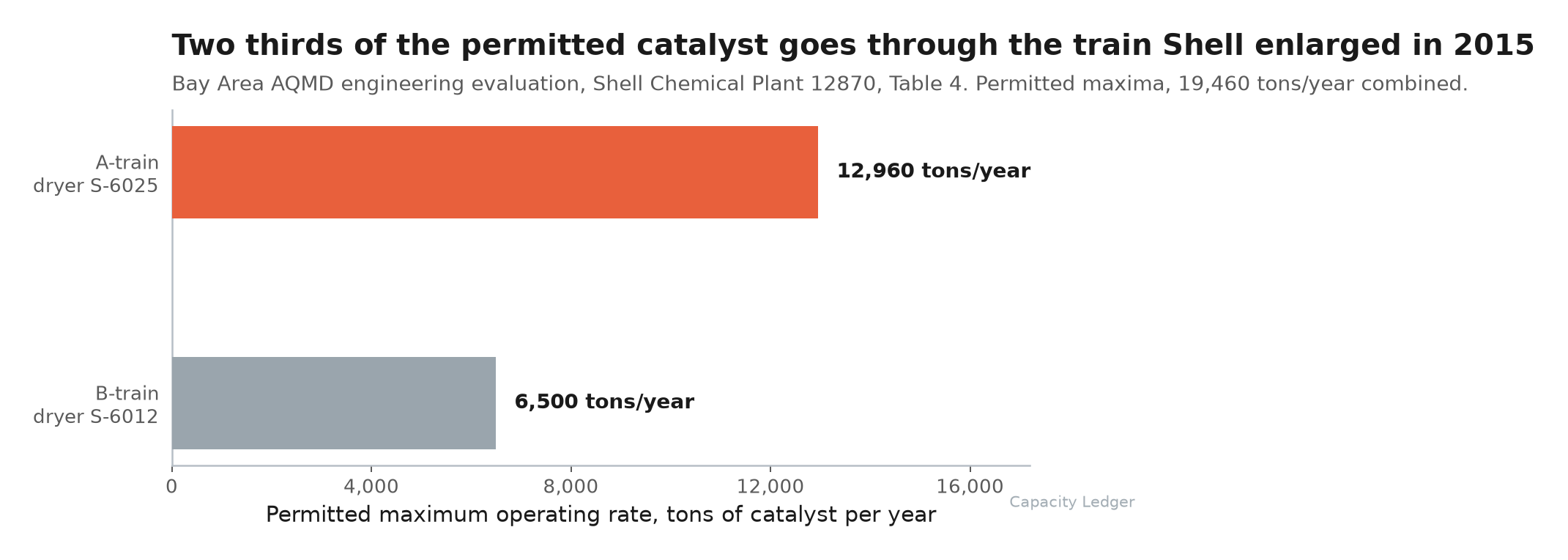
Those numbers are ceilings the district agreed to, and nobody outside Shell knows the rate the plant actually ran.
What the ceiling tells you is the size of the asset Shell asked to have permitted. Two industrial trains, nineteen thousand tons of headroom, a dedicated dryer each.

The rest of this brief is for subscribers.
The capacity math, the trade-flow read, and what it means for the products you buy.
$50 a month, or $400 a year.
Already a subscriber? Sign in