Losing Twenty-Six Thousand Tonnes Was the Good Quarter
Trinseo shut its own MMA monomer, folded German polystyrene into one Belgian plant, and then a storm took that plant out for five weeks. Company volume fell from 334 kilotonnes to 308. The segment that gave up the most volume took its adjusted EBITDA from $5m to $43m, which is the number to have in front of you at renewal.
Trinseo moved 308 kilotonnes of product in the second quarter against 334 a year earlier, and the August 6 release refuses to spread the blame around.
The decline was "entirely attributable to the closure of our virgin MMA production facilities in Italy and the force majeure at our polystyrene plant in Tessenderlo caused by operational damage from a severe storm."
One of those the company decided on. The other arrived on the weather.
They landed on the same European estate inside nine months, and the quarter they produced was the strongest the polymer business has printed in a long time.
"If shedding volume is what fixed the margin, what are you actually negotiating against at renewal?"
Two Decisions, Fourteen Months Apart
On October 6, 2025, Trinseo said it would permanently close MMA production at Rho, Italy and acetone cyanohydrin production at Porto Marghera, completed by the end of that year. Trade coverage puts Rho's monomer nameplate at roughly 90,000 t/yr; Trinseo has never published the figure itself.
The company kept PMMA at Rho, kept the depolymerization line, and said it would "source MMA feedstock from third-party producers, ensuring continuity of supply while improving overall cost to produce downstream products."
That is a producer choosing to become a buyer in its own chain. The price was $80m to $100m of pre-tax charges against roughly $20m a year of profitability and $10m a year of capex it no longer spends.
The same release opened a works council consultation on polystyrene at Schkopau, Germany. On December 5, 2025 the board approved that closure too, with European polystyrene consolidating into Tessenderlo, Belgium: $30m to $40m of charges, another $10m a year, actions running to the end of 2028.
Two sites out, one site left carrying the product.
Then the Roof Came Off the Survivor
A severe storm damaged operating equipment at Tessenderlo at the end of March. Force majeure ran from the end of March to the beginning of May, and operations were "fully restored by the end of May" (chart below).
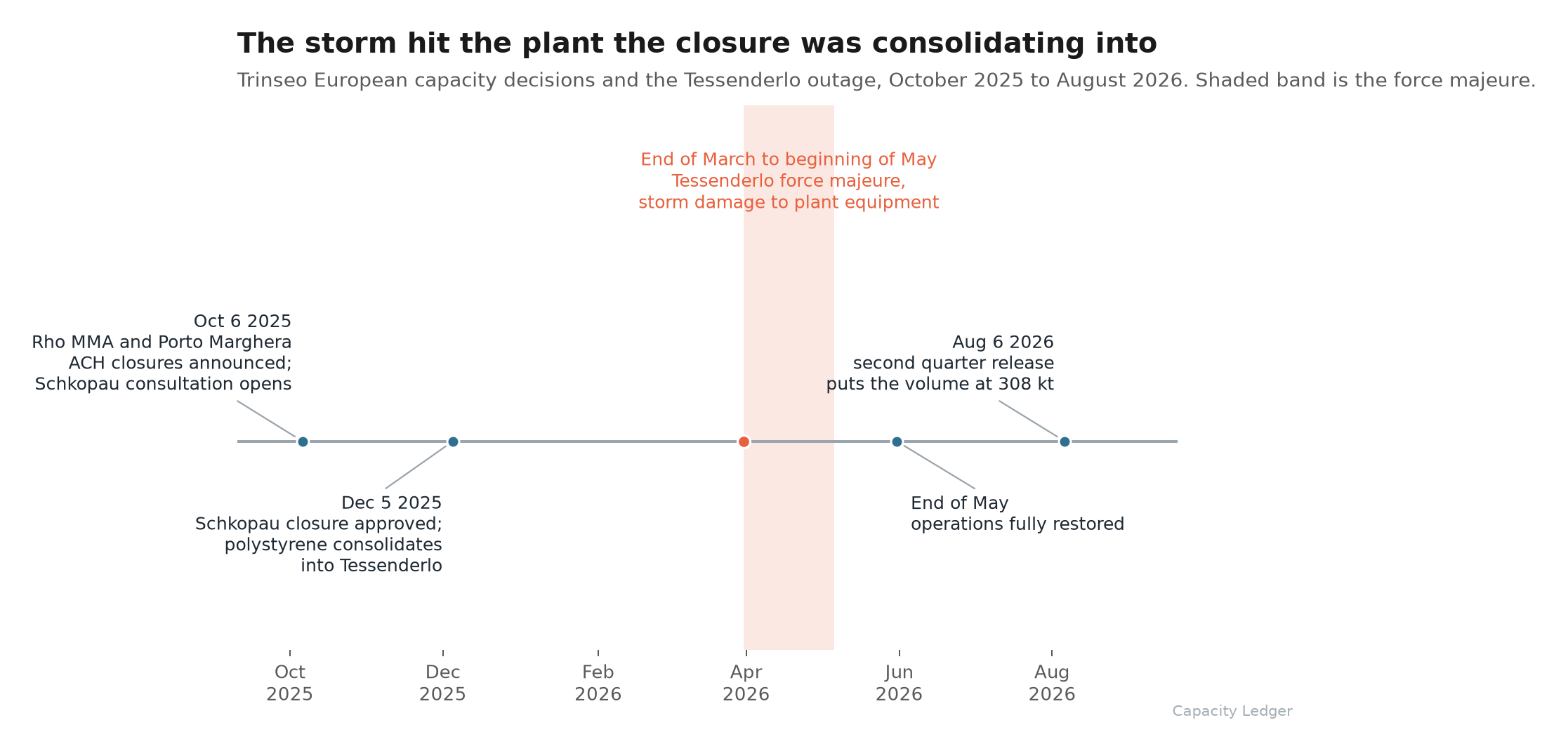
Eleven weeks separated the decision to make Tessenderlo the European polystyrene plant from the week Tessenderlo stopped being a plant at all.
Nobody planned that sequence and nobody could have. It is worth sitting with anyway, because the consolidation case that every European producer is running right now assumes the receiving site keeps running.

The rest of this brief is for subscribers.
The capacity math, the trade-flow read, and what it means for the products you buy.
$50 a month, or $400 a year.
Already a subscriber? Sign in