 Capacity Ledger
Morris Has Been Splitting Fat Since 1973
Nouryon announced its first American solar array on Thursday, at Morris, Illinois, and the release quietly sizes the plant at about 34,000 megawatt-hours a year. The five unit operations behind that number have not changed since the Energy Department walked the site in 2003.
A corporate solar announcement is usually the least informative document a chemical company publishes.
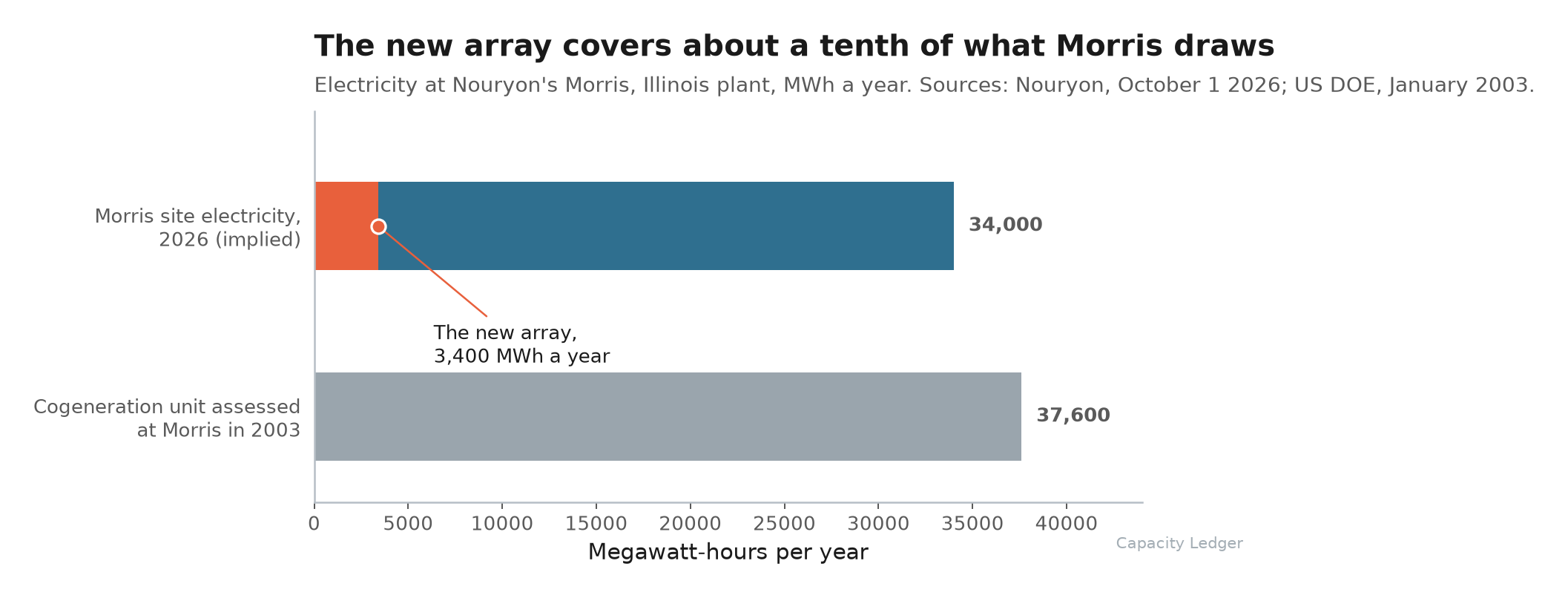
Nouryon's, dated Thursday, is an exception. The array now running at its Morris, Illinois plant will make about 3,400 megawatt-hours a year, and the company says that covers about 10% of the site's electricity.
Do the division.
That plant pulls roughly 34,000 megawatt-hours a year, and the only public figure anyone has attached to its scale in two decades arrived inside a sustainability release.
What Actually Comes Out of Morris
The release describes the output as ingredients for cleaning, personal care and crop protection. True, and useless to anyone who buys them.
The federal record is better. Morris files with EPA as Nouryon Surface Chemistry LLC, 8005 North Tabler Road, Grundy County, under NAICS 325613, surface active agent manufacturing.
And in January 2003, when the plant answered to Akzo Nobel, the Department of Energy published an assessment case study that walks the flowsheet unit by unit.
A fat splitter. A nitrile unit. Continuous and batch hydrogenation. Distillation, esterification, and quaternization.
Tallow, coconut oil and soybean oil go in at the front, with ammonia, hydrogen and methyl chloride consumed alongside them in large quantities. What comes out is primary, secondary and tertiary amines, di-amines, and quaternary ammonium chlorides.
DOE then lists where they land, and the list is the reason this site matters to you: agricultural products, personal care, detergents and fabric softeners, then food, highway paving, metal processing, mining, petroleum, paint, ink, paper, pharmaceutical, rubber and polymer processing.
Ore flotation collectors, asphalt emulsifiers, clay treatments, softener quats. If you buy a cationic surfactant in North America, some part of that chain begins in Grundy County.
The Filings Say the Units Are Still the Units
A 2003 case study is a historical document. What makes it load-bearing is that the plant's own federal reporting still matches it.
Across its TRI reporting history Morris has filed on seventeen chemicals, and the roster reads like the flowsheet:
- Ammonia and acrylonitrile, which is the amine end of the plant.
- Chloromethane and benzyl chloride, which are the quaternization agents.
- Nickel and cobalt, which are the hydrogenation catalyst metals.
For the 2024 reporting year the site submitted eight Form Rs and one Form A, and moved 9,185,525 pounds of total waste managed, up from 8,104,718 the year before.
Twenty-three years between the two documents. Same five unit operations, same chemistry, same county.
The Number Inside the Solar Release
Now the arithmetic, stated plainly so you can discount it yourself. Both inputs are the company's approximations, so 34,000 MWh is a neighborhood and not a meter reading (chart below).
Set it against what DOE costed at this plant in 2003. The assessment scoped a cogeneration unit at Morris producing 37.6 million kilowatt-hours a year, on a $5 million investment with a four-to-five-year payback.
One project, drawn up in 2003, sized larger than everything the plant draws today.
That is what a fifty-three-year-old fat-splitting site looks like from the outside: a load that barely moves, because the unit operations that set it were fixed when the plant was built. The array is Nouryon's first in the United States, after Mons, Singapore and Guangzhou, with Fort Worth, Houston and Asa, Japan named as next. The company ran 54% of its global electricity on renewables in 2025 and is working to a 40% absolute cut in Scope 1 and 2 by 2030.
The array avoids an estimated 1,152 metric tons of greenhouse gas a year, and it was built with Convergent Energy and Power.
The site manager quoted welcoming it, Brandon Sieve, is also the name in the public contact field of the plant's TRI filings. Small detail, and the kind that tells you the same people who run the reporting ran the project.
Final Thoughts
The trade press will carry this as a solar story and move on. What a buyer wants from it is the plant underneath.
A 1973 fat splitter in Morris, Illinois, still running ammonia and methyl chloride into amines and quats, still sitting at the front of the North American cationic surfactant chain, and now with a tenth of its power coming off its own ground. The solar is the news. The continuity is the finding.
Thanks for reading.