 Capacity Ledger
Seventeen Industries Reported. Chemicals Finished Last.
The ISM's August report landed Tuesday morning. Fifteen manufacturing industries grew, two contracted, and chemicals was the second of the two. July was worse: chemicals was the only industry in the country going backwards, in the strongest headline month of the year.
Seventeen manufacturing industries turned up in Tuesday morning's ISM report. Fifteen of them were growing.
Chemicals finished seventeenth.
That is two months in a row below the line, and July was the uglier one.
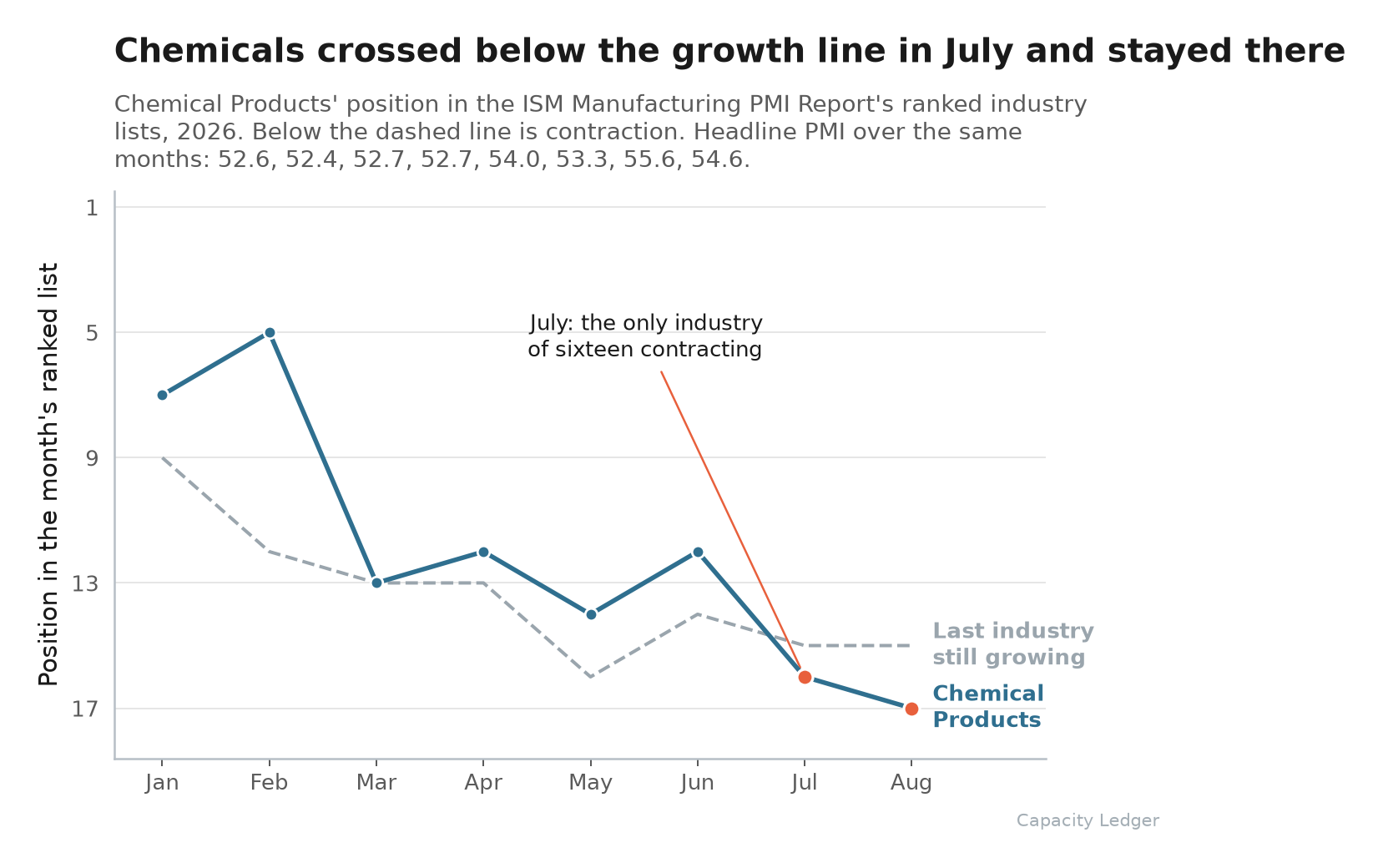
Sixteen industries reported that month, the headline Manufacturing PMI printed 55.6, the best reading of 2026, and the contraction list ran to a single entry: Chemical Products. Everything else in American manufacturing was expanding.
The walk down to that point started in February (chart below).
Twenty Percent of the GDP, One Industry
ISM weights each industry by its share of manufacturing GDP and publishes the total share that contracted. It is the most useful line in the report and almost nobody quotes it.
In June, with Paper Products, Furniture and Wood Products on the contraction list, 5 percent of manufacturing GDP was contracting.
In July, with chemicals alone on that list, it was 20 percent.
One entry, four times the weight. That is ISM's own arithmetic putting chemicals at roughly a fifth of manufacturing GDP inside this survey, which makes that one line worth more to you than the headline sitting above it.
August took it to 22 percent on chemicals plus Wood Products, and 2 percent of that sat in strong contraction, defined as a composite reading at or below 45.
That 2 percent belongs to Wood Products. Chemicals is roughly ten times the weight, and in July, when it was the only industry contracting, the report recorded no strong contraction at all.
The Plants Are Still Running
Here is the part that changes a sourcing conversation this month.
Chemicals is still on the production growth list, eleventh of the twelve industries reporting higher output in August. Output is fine. What came off is the book behind it:
- New orders: three industries reported a decline, and chemicals is one, alongside Wood Products and Food, Beverage & Tobacco. Eleven industries reported growth.
- Backlogs: four reported lower backlogs. Chemicals is on that list too, and the Backlog of Orders Index fell 3.2 points to 51.8.
- Employment: three reported a decrease. Chemicals again.
- Prices: chemicals is on the list of industries paying more for raw materials, and no industry anywhere reported paying less in August.
"If the plants are still running, what exactly is contracting?"
The order book, the backlog behind it, and the payroll. Output moves last because the feedstock is already committed and the reactor is already lit, so a plant runs through the quarter it stopped selling well.
The panel says the same thing out loud. Pricing volatility showed up in 57 percent of August's negative comments, longer lead times in 46 percent, the Iran war in 30 percent and tariffs in 29 percent.
One chemicals respondent put the year plainly: "It's an uncertain year, our second in a row."
February Was the Warning
Read the ranked lists back and the slide is six months old.
In February chemicals sat fifth of the twelve industries growing, and ISM named it among the four largest industries expanding. In March it was thirteenth of thirteen, last on the growth list while still technically growing.
April, twelfth of thirteen. May, fourteenth of sixteen. June, twelfth of fourteen.
So chemicals spent the spring pinned to the bottom of the growth list while the headline PMI climbed from 52.4 to 55.6. The July crossing was arithmetic catching up.
Final Thoughts
Everyone in the industry already knew chemicals was soft; they can read their own order entry. The useful thing in these lists is where the softness sits.
Plastics and Rubber Products grew in August. So did Petroleum and Coal Products on the feedstock side. The squeeze is landing on the middle of the chain, which is exactly where you buy.
For a buyer that means availability improves before price does. A producer with committed feedstock and a thinning backlog keeps running and sells the length into spot, so the spot market loosens first while contract numbers hold, and the window opens on the next renewal rather than this month's nomination.
It also means the announcements are coming. Falling orders with production still up is the state that precedes a curtailment decision, usually by a couple of quarters.
That is the part of this we count.
Thanks for reading.