 Capacity Ledger
The Pentane Plant With Two Capacities
South Hampton Resources has quietly turned Silsbee, Texas into roughly four times the plant it was in 2004, and its own EPA filings show the climb. The last increment of headroom was never a steel problem.
Thirty miles north of Beaumont, on 130 acres in Hardin County, a plant takes refinery feed and pulls four hydrocarbons out of it pure enough to sell by the grade: isopentane, normal pentane, isohexane, hexane.
You have handled all four without ever handling the plant.
The pentanes go into expandable polystyrene and poly-iso and urethane foams. The hexanes go into the reactors where polyethylene and polypropylene get made.
We put that address in this letter twice in the last two days and never once wrote about the plant itself. Anellotech's TCat-8 pilot unit sits inside the fence at Silsbee under a site-host agreement, and Anellotech is liquidating, so the tenant got the coverage. The landlord is the more interesting company.
"What does a plant that quadrupled inside its own fence reach for next?"
What Silsbee Actually Is
South Hampton Resources, a Texas corporation, is the specialty petrochemicals arm of Trecora Resources, which was incorporated in Delaware in 1967 and has been owned by an affiliate of Balmoral Funds since June 2022, when the buyer paid $9.81 a share and the stock came off the NYSE.
The base plant is five interconnected units making distinct products through different processes:
- a Penhex unit, the front end, permitted to process about 11,000 barrels a day of fresh feed
- a Reformer unit and a 4,000 barrel a day Advanced Reformer, which upgrade Penhex by-products and secure the site's own hydrogen
- a Cyclo-pentane unit
- an Isomerization unit
Three more proprietary production facilities on the site run toll processing for customers. Around it sit roughly 100 storage tanks holding close to 294,000 barrels, a separate 63-acre truck and rail terminal with nine rail spurs, and about 70 miles of the company's own 8-inch and 4-inch pipeline connecting the plant to gas, to the terminal, and to a third-party products system.
That is a lot of infrastructure for four molecules. It is what buying high purity actually costs.
The Plant Filed Its Own Growth Chart
Here is the part nobody publishes. Every Form R a facility files with EPA carries a production ratio in Section 8.9: this year's production over last year's, for the activity that uses the reported chemical, certified by the plant.
Chain twenty of those together and you get a throughput index for a private company that stopped filing with the SEC four years ago.
For the n-hexane forms at Silsbee, indexed to 2004, that chain runs to about 390 by 2024, with a peak near 500 in 2019 (chart below). Roughly four times the 2004 rate, and the climb came in steps rather than a slope: 1.74x in 2012, the largest single year in the series, then 1.26x in 2014 and 1.28x in 2018.
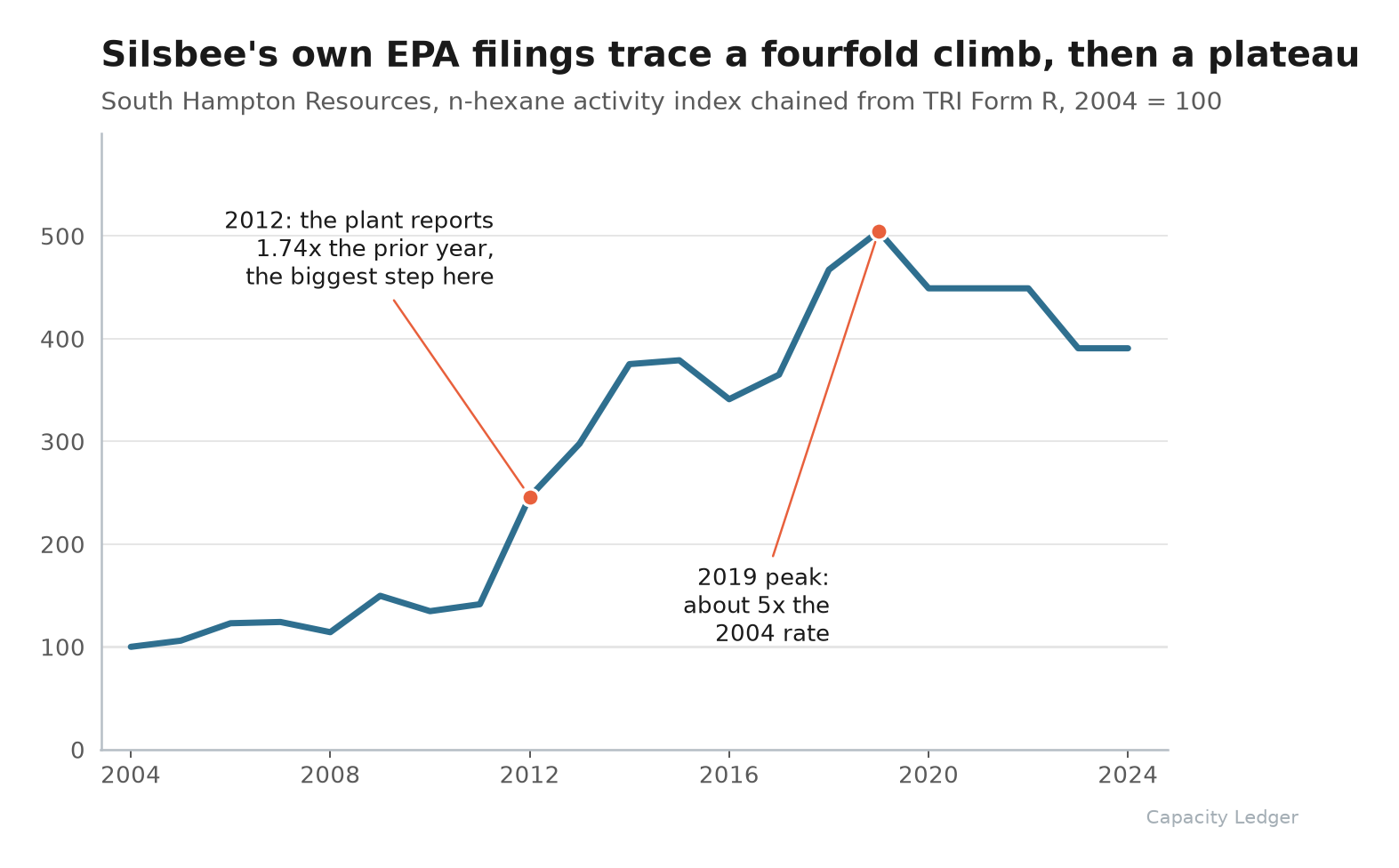
A ratio is not a tonnage, and the number covers the process using one chemical rather than the whole site, so read it as shape and not as volume.
The shape is unambiguous. This is a plant that got much bigger without moving.
Two Capacities, One Fence
Now, the line in the last annual report that a capacity file should have flagged in 2022 and did not.
"Our present total capacity at our Silsbee facility is 13,000 barrels per day of fresh feed; however, our air permits limit us to a maximum processing rate of 11,000 barrels per day."
Two capacities, and the smaller one governs. 13,000 barrels a day of installed steel, 11,000 allowed to run, which puts the site at about 85% of its own hardware before anyone spends a dollar (chart below).
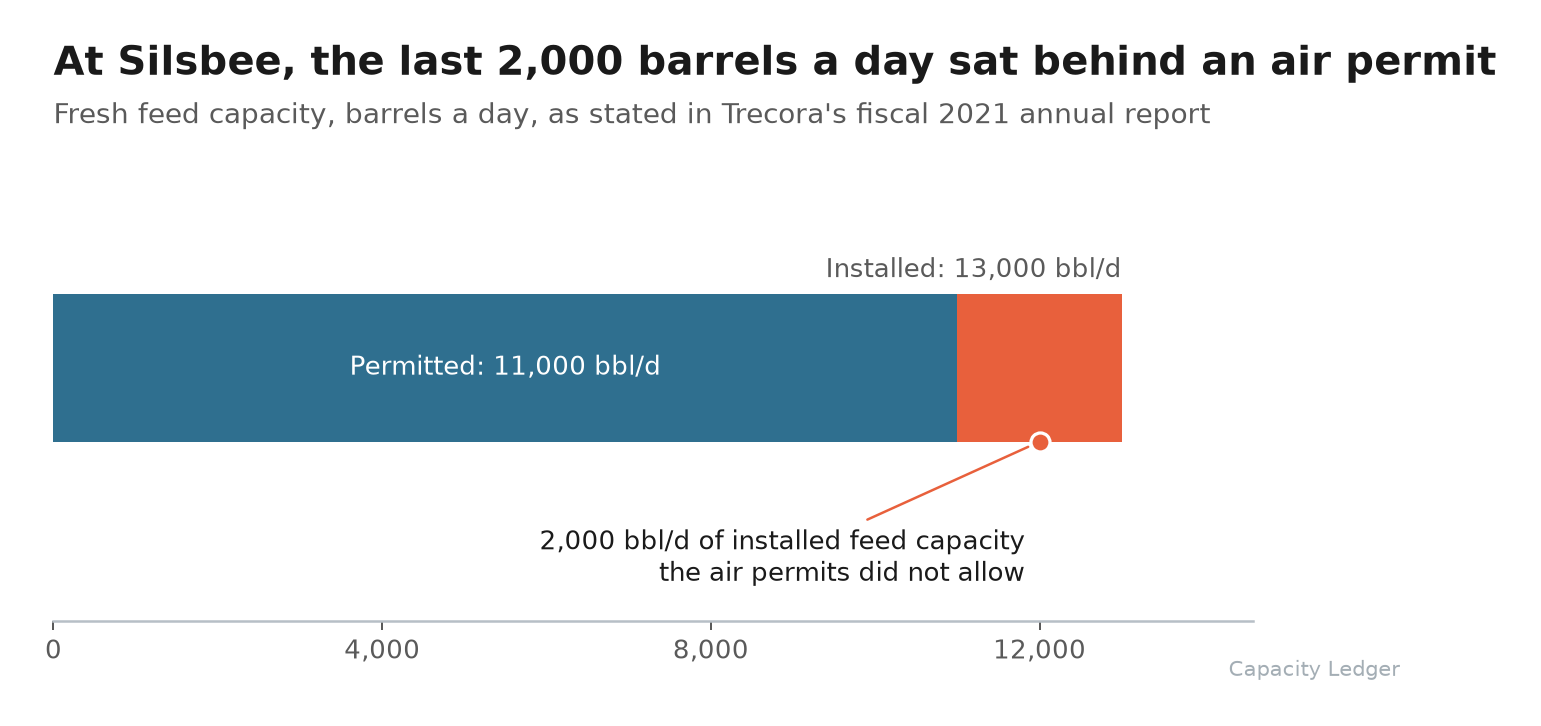
That gap is 2,000 barrels a day of the cheapest capacity in American specialty petrochemicals, because it is already built. A permit action moves it rather than a project approval, and the company told its shareholders it had "sufficient pentane capacity to maintain our share of market growth for the foreseeable future."
Where it gets interesting is what the index does after 2019. It has not made a new high. A plant that ran 1.74x in a single year stops making new highs right around the level its permit describes, which is what a paper ceiling looks like from the outside.
The usual caveat applies and applies hard here: those figures are dated to fiscal 2021, Trecora has filed nothing public since Balmoral took it private, and the TCEQ record may well have moved. If you buy pentane out of Silsbee, that permit file is worth an afternoon.
Final Thoughts
The closure file gets written because closures announce themselves. A plant that quadruples on the same 130 acres over twenty years never issues a release about it, and the only continuous record of what it did is a compliance form filed for an entirely different reason.
Silsbee is a good reminder that the capacity you cannot see is mostly capacity that grew in place. And when a plant like that finally does run out of room, the constraint that shows up first is rarely the equipment.
Thanks for reading.