 Capacity Ledger
Sixty-One Percent at the Cracker
US petrochemical producer prices rose 61% in five months. By the time that shock reached basic inorganics it was worth 4%, and the front end has already turned over while the back end is still climbing.
US petrochemical producer prices rose 61% between January and June.
Nobody closed a plant to do it.
The BLS index for petrochemical manufacturing (NAICS 325110) sat at 132.1 in January 2026, the bottom of a year-long slide, and printed 212.6 for June. The Strait of Hormuz effectively shut in March, oil-linked feedstock went with it, and the number moved.
The question worth asking is the one further down the chain.
"How much of a sixty-one percent move at the cracker ever reaches the thing I actually buy?"
Roughly a sixth of it, and where you sit relative to a barrel decides the rest (chart below).
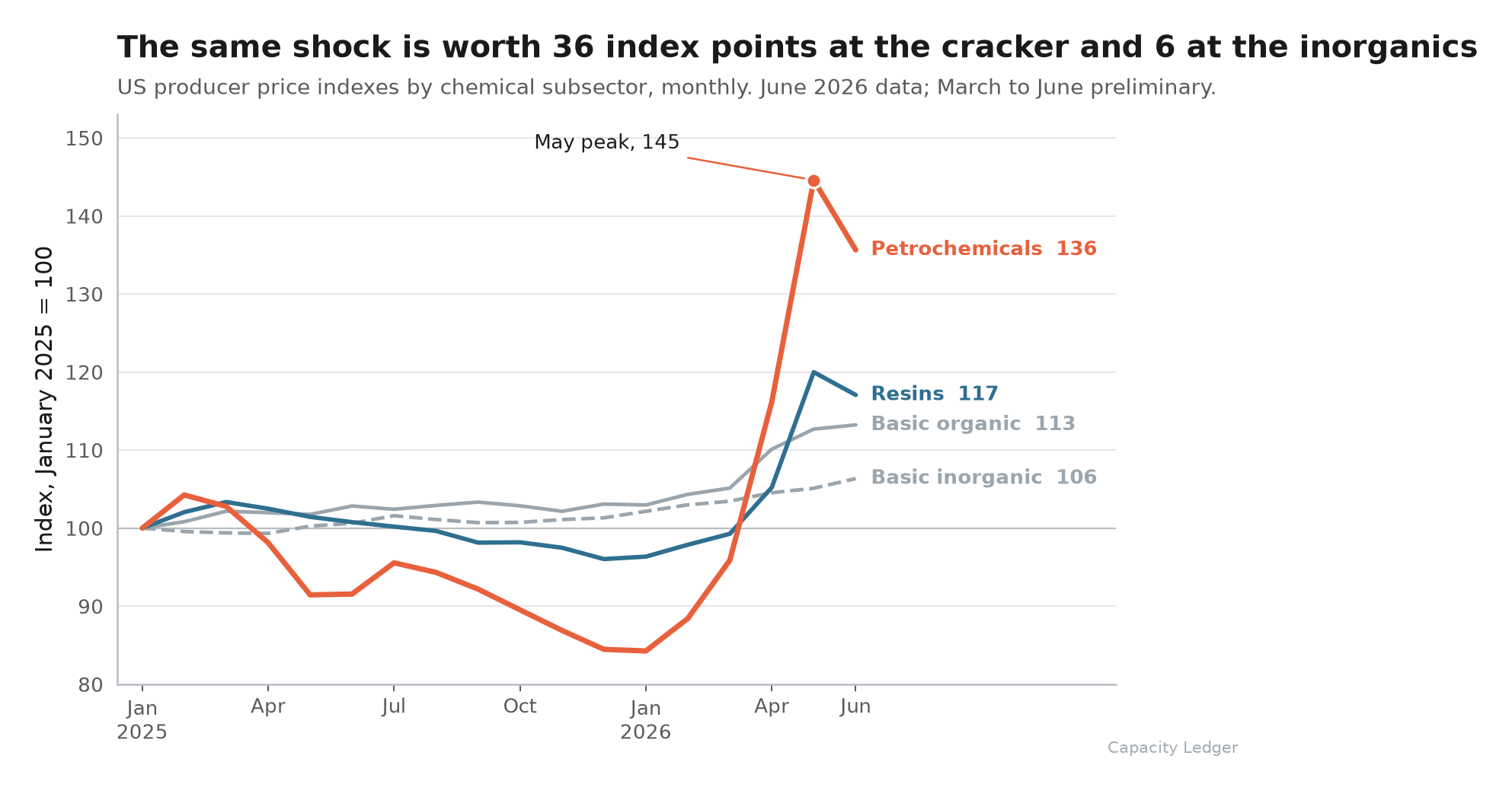
Four subsectors, one shock, four answers
Index each series to its own January 2025 value and June 2026 lands like this:
- Petrochemical manufacturing: 136
- Plastics material and resin: 117
- All other basic organic chemicals: 113
- Other basic inorganic chemicals: 106
Measured from January 2026 instead, the same four are +61.0%, +21.5%, +10.0% and +4.1%. Industrial gas manufacturing went the other way entirely, down 2.1% over the same five months.
That spread is the whole point. A feedstock event arrives as a gradient, and this one is steep.
Every step away from the cracker converts about half of what is left into somebody's conversion cost, labor, utilities, and contract structure, none of which moved in March.
The front end has already turned. The back end has not.
Look at the last two months rather than the last six, because that is where the negotiating read lives.
Petrochemicals peaked in May at 145 on the rebased scale and gave back 6.2% in June. Resins peaked in the same month and gave back 2.4%.
The two lines that moved first are the two already rolling over.
The other two are still going up.
Basic organic chemicals printed 260.6 in June, the highest value in that series since BLS started publishing it in December 2003. Basic inorganics added another 1.2% and have risen every single month of 2026.
Caustic soda is the sharpest case. The product line inside 325180 rose 4.3% in June alone, its largest one-month move since July 2022, and it is up 12.7% year to date with no peak in sight.
So the same calendar month reads as relief at one end of the chain and as a fresh increase at the other.
Why a US buyer felt this at all
The mechanical part is worth being precise about, because it explains why the gradient is this steep in North America specifically.
Most US Gulf Coast crackers run ethane, which prices off natural gas rather than off crude. When Hormuz tightened the naphtha and LPG that the rest of the world cracks, East Daley's read on March 20 was that US ethylene prices climbed while the US feedstock underneath them barely moved.
Call that what it is. Margin expansion at the cracker.
Which means the 61% in the January-to-June print is substantially a price event travelling downstream from a global marker, arriving at each US converter as a quoted number rather than as a bill they can trace to their own utility meter. It thins out fast on the way, and it thins out faster the more of your cost sits in conversion.
A few things follow for anyone renewing in the next two quarters:
- If your spend is concentrated in olefins, aromatics or commodity resin, June and probably July are moving your way. Ask for the reset now, while the seller's own index is falling.
- If you buy caustic, sulfur chemistry or specialty inorganics, your increase is still in transit. The producer quoting you a Q4 number is quoting a series that has not peaked.
- If you buy industrial gas, none of this is your story. That index is down on the year, and what moves it is power, on-site contracts and where the majors are pointing their capital.
Final Thoughts
Two years of closure announcements across US and European chemicals produced almost nothing visible in these four indexes. Five months of a disrupted shipping lane produced 61% at one end of the chain and 4% at the other.
Capacity discipline is a slow variable. It works on the shape of the curve over a cycle, and feedstock works on this month's print.
When a buyer asks the desk why a year of removed tonnes never showed up in their price, the honest answer is that removed tonnes take a cycle, and a strait takes six weeks.
None of which is settled yet. March through June are still preliminary, BLS revises four months back, and the June petrochemical figure will change.
The direction of the gradient will hold.
Thanks for reading.