 Capacity Ledger
Ten Percent Came Off Your Organic Chemicals in July
Proclamation 11012's import surcharge expired on its own terms at 12:01 in the morning on July 24, and pharmaceuticals were carved out of it where chemicals never were. August organic chemical imports came in at $2.36 billion, the biggest month since January 2024, and the monthly trade surplus in the line gave up 61 percent in four weeks.
If you buy imported intermediates, the number worth having out of Tuesday's trade release is not in the text of it.
Census and BEA published August goods and services at 8:30 on Tuesday morning. The narrative does what it always does with industrial supplies, which is name the two biggest movers and stop.
Crude oil, up $3.3bn. Nonmonetary gold, up $3.1bn.
Third on the same ranked list, and nowhere in the prose, is organic chemicals at $2,361m, up $556m on July.
That is the biggest month for US organic chemical imports since January 2024.
"What was true in August that wasn't true in July?"
One thing, and it has a timestamp on it.
The Ten Percent You Weren't Carved Out Of
Proclamation 11012, signed February 20 and published at 91 FR 9339, imposed "for a period of 150 days, a temporary import surcharge of 10 percent ad valorem" on articles imported into the United States, effective February 24. Section 122 of the Trade Act of 1974 caps that authority at 150 days and 15 percent without an Act of Congress. The proclamation took the full term at two thirds of the ceiling.
Clause 7 wrote the end date into the HTSUS itself. The modifications ran through 12:01 a.m. eastern daylight time on July 24, 2026, and they expired there.
Paragraph 14 carries thirteen lettered exceptions, and three of them decide whether this was your problem:
- (f) pharmaceuticals and pharmaceutical ingredients. Out entirely.
- (k) anything already under a section 232 action. Out.
- (l) goods of Canada or Mexico entered free of duty under general note 11. Out.
There is no chemicals exception anywhere in the list. So a non-USMCA organic intermediate entering between February 24 and July 24 carried 10 percent on top of its column 1 rate and whatever AD/CVD deposit it already owed, reported under HTSUS 9903.03.01 per CBP's implementing guidance. Worth knowing if you were one of them: that guidance also says drawback is available on the additional duties.
Here's the catch, and it changed nothing about what you paid. The Court of International Trade held the proclamation unlawful on May 7 and enjoined the surcharge for three importers, the State of Washington, Burlap and Barrel and Basic Fun, dismissing every other plaintiff for lack of standing.
Everyone else kept paying it until the clock ran out.
The Month the Clock Ran Out
August is the first full month on the far side of July 24, and the import line turned in it (chart below).
Imports $2,361m, up 30.8% on July. Exports $2,797m, down $114m.
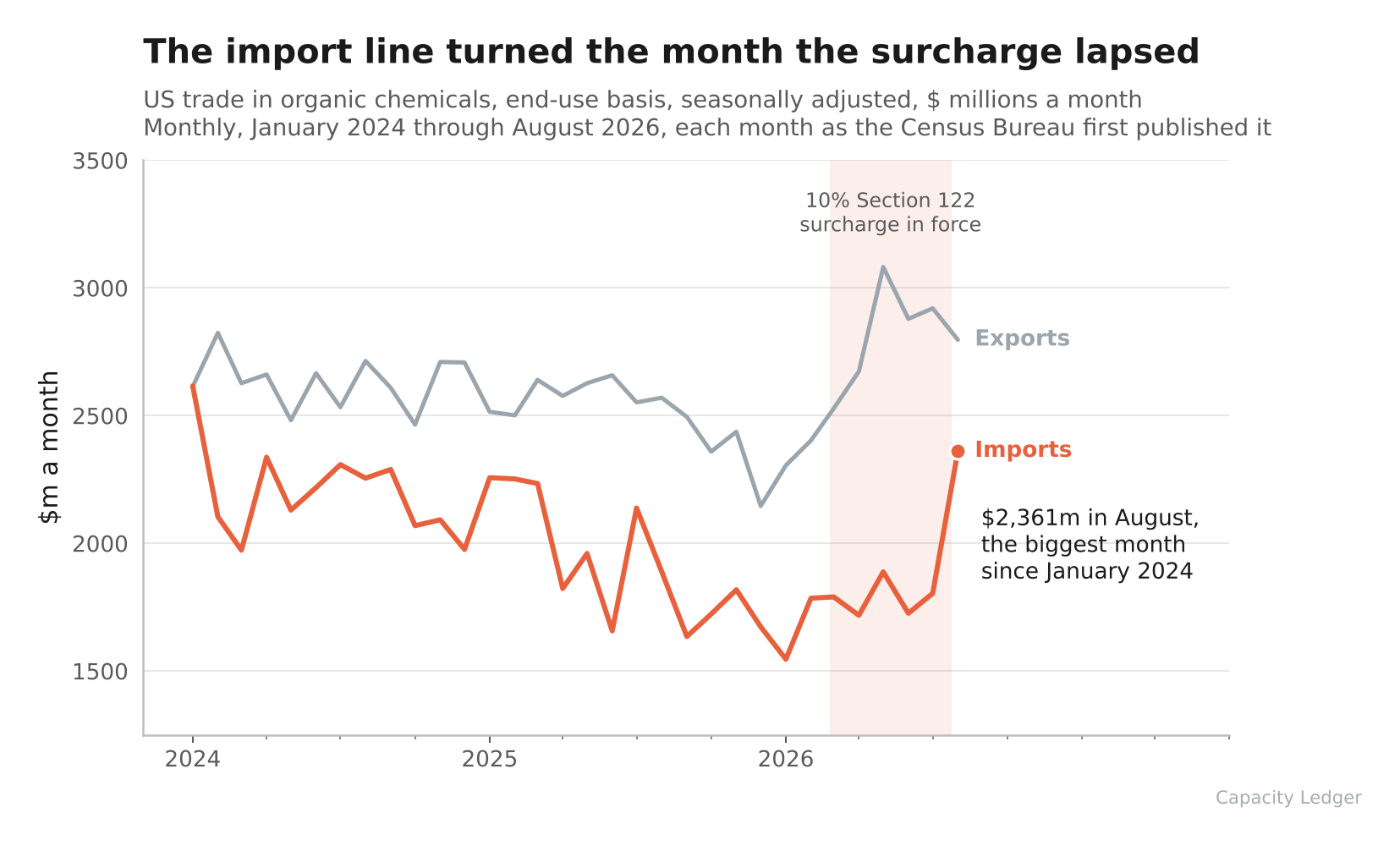
Run those two together and the monthly trade surplus in organic chemicals goes from $1,116m in July to $436m in August. Four weeks, 61 percent of it gone, and the smallest monthly surplus in the line since July 2025.
The last time imports printed this high was January 2024, when the United States ran a $2m deficit in organic chemicals. That is where the chart starts, and the line had not been back until Tuesday.
It Isn't One Line Doing This
Every chemical line on the import side of Exhibit 8 rose in August:
- Organic chemicals, +$556m
- Other chemicals, +$189m
- Fertilizers, pesticides and insecticides, +$177m
- Plastic materials, +$76m
- Inorganic chemicals, +$61m
$1,059m across the five. Going back through the monthly releases to January 2023, all five have risen together three times: January 2024, March 2026, and now. August is the largest of the three.
A move that lands on five differently sourced chemical lines in the same month is hard to pin on any one chain.
What It Does to Your Year
Eight months in, the direction is still the other way.
Organic chemical imports are $14,579m January through August against $16,596m last year, down 12.2%, while exports are up 4.2%. The surplus for the period runs $7,024m against $4,128m.
Across all five chemical lines the balance improved $6,171m year to date, and $3,320m of that, 54%, is imports that did not arrive rather than exports that did.
That is the part worth taking into a negotiation. The domestic tightness you have been quoting against since February was partly a customs condition, and the customs condition ended on a date somebody wrote down in February.
Two honest limits. The end-use detail in this release is dollars, so nothing here splits August into price and volume. And it is one month: September publishes on November 4, and that is the print that says whether this was a catch-up on entries held back through July or a new run rate.
Final Thoughts
Temporary trade measures leave a mark on the data long after the legal instrument stops existing, and the mark is usually mistaken for something about the industry. Five months of suppressed imports reads like structural tightness when you are inside it. It reads like a 150-day clock when you put the dates side by side.
The clock part is over. Whether the tightness was ever anything else is a question the November print starts answering, and the one after that finishes.
Thanks for reading.