 Capacity Ledger
The Bromine Was Already in the Salt Pans
GHCL started commercial production of liquid bromine at Rajula on October 12, nine days after the monsoon cleared Gujarat. The nameplate is 2,800 tonnes, which is 40% of everything USGS credits India with producing and a quarter of what the country imported last year. The unit sits on salt works the company already owned.
Seawater runs about 65 parts per million bromine. USGS prints that number in the same chapter every year, and it is the same everywhere there is an ocean.
So who makes bromine was never a question about who has seawater.
On October 12 GHCL Limited sent four paragraphs to the Bombay and National exchanges. Commercial production of a new product had commenced at 122/1/k/paiki Village Kathivadar, Taluka Rajula, District Amreli, Gujarat.
Product name as filed: Liquid Bromine (Br2). Annual capacity: 2,800 MT.
That is a routine Regulation 30 intimation, the kind a company secretary signs in the afternoon and nobody reads.
Set it against the row USGS keeps for India and it stops being routine.
Forty Percent of a National Number
The USGS bromine chapter credits India with 7,000 tonnes of production in 2024 and 7,000 again in its 2025 estimate. The row did not move.
Against that, GHCL's single new unit is 40% of everything the United States Geological Survey believes India makes.
The import side is bigger and more concentrated. India brought in 10,848.8 tonnes under HS 2801.30 in 2025, and 93.0% of it came from two countries (chart below).
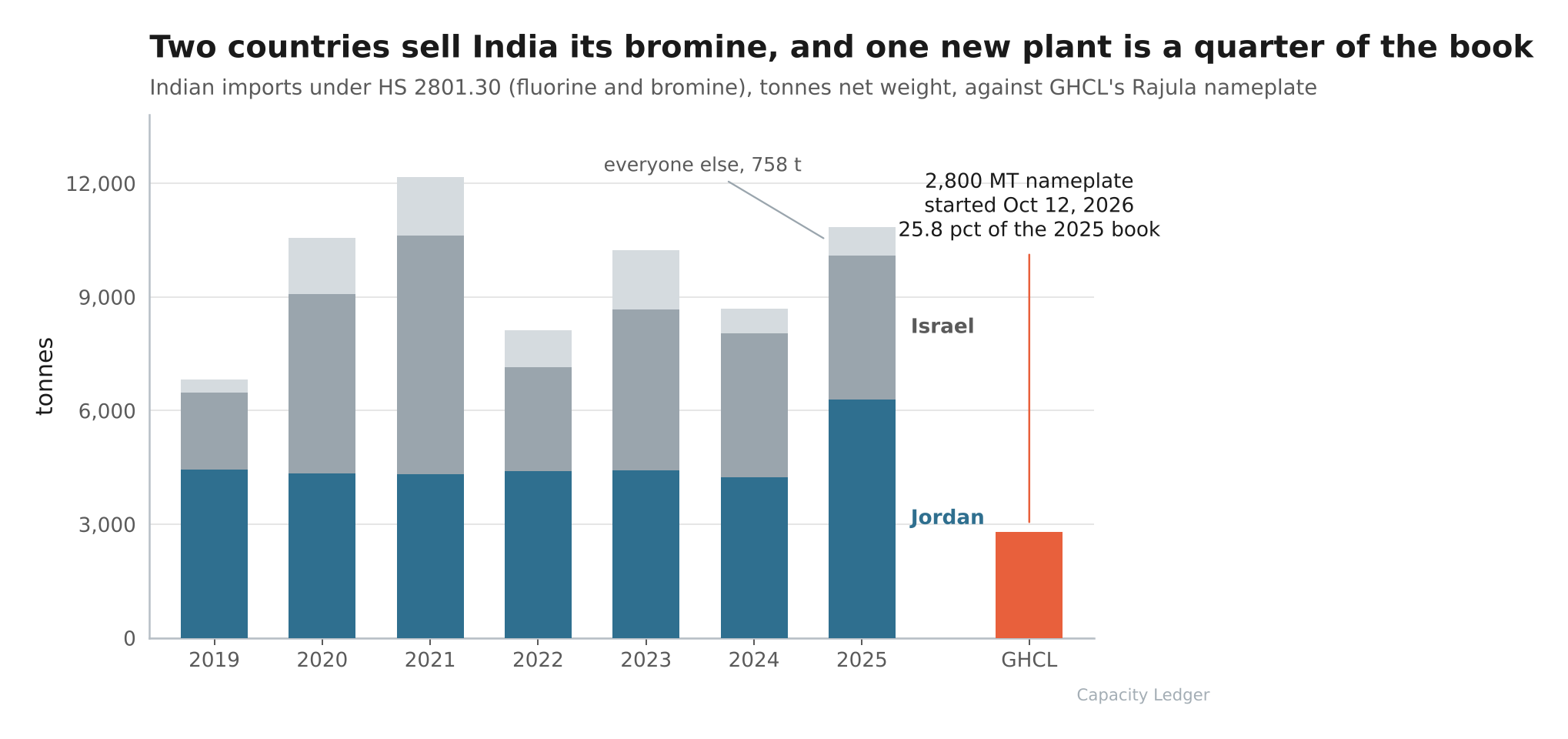
Jordan sold India 6,282.0 tonnes last year, its largest in the seven years we pulled and 48% above its own 2024. Israel sold 3,808.4.
Everyone else on the line together managed 758.4 tonnes, all of it American.
A caveat the customs file forces: 2801.30 is the heading for fluorine and bromine, two elements in one code.
The origins are the world's two largest bromine producers, the 2025 unit value works out to $2,658 a tonne, and elemental fluorine does not move in thousand-tonne lots. Read it as bromine.
Against a book that shape, 2,800 tonnes of domestic nameplate is 25.8%.
The Plant Was Mostly Already There
Here is the part a sourcing manager should like. GHCL's own investor deck from August describes the project in nine words:
"Capacity of 2,800 MT at existing salt works."
GHCL is a soda ash company. Soda ash, sodium bicarbonate, industrial and edible salt, a consumer brand called I-Flo.
Nothing about that portfolio says halogen chemistry.
What it does say is that the company already ran solar evaporation at coastal scale, and that is the whole trick. USGS puts the route in one sentence: bromine "is recovered from seawater as a coproduct during evaporation to produce salt."
The salt works had been concentrating the liquor for years. The bromine was sitting in it.
So the capital went to the back end rather than the front:
- The feedstock needed no new source, no new permit for a new intake, and no third party.
- The evaporation train, the land and the water handling were already built and already paid for.
- The company's stated FY27 capital plan, across this project, the vacuum salt plant and ordinary factory spend together, is INR 140 to 150 crore. Managing Director R. S. Jalan gave that figure on the August 3 call.
- The deck's target for the unit is a 40%-plus EBITDA margin.
The same program put a 1.7 lakh MT vacuum salt plant into commercial production at Sutrapada, running on surplus energy from the soda ash works next door. Two commissionings off one brine base in six weeks.
Why It Started in October and Not in July
The Managing Director told the August call something that reads like a throwaway and is not:
"In the case of bromine, output in any case, seasonally lower than through the monsoon months."
A plant whose feedstock is concentrated by sunlight has a weather calendar, and in Saurashtra that calendar has one entry. On October 2 the India Meteorological Department still had the southwest monsoon withdrawal line running through Deesa and Naliya, both in Gujarat. By the October 3 bulletin the line had jumped east to Supaul, Ranchi and Raipur, with no Gujarat station left on it. The monsoon was off the state. IMD declared it gone from the entire country on October 15.
GHCL's commercial production date is October 12.
We would not call that a coincidence, and we would not call it a stunt either. It is what a start date looks like when the process engineer, not the press office, picks it.
Final Thoughts
Two months back we wrote about USGS quietly restating Israel's 2024 bromine output from 140,000 tonnes to 190,000, and about the 83% of US bromine imports that one country supplied over 2021 to 2024. The honest conclusion then was that nobody outside the producers can compute the concentration number properly.
This is the other side of that ledger, and it is a far smaller entry. 2,800 tonnes against a world total USGS rounds to 430,000 moves nothing at all in flame retardants or clear brine fluids.
India's row goes from 7,000 to something under 10,000 and stays a rounding error next to the Dead Sea.
What it moves is the count of places the molecule comes from, and that count has been falling for a decade in almost every chain this desk follows.
A soda ash producer looked at a liquor stream it had been running past for years, found a halogen in it, and built the back end to take it out. Every chain should be so lucky in its incumbents.
Thanks for reading.