The Five Quarters Celanese Just Bought
A First Amendment filed this afternoon pushes the leverage covenant on Celanese's $1.75bn revolver out five quarters and lifts the terminal level from 3.5x to 4.0x. The same filing day carried a finished nylon 6,6 optimization, a closed Korean compounding plant, and a Belgian tow site still on its way out.
Celanese filed two 8-Ks this afternoon. One carried the quarter everyone was waiting for.
The other carried a table.
The table is Section 7.07(b) of the revolving credit agreement, and it sets the maximum leverage the company may carry at the close of every fiscal quarter between now and the end of the decade. On July 31 the lender group rewrote it, and the rewrite showed up in an 8-K a few hours before the results (chart below).
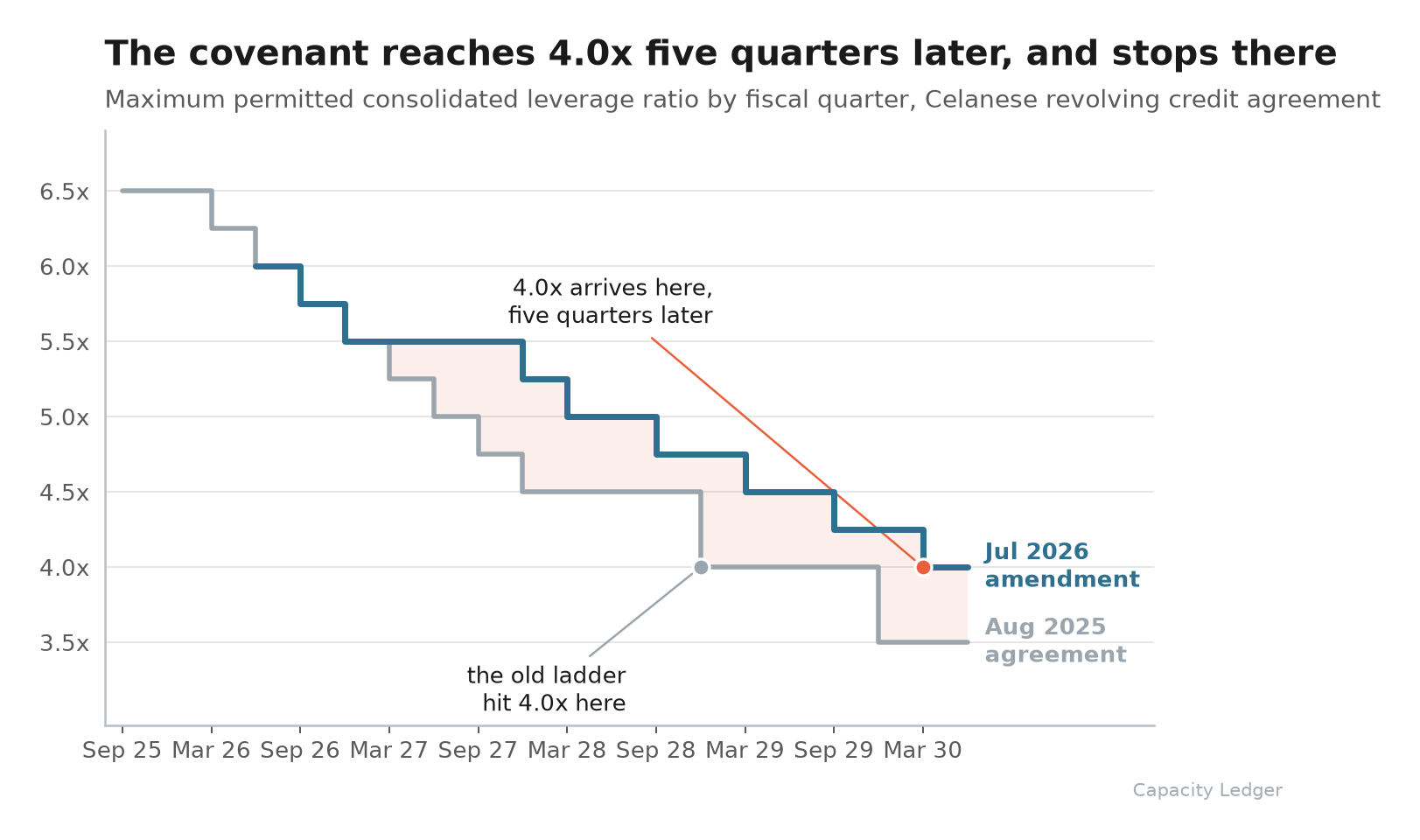
Nothing changes this year. The June, September and December 2026 rungs are identical in both documents at 6.00x, 5.75x and 5.50x.
The two ladders separate at the quarter ending March 31 2027, and they never come back together.
"What does a lender group understand about a producer's next four years of plant decisions that its customers do not?"
What the ladder actually says
The August 2025 agreement, a five-year $1.75bn unsecured revolver arranged through Bank of America, wrote a steady descent: 5.25x at the first quarter of 2027, 4.50x by that December, 4.00x by the end of 2028, and a terminal 3.50x from December 2029 onward.
The amendment holds the covenant flat at 5.50x through all of 2027 before it starts stepping down again. The widest single gap is 0.75 turns, and it appears four separate times. The floor stops at 4.00x, first reached in March 2030 rather than December 2028, so the schedule now arrives five fiscal quarters late and never touches 3.50x at all.
There is a second change worth reading. The combined baskets for debt raised by foreign subsidiaries against acquisitions, and by Chinese subsidiaries for corporate purposes, went from $900m to $1,050m in the same document.
Headroom is not a plan. It is still a direction.

The rest of this brief is for subscribers.
The capacity math, the trade-flow read, and what it means for the products you buy.
$50 a month, or $400 a year.
Already a subscriber? Sign in