The Mine Comes Back Before the Plant Does
Tronox spent eighteen months taking pigment capacity out. On Wednesday it restarted a smelting furnace instead, and told the market that TiO2 prices go up again in the third quarter. The 136,000 tonnes of pigment are not coming back with the furnace, and nothing in the capacity tables will ever show that the furnace left.
On March 6, 2025, the chlorine supplier to Tronox's Botlek plant went down and took the plant with it.
Eleven days later Tronox told the Dutch works council that Botlek would not be coming back. 90,000 t/yr of chloride pigment, 240 people, and an outage that quietly became a closure.
In January of this year Fuzhou followed: 46,000 t/yr of sulfate pigment in Jiangxi, 550 people, killed by sulfur costs and Chinese oversupply.
So when the world's largest integrated TiO2 producer finally turned something back on, the question worth asking was which end of the chain it picked.
"After eighteen months of taking capacity out, what does a producer restart first?"
Not a pigment line. A furnace.
What actually came back
Tronox released the second quarter after Wednesday's close. Buried in the CEO's closing paragraph, past the free cash flow and the leverage ratio, is the only capacity sentence in the document:
"we are making targeted operating decisions to support future demand and product availability, including the restart of a furnace and advancing plans to bring production back online at our West Mine, both at Namakwa, to support inventory levels, including zircon, to meet demand."
Namakwa Sands sits on the west coast of South Africa: the mine in two pits, two concentration plants, a mineral separation plant, and two electric arc furnaces that smelt ilmenite into titanium slag and high-purity pig iron. One of those furnaces went dark during 2025, alongside Botlek and Fuzhou, in the same paragraph of the same annual report, under the same heading about managing near-term cash flow.
Three months ago John Romano said on the first-quarter call that "the west mine and one furnace in Namakwa as well as our Wonnerup in Australia remained idled." He also said, in the same hour, that "we've got more orders on our order book than we can fill."
That is the whole story of this quarter in two sentences from the same man.
Now notice which lever moved. Zircon is the pull here, and zircon is not something you make. It comes out of the mineral separation plant alongside the rutile, the leucoxene and the ilmenite, which is to say it comes out of the ground with everything else or it doesn't come out at all. Namakwa produced 85,308 tonnes of zircon last year, 41% of the group total, and zircon volumes ran 61% above prior year in the second quarter.
So the sequence goes: zircon demand pulls the West Mine, the West Mine pulls heavy mineral concentrate, the concentrate arrives with ilmenite attached, and the ilmenite needs a furnace. Restart the mine and you have restarted the smelter whether or not slag was the point.
Pigment sits downstream of all of it and did not move.
The 136,000 tonnes that aren't coming with it
Here is the part that matters for anyone keeping a capacity file.
Tronox's FY2024 10-K lists nine pigment plants and 1,078,000 t/yr of nameplate. The FY2025 10-K lists seven and 942,000 t/yr (chart below).
Two named sites, two published tonnages, 12.6% of the table, gone in ten months and gone on the record.
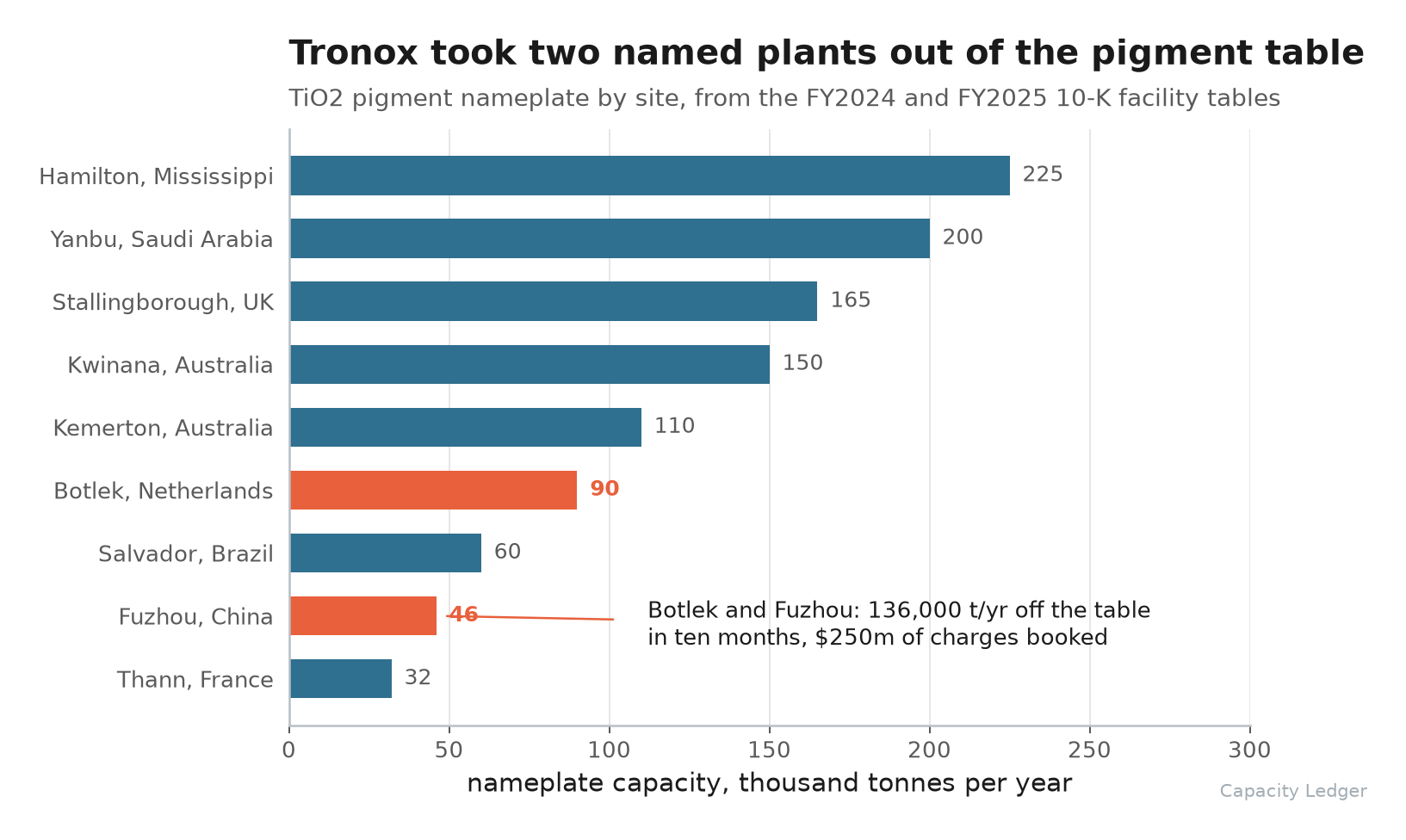
The company booked $184m of restructuring and other charges against Botlek and $66m against Fuzhou, both plans complete as of June 30. Run that through the dollars-per-annual-tonne screen we built on the addition side last week and the removal side prices at roughly $1,838 per annual tonne taken out. Closing capacity is not free and Tronox has now paid a quarter of a billion dollars for the privilege.
Now hold that against the feedstock disclosure. Both 10-Ks, the one with nine pigment plants and the one with seven, carry the identical sentence:
"Our current mining and beneficiation operations have an annual production capacity of approximately 832,000 metric tons ('MT') of titanium feedstock, which is comprised of 182,000 MT of rutile and leucoxene, 240,000 MT of synthetic rutile and 410,000 MT of titanium slag."
Word for word. Unchanged.
A furnace inside that 410,000 tonnes of slag capacity went off for most of a year and came back this quarter, and the number never twitched in either direction. Nameplate does not know the difference between a furnace that is running and a furnace that is banked.
That asymmetry is why a closure file is worth keeping by hand. Closures announce themselves, arrive with a tonnage and a press release, and print in the next 10-K; idlings arrive in a subordinate clause of a CEO quote and leave the same way.

The rest of this brief is for subscribers.
The capacity math, the trade-flow read, and what it means for the products you buy.
$50 a month, or $400 a year.
Already a subscriber? Sign in