 Capacity Ledger
The New API Capacity Is Sixteen Years Old
America makes 15% of its own patented active ingredient by volume, and the 100% duty on the rest started biting on July 31. One of the world's largest contract API sites is a Lafayette, Indiana plant Evonik bought from Eli Lilly on New Year's Day 2010, and it just took another $100 million into reactors that are already standing.
On the first day of 2010, Eli Lilly closed the sale of its Tippecanoe Laboratories site in Lafayette, Indiana. Roughly 650 people went to work the next morning for a new owner.
Evonik didn't disclose the price. What it said was that the plant "significantly strengthens its exclusive synthesis business in the US and offers scope for further long-term growth", which is the line every acquisition release carries and which means nothing until somebody spends money on it.
On July 8 somebody spent $100 million.
"What does a 100% duty on imported active ingredient do to a country that makes 15% of its own?"
Capacity Measured in Cubic Metres
Here is the part a specialty chemicals reader will appreciate immediately. Evonik publishes the site's capacity, and it publishes it in a unit that means something.
Tippecanoe carries 170 m³ of dedicated high-potency reactor capacity, 860 m³ of general API reactors and 2,500 m³ of large-scale fermentation. The high-potency pool is the one Evonik calls the industry's biggest, and it is under a twentieth of the volume standing on the ground (chart below).
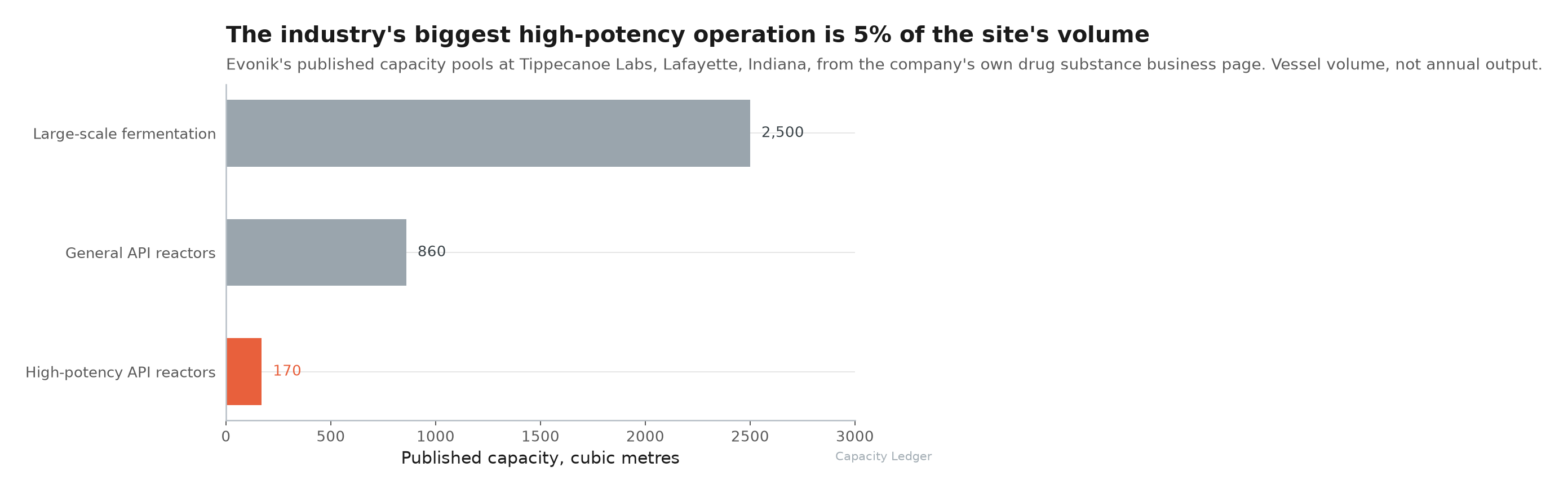
The rest of the site sheet is just as specific: five small-molecule plants, three of them for high-potency work, single vessels up to 7,600 litres, and containment rated to an occupational exposure limit of 0.1 µg/m³ at large scale and 5 ng/m³ at small scale. Ten technology platforms. More than 650 employees, plus the contractors who run maintenance, logistics, catering and security.
We spend a lot of time on this desk complaining that the addition column arrives as a press release with a dollar figure and no tonnage. Here is a site that published its volumes before anyone asked, and then told you where the capital lands: the 100 m³ reactors, for reliability, automation and energy efficiency, over five years.
Fifteen Percent
Now, the reason any of this is time-sensitive.
The Commerce investigation behind the April 2 proclamation found that roughly 53% of the patented pharmaceutical product distributed in the United States is made outside it. On the ingredient itself the number is worse: only 15% of patented APIs by volume are produced domestically for the US market.
The proclamation puts a 100% ad valorem duty on patented pharmaceuticals and pharmaceutical ingredients, and key starting materials are named in scope. The clock has two hands:
- July 31, 2026 for the companies listed in Annex III, which is already behind us.
- September 29, 2026 for everyone else.
- 20% instead of 100% for a company with an approved onshoring plan, escalating back to 100% on April 2, 2030.
- 0% through January 20, 2029 for a company that also signs an MFN pricing agreement.
Generics and biosimilars sit outside it, as do orphan drugs, cell and gene therapies, antibody drug conjugates and a short list of others.
So the industry did what an industry does when a duty that size lands on a molecule it imports. Announced US reshoring commitments now run past $480 billion across 22 sites and something like 44,000 jobs, by the running tally the trade press keeps. Lilly's own new API plant is going up in the same state, at Lebanon, Indiana, where the company raised its investment to $9 billion and added $4.5 billion more this May, on a site that opens in 2027.
Here's the catch, and it is the one every process chemist already knows.
Lilly announced the Lebanon district in 2022 and the API plant opens in 2027, five years later, and that is a well-capitalised owner building for its own molecules. Every one of those 22 announced sites still has its own qualification, process validation and regulatory filings ahead of it.
Reactor volume that is already installed, already inspected and already running other people's molecules is on a different clock entirely.
That is what $100 million into existing 100 m³ reactors buys, and it is why the number is small next to the headlines.
The Second Build on the Same Ground
This is also not the first time Evonik has pointed capital at Lafayette.
In March 2023 it broke ground on a $220 million Lipid Innovation Center on the grounds of Tippecanoe itself, for the pharmaceutical specialty lipids that RNA therapeutics need, with up to $150 million of it funded through BARDA. More than 80 skilled roles, and roughly 300 contractor positions across the project.
One site, an API estate and a lipid plant, an ingredient and the thing that delivers it. Evonik's Health Care business line put it as "creating a more resilient and globally balanced asset footprint", and the segment the site reports into grew adjusted EBITDA 7% to EUR 271m in the second quarter.
Final Thoughts
Two sets of numbers ran side by side this summer.
One is a tally of announcements in the tens of billions, with ribbon-cuttings attached to years ending in 7, 8 and 9. The other is 3,530 cubic metres of vessel volume in Indiana that has been making active ingredient continuously since before either the duty or the announcements existed.
Only one of them can take an order this quarter.
If you buy intermediates, or you tender tolling work, the useful question to put to a US site right now is how much volume is already installed, what condition it is in, and what it costs to bring back to spec. Evonik answered the first part in public and priced the third at a hundred million dollars over five years.
Thanks for reading.