 Capacity Ledger
The Molecule DOE Picked in 2004 Finally Has a Plant
In August 2004 a DOE screening report named 2,5-furandicarboxylic acid one of twelve building blocks worth making from sugar, and said the barriers were selective sugar dehydration and an industrially viable oxidation step. Avantium finished commissioning the last unit at Delfzijl on September 7, so both of those barriers are now running equipment. The interesting number is where the contracted volume sits.
In August 2004, staff at PNNL and NREL handed the Department of Energy's Office of the Biomass Program a screening exercise. Out of everything you could build from sugar, which twelve building blocks were worth the money?
2,5-furandicarboxylic acid landed at section 9.2, second on the list behind the four-carbon diacids.
The report was unusually plain about why FDCA was not already a business:
"The primary technical barriers to production and use of FDCA include development of effective and selective dehydration processes for sugars."
And in the same paragraph, the second half of the problem: FDCA formation "will require development of cost effective and industrially viable oxidation technology that can operate in concert with the necessary dehydration processes."
Two things, in a specific order. Dehydrate sugar selectively, then oxidize what comes out, cheaply enough to matter.
On September 7, Avantium announced it had completed commissioning of the purification unit at its FDCA Flagship Plant in Delfzijl. With that, every major process unit at the plant has been commissioned.
The units went into service in this order: utilities and tank farm, sugar dehydration, oxidation, purification.
DOE named two barriers. Those are now two running units, in the same sequence.
Which leaves the question a buyer actually has:
"So who gets FDCA, and when?"
The Plant Is Small, and That Was Always the Plan
The Flagship Plant sits at Chemie Park Delfzijl, construction finished in October 2024, and it is designed to make up to 5 kilotonnes of FDCA a year.
Avantium has described it as the world's first commercial-scale FDCA plant since its December 2021 investment decision, and the description has gone publicly uncontested since.
The sugar dehydration unit is the largest piece of it. Its job is to convert plant sugars into methoxymethyl furfural, the intermediate the oxidation step then works on.
Worth knowing if you are mapping the chain: Avantium does not polymerize its own output. The FDCA goes to tolling partner Selenis, which combines it with bio-based MEG to make PEF.
The start-up ran late, and the company said why. Construction-related titanium welding issues in the piping were resolved in April 2026, at roughly EUR 7 million of additional capital expenditure and a lot of extra commissioning work.
That is the ordinary tax on a first-of-a-kind, and it now sits behind the plant rather than in front of it.
Twenty-Two Contracts on Five Kilotonnes
Avantium reports 22 long-term offtake agreements for material produced at the Flagship Plant. Commercial deliveries under those agreements are expected to start at the end of 2026, once first batches and product qualification are done.
Then the slow part. Ramp to full design capacity is guided at roughly 24 months after start-up.
So the honest read on near-term availability: whatever leaves Delfzijl through 2027 is qualification tonnage going to contracted partners, and the applications being qualified are already named:
- Gepack and Frubaça, on bottles for functional beverage shots.
- Tricover, on a cushion built with PEF.
- Lacatoni, on sportswear made with PEF-based fibres.
The pull is a property set. Avantium's published figures put PEF's oxygen barrier at 10 times PET, its CO2 barrier at 15 times, and its water barrier at three times.
Its updated life cycle assessment puts greenhouse gas reduction at up to 88% for a 500 mL beverage bottle against conventional PET under representative European conditions.
Shelf life and carbon in one material is a combination a packaging buyer has been asking for since roughly the date of that DOE report.
The Book Isn't on This Plant
Here is the number that reframes everything above.
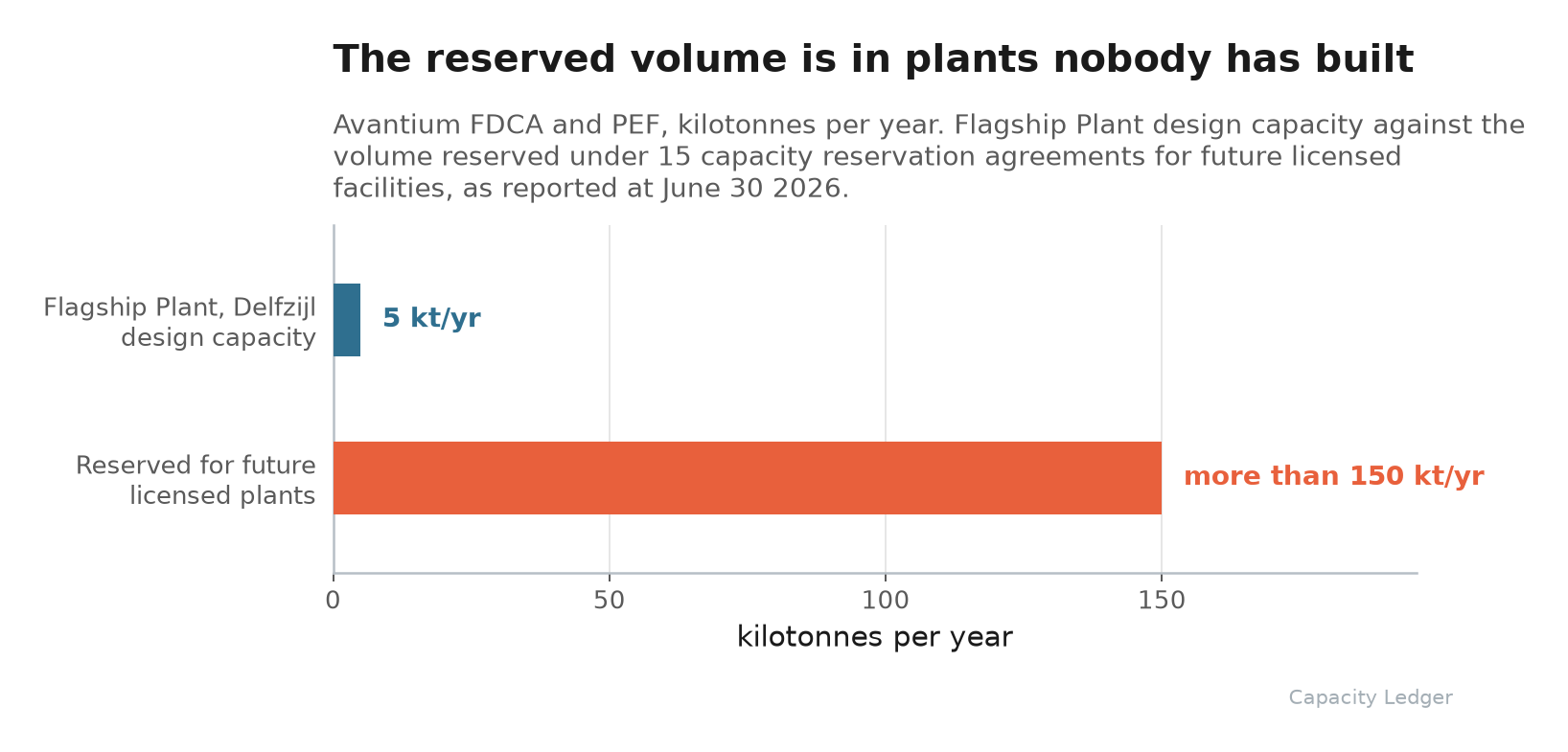
Alongside the 22 offtake agreements, Avantium has secured 15 capacity reservation agreements representing more than 150 kilotonnes of FDCA and PEF, with a potential annual product value it puts near EUR 750 million. Recent signatories include Packamama and Hoogesteger.
Those reservations sit on future licensed production facilities, which is to say plants that do not exist yet, and the reserved volume runs about thirty times the Flagship Plant's nameplate (chart below).
That gap is the business model working as drawn. At the final investment decision in December 2021, Avantium said the route to PEF's potential end-market, which it sized at $200 billion a year, was technology licensing.
Delfzijl is the reference plant that makes a license sellable.
Where a US Buyer Sits in This
Avantium says its licensing pipeline is active in North America, Europe and Asia, and it describes three deployment shapes: retrofit of existing industrial assets, new-build capacity, and consortium initiatives drawing in several parties from the value chain.
It also characterizes the counterparties without naming them: a specialty chemicals company, an established family-owned business, an integrated chemicals producer, and a multi-party consortium. Several have moved into detailed technical, commercial and project development discussions.
"Retrofit of existing industrial assets" is the phrase to read twice. Sugar dehydration and oxidation trains are not exotic equipment, and the US has assets that already do adjacent chemistry.
Four things to watch from here:
- First FDCA batches out of Delfzijl, which the company expects inside 2026.
- Completion of qualification campaigns, because that is what converts an offtake agreement into a delivery.
- The first signed license, and the continent it lands on.
- Whether reservation holders convert into firm volume once a licensed plant has an address.
Final Thoughts
Twenty-two years is a long time between a screening table and a purification unit, and the interval says something about how this industry actually adopts a new molecule.
The 2004 report was right about the chemistry and right about both barriers. It was silent on the schedule, which turned out to be the hard variable.
For anyone sourcing barrier resins or bio-based polyester intermediates, Delfzijl is a proof and the volume arrives through licensees. The licenses are the thing to track.
Thanks for reading.