Which Half of Augusta Comes Back?
Sasol's 20-F reached the SEC on 1 September carrying a plain six-line list of what International Chemicals switched off and on last year. Two of the lines name the same Sicilian site and point opposite ways: the paraffin separation unit restarts by December, the alkylation plant it feeds stays mothballed. The tonnes coming back are feedstock, and they land in somebody else's LAB plant.
Sasol is restarting a unit whose only customer on site is switched off.
The company's Form 20-F for the year ended 30 June reached the SEC on 1 September. Inside the integrated-report exhibit sits a six-line list of what International Chemicals did to its own asset base over the year: four mothballs or exits, one expansion, one restart.
Two of those lines name the same site in Sicily, and they run in opposite directions:
- "Restarting the ISOSIV unit in the Augusta, Italy plant in Italy producing high-quality n-paraffins"
- "Mothballed the HF linear alkyl benzene (HF-LAB) production asset in Augusta"
The paraffin unit feeds the alkylation plant. Sasol's own footnote to its capacity table says so in six words: "Paraffins mainly consumed for LAB production."
So the front of the chain comes back and the back of it stays dark.
"When a producer restarts the front of a chain and leaves the back of it mothballed, what actually reaches the market?"
Feedstock.
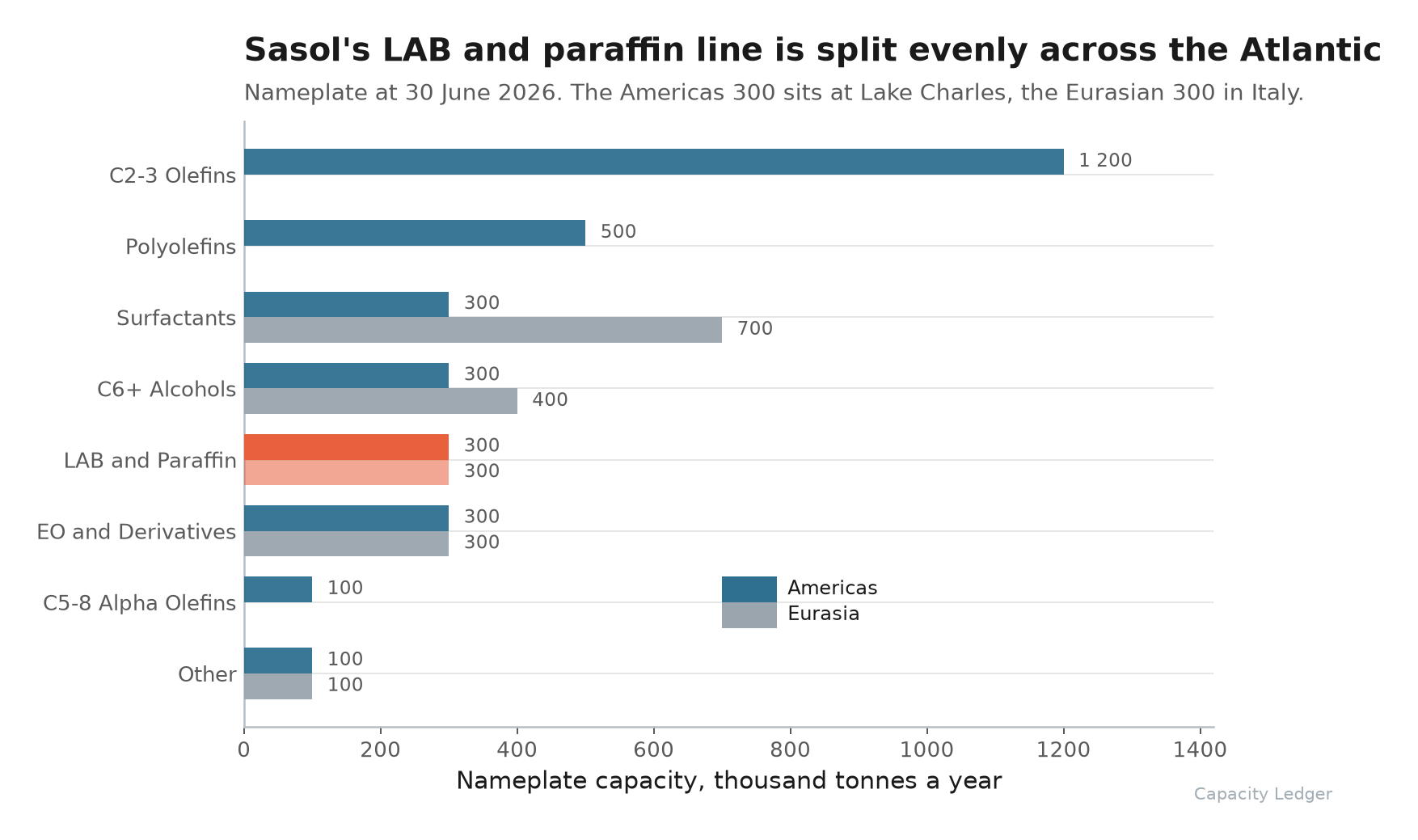
And if that reads like a European housekeeping detail, look at where Sasol's LAB and paraffin capacity physically sits.
Half is in Italy. The other half is at Lake Charles (chart below).

The rest of this brief is for subscribers.
The capacity math, the trade-flow read, and what it means for the products you buy.
$50 a month, or $400 a year.
Already a subscriber? Sign in