 Capacity Ledger
The Ordinance Said Nonhazardous
Saukville's zoning code permitted nonhazardous chemical manufacturing and had no category at all for the plant Ereztech wanted to build there, so the site that now turns out a US-qualified cobalt precursor needed a use determination before it could exist. Its whole published output ladder stops short of a tonne.
The largest container that leaves 700 North Progress Drive holds five gallons.
Plenty of them hold far less, down to 100 cc, and most of them reach the customer by air, on a commercial carrier. That is the entire outbound logistics footprint of a plant whose product ends up inside the interconnect of an advanced logic device.
Ereztech runs it, in Saukville, Wisconsin, a village of 4,258 people in Ozaukee County, north of Milwaukee. The company has been synthesizing high-purity organometallics since 2010, it is headquartered in Johns Creek, Georgia, and in September 2025 it finished a $10m conversion of a 30,000 square foot building that used to make cleaning wipes.
"What does a capacity ledger do with a plant whose entire year of output fits on a pallet?"
The whole ladder stays under a tonne
Ereztech publishes its scale-up steps, which is unusual and useful.
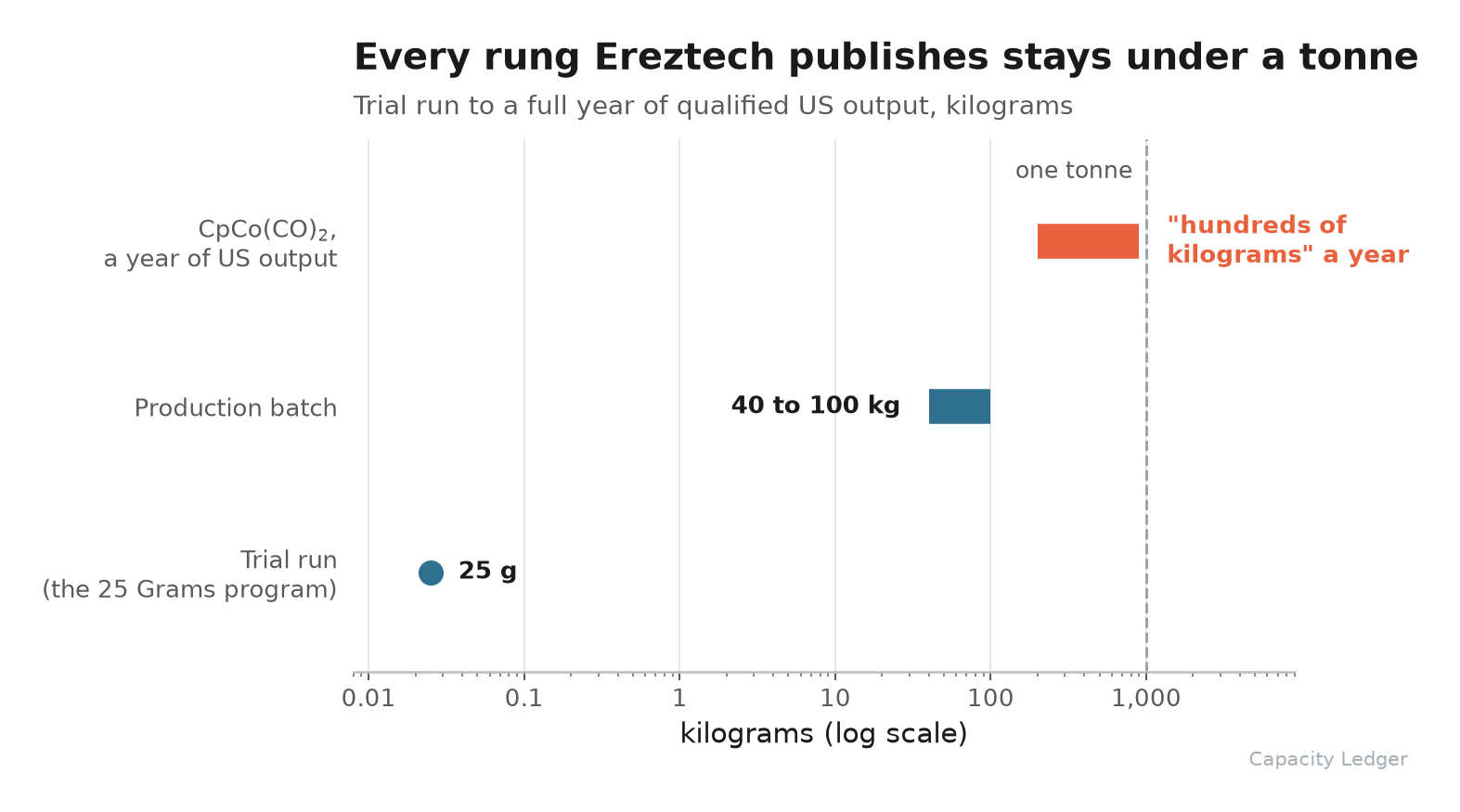
A new molecule starts as a 25 gram trial run under a program the company named after the number. Once it works, it moves to 40 to 100 kilogram production batches.
And the top rung of that ladder is a full year of output (chart below). The company's flagship qualified product, CpCo(CO)₂, is made in the US at "hundreds of kilograms annually" by its own account.
Set that against what the same fab spends on the easy molecules. On July 31 Linde committed $1bn to two more air separation units at its Phoenix complex, which already runs three, to push ultra-high-purity nitrogen, oxygen and argon into two new fabs for a customer it declined to name.
A billion dollars for the gases you can pull out of the air. Hundreds of kilograms a year, in a village of four thousand people, for the cobalt that goes into the interconnect.
The ordinance had a word for it, and the word was nonhazardous
Here is the part worth reading twice if you have ever tried to site this kind of chemistry.
Ereztech approached the Village of Saukville in late November 2021 about buying the vacant Rebel Converting building. The property sits in the M-2 General Manufacturing District, the village's most permissive industrial zone. Village staff read the permitted-use list and wrote this in a memo dated January 26, 2022:
The proposed use "was not among those permitted uses and was in fact the opposite of one of the permitted uses in that Ereztech uses hazardous chemicals whereas § 205-43.A(21) permits nonhazardous chemical manufacturing, processing, or use."
So the company could not build there as a matter of right. Its route was § 205-21.E, which lets the Plan Commission permit an unclassified use if it is "similar in character" to what the district already allows, and the filing it produced is a small masterpiece of the genre. Closed cycle, zero discharge to air or sewer. Batch operations at low temperature or under vacuum, in enclosed glass and stainless vessels, purified in dedicated columns. Registered at Wisconsin's small waste generator level, generating 4 to 6 fifty-five-gallon drums a quarter.
The village's own worries were specific, and they were about water and fire:
- The foam fire suppression system for the flammable liquids area uses PFAS and PFOS, which the utility superintendents flagged as forever chemicals under rising EPA scrutiny.
- Well #4 sits approximately 1,500 feet from the property and Well #6 approximately 2,200 feet, and both are among the village's highest producing wells.
- The fire department called the proposed operating system "unique and complicated" and asked that any approval be conditioned on it signing off every safety system at installation.
Ereztech answered with a suppression design built to NFPA 11, 13, 14, 16, 17, 30 and 400, dry suppression over the water-reactive materials, and an alarm system to the 2022 edition of NFPA 72 with a 3 to 5 minute estimated response.
Then it made the argument the whole filing is built around. The district's list of flatly incompatible materials runs: ammonia, asbestos, asphalt, cement, chlorine, coal tar, creosote, explosives, fertilizer, glue, gypsum, insecticide, lampblack, poison, pulp, pyroxyline, radium, grease and large quantities of gasoline.
Lampblack. Pyroxyline. That list is an honest snapshot of what a Wisconsin village thought dangerous manufacturing meant when it wrote the code, and none of it is what happens at 700 North Progress Drive. The Plan Commission took the application up on February 1, 2022, the company closed on the building that May, and the plant has been running since last September.
One of three, with two in progress
The cobalt shelf is where this matters to anyone qualifying a domestic second source.
- CpCo(CO)₂, for selective cobalt deposition and copper capping, is US-manufactured and qualified by multiple SEMI vendors today.
- CCTBA, dicobalt hexacarbonyl tert-butylacetylene, the seed-layer and gate-fill workhorse, is listed as US manufacturing in progress.
- Dicobalt octacarbonyl, for ALD cobalt films, is listed the same way.
One of the three customers Ereztech named in that 2022 zoning filing was Applied Materials, alongside Intel and Samsung. Applied Materials is also the assignee on the patent art for CCTBA-based CVD cobalt nucleation into vias, trenches and high-aspect-ratio features, deposited between about 100 and 250 °C. So the company that owns the deposition chemistry sat, by Ereztech's own account to the village, on the customer list of a converted wipes plant.
Final Thoughts
This desk counts capacity in kilotons, and that habit makes an entry like this one nearly invisible. Nothing here files an 8-K, nothing shows up in a WARN notice, and the tonnage would not round to a rounding error on a cracker.
It still gates a fab. And the document that decided whether it could exist at all was a village zoning ordinance whose idea of hazardous chemistry stopped at lampblack.
Thanks for reading.