Fifty-Five Percent of a Methanol Plant
Methanex sold substantially all of its New Zealand gas entitlements on Tuesday and will indefinitely idle Motunui in the first quarter of 2027. Every closure list this week will carry the number 860,000 tonnes. The site has produced at 55 percent of that for six straight quarters, so the tonnes actually leaving are closer to 474,000, and the gas risk in Methanex's book moves to Louisiana.
Methanex has idled three methanol plants in fifteen months. The reason on all three is the same, and none of it is about methanol.
On Tuesday the company filed a release saying it had agreed to sell substantially all of its New Zealand natural gas contractual entitlements, starting in the first quarter of 2027 and running to the end of the decade when those entitlements expire. It expects to indefinitely idle the New Zealand production facilities in that same quarter.
Forty years of methanol out of Taranaki, ended by a gas trade.
The number that will go on every closure list this week is 860,000 tonnes a year. That number is a nameplate, and it is wrong in a way that matters if you are pricing methanol into a 2027 contract.
"How many tonnes actually leave the market when a plant that was already not running gets idled?"
Six Quarters, One Answer
Methanex publishes operating capacity and production by site every quarter, which makes this checkable rather than a matter of opinion.
New Zealand's operating capacity is 215,000 tonnes a quarter. The company's own footnote says that figure "consists of one Motunui facility, with the other excluded as it is currently idle," so the 860,000 already writes off a train.
Against that 215, the six quarters from the start of 2025 run 160, 53, 123, 171, 158 and 46 (chart below).
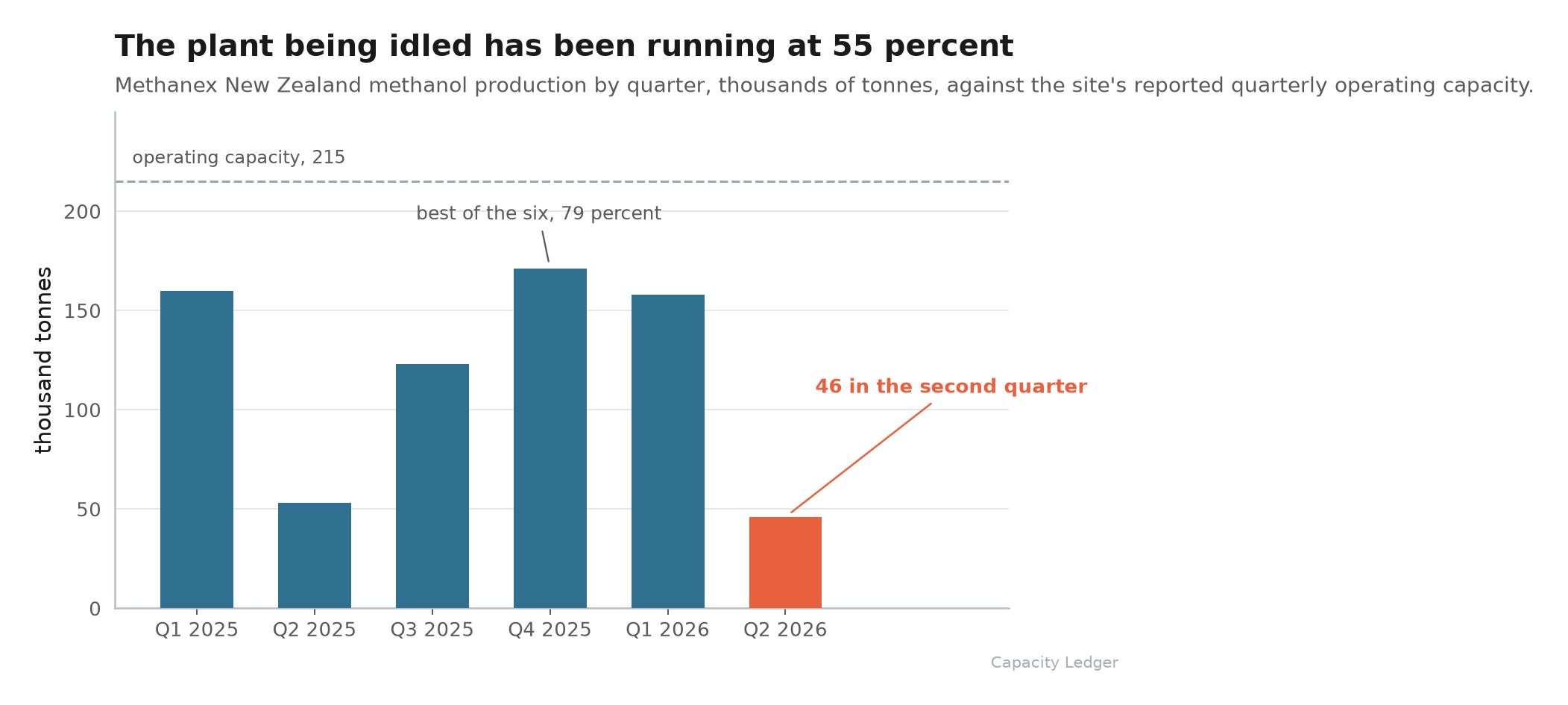
That is 711 against 1,290, or 55 percent. The best of the six, the fourth quarter of 2025 at 171, still came in under 80 percent of the site's own operating capacity.
Annualise the tonnes the plant was actually making and you get 474,000 tonnes a year. The gap to the headline is 386,000 tonnes a year of capacity that quietly stopped existing well before anybody announced it.

The rest of this brief is for subscribers.
The capacity math, the trade-flow read, and what it means for the products you buy.
$50 a month, or $400 a year.
Already a subscriber? Sign in