 Capacity Ledger
The Pigment Was Always the Byproduct
A hundred years ago a chemist at Uerdingen turned what aniline manufacture left behind into iron oxide pigment, and that reaction has run on the same site ever since. On August 11 Lanxess said the dryer at the end of it stopped burning natural gas and started burning the hydrogen the chlorine plant next door was going to make anyway.
In 1926 a chemist at Uerdingen named Julius Laux looked at the part of aniline manufacture that was not aniline.
He turned it into pigment. A century later that reaction is still running on the same patch of the Rhine, it is still the only plant in the world that runs it, and more than 15 million tons of iron oxide have come out of it.
"What do you do with the part of the reaction nobody ordered?"
A hundred years of the leftover
The Laux process makes synthetic iron oxide out of what aniline production leaves behind.
Run the reaction one way and you get a black suspension, run it another and you get yellow; both get washed, concentrated and dried. The reds come from cooking the black paste at high temperature.
Lanxess is the only supplier anywhere producing pigment this way, and Krefeld-Uerdingen is the only site where it happens. Capacity there is roughly 300,000 tons a year across more than 100 shades, sold as Bayferrox and Colortherm into paving stones, roof tiles, coatings and plastics, and more recently into artificial turf, brake pads, catalysts and battery precursor materials.
If you have ever specified a colour for concrete, you have almost certainly bought this plant's output without knowing whose it was.
The second leftover
On August 11 Lanxess said the spray dryer that dries those pigments had stopped burning natural gas.
It runs on hydrogen now. All of it.
The hydrogen comes off Covestro's chlorine electrolysis next door, where hydrogen is the third thing out of every cell whether or not a customer ordered it, and it crosses the fence in a dedicated pipeline (chart below).
Lanxess put the burner in at the end of 2025 and brought it up gradually. The scope was a hydrogen line, a hydrogen-capable burner, adapted measurement and control technology, and additional safety systems.
The company puts the result at approximately 6,000 metric tons of CO2 a year and calls it one of the first large-scale industrial plants in Germany running on hydrogen as a fuel in continuous operation.
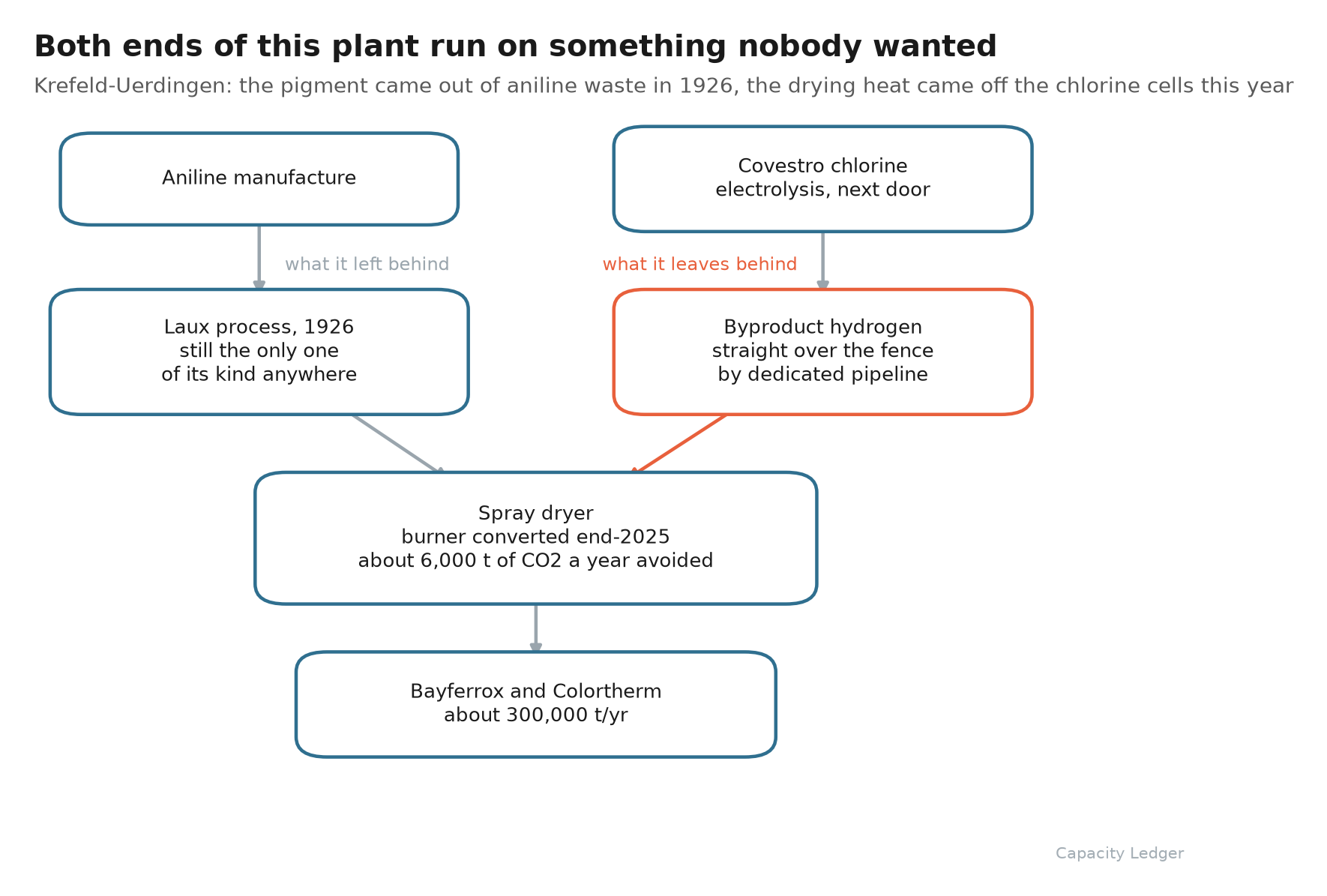
Michael Ertl, who runs the Inorganic Pigments business unit, called the burner swap "a significant technological step towards low-greenhouse-gas processes." Rob Eek, Covestro's production manager at the site, gave the sentence a plant engineer would underline: what made it work was short pipeline routes, shared infrastructure and established safety concepts.
The plumbing was already there. Covestro has supplied Lanxess at Uerdingen with chlorine, caustic soda and hydrogen since a January 2023 agreement, roughly a third of that volume made on hydropower guarantees of origin, out of ISCC PLUS certified cells.
So how much chlorine is that?
Lanxess published the CO2 figure and nothing else, which leaves the question a buyer of either product actually wants answered. Here is our arithmetic, in round numbers.
EPA's stationary-combustion factor for natural gas is 53.06 kg of CO2 per mmBtu. Six thousand tonnes of CO2 is therefore about 113,000 mmBtu of gas a year, call it 119,000 GJ of gross heat.
Deliver that as hydrogen instead and you need roughly 840 tonnes of it.
Chlor-alkali hands you 2.016 kg of hydrogen for every 70.9 kg of chlorine, so 28.4 kg H2 per tonne Cl2. Eight hundred and forty tonnes of hydrogen is the byproduct of about 30,000 tonnes of chlorine a year.
That is the number worth carrying. A pigment dryer on the Lower Rhine is now fuelled by a chlorine rate, and the two units are coupled on energy as well as on raw material.
Which is what a Verbund site is supposed to be for.
Set the saving against the site instead and it comes to 20 kg of CO2 per tonne of pigment nameplate. That is one burner on one dryer at a plant that has been making pigment for a hundred years, and the interesting part is what it cost to get: no new molecule, no new plant, no offtake contract for a fuel that does not exist yet.
Final Thoughts
Most industrial decarbonisation announcements are a promise about 2030 attached to a technology somebody still has to finance. This one is a burner, a pipe, and a neighbour whose process was going to make the fuel regardless.
The European closure file this desk keeps is full of plants that could not carry their energy bill. Uerdingen is in the other column, and it got there by noticing, twice in a hundred years, that the thing coming out of the reaction that nobody ordered was worth something.
Thanks for reading.