 Capacity Ledger
The Polysilicon Floor Lands on Malaysia
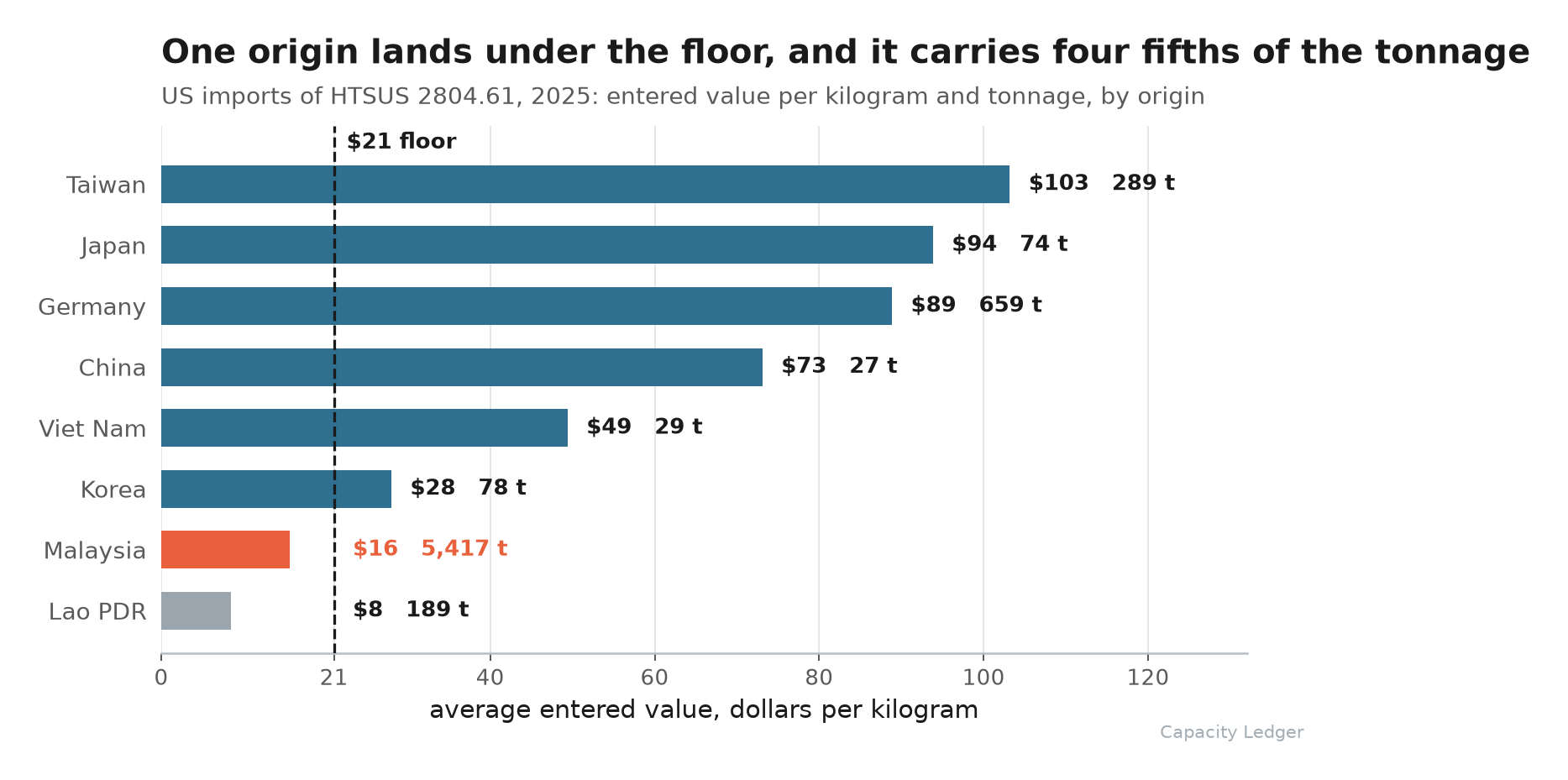
Section 232 put a $21 per kilogram minimum import price on HTSUS 2804.61 starting December 4. In 2025 that line carried 6,791 tonnes, four fifths of it Malaysian at $15.66 a kilo, and the Chinese share was 27 tonnes at $73.
If you import polysilicon, one line in Annex I decides your December bill, and it reads twenty-one dollars a kilogram.
We read the proclamation itself on August 13, two days after it published: the four minimum import prices, the December 4 effective instant, the documentation mechanic, the grandfather for fixed-terms contracts signed before August 6. What we deliberately left alone that morning was the customs book the floor lands on. Annex I lists exactly one HTSUS provision under the polysilicon tier, 2804.61.0000, "Silicon: containing by weight not less than 99.99 percent of silicon," and that line has eight years of public trade record sitting behind it.
So we pulled it.
"Which kilograms on that line actually enter below twenty-one dollars?"
Four fifths of them, and they come from one country (chart below).
One Line, Two Products
2804.61 is a single statistical line carrying two businesses that share a molecule and nothing else. The proclamation's own recital puts semiconductor-grade at 2.4% of global polysilicon production; the rest is solar-grade, and inside this one customs line the two enter about six to one apart.
That gap shows up cleanly in entered values. In calendar 2025 the material arriving from Taiwan averaged $103/kg, from Japan $94, from Germany $89, from China $73. The material arriving from Malaysia averaged $15.66.
The floor sits in the empty space between those two clusters. Nothing about it is subtle: four of the eight meaningful origins enter at three to five times the number CBP will be checking.
And the number CBP will be checking is the same one we just averaged. Clause (2)(c) keys the specific tariff to "the entered value on the entry summary," which is the numerator of every dollars-per-kilogram figure in the chart above.
The customs aggregate and the enforcement variable are the same quantity here, which is rare enough to be worth saying out loud.
Where the Tonnage Came From
2025 was a break in an otherwise dull series. US imports on this line ran between 1.0 and 2.0 million kg every year from 2018 through 2024.
In 2025 they hit 6,791,488 kg, a 5.3x jump in mass on an 83.8% rise in value. The average entered price collapsed from $80.42 to $27.99 without a single contract repricing, because the mix moved.
One origin did essentially all of it. Malaysia shipped 92,880 kg in 2024 and 5,416,980 kg in 2025, which is 96.7% of the entire year-over-year increase and 79.8% of the 2025 book by weight.
Malaysia has one polysilicon producer of consequence: OCI TerraSus at Samalaju Industrial Park in Bintulu, Sarawak, 35,000 t/yr of solar-grade capacity against a stated target of 56,600 t/yr, running on Sarawak hydropower and selling on a UFLPA-clean, non-China provenance story. Its parent is putting that polysilicon into a solar cell plant it is building in Texas.
China, on the same line, in the same year: 26,631 kg. Four tenths of one percent of the tonnage, entering at $73.10/kg, comfortably above the floor.
Worth knowing before you extrapolate 2025: the surge has already receded. First-half 2026 imports total 1,228,622 kg, an annualised pace near 2,460 t, with Malaysia at 213,120 kg and an average entered value of $15.14/kg.
Lower price, same side of the line.
What the Difference Costs
The arithmetic on the Malaysian number is the whole story for a buyer.
- No documentation at entry: a specific tariff equal to the full MIP, so $21/kg on top of a $15 kilo.
- Documentation filed, entered value below the floor: a specific tariff equal to the difference. At the first-half 2026 average that is $5.86/kg, an effective 38.7%. At the 2025 average it is $5.34/kg, or 34.1%.
- German, Taiwanese and Japanese material at $83 to $94/kg: nothing.
Two details cut in the same direction. Clause (4)'s additional 15% ad valorem names polysilicon ingots and derivatives, so raw polysilicon under 2804.61 is reached by the MIP program alone. And the 15% all-in cap for Japan, Korea, Taiwan, Switzerland, Liechtenstein and the EU is written against clause (4), which means it never touches the MIP. The trading partners who got the cap are the ones already entering at four times the floor.
One line we cannot explain, recorded rather than used: Lao PDR shipped 550,000 kg in the first half of 2026 at $2.49/kg. We can identify no Laotian polysilicon plant, and we are not building anything on that row.
Final Thoughts
The instrument prices a grade. The tariff schedule administering it does not know grades, only purity above 99.99 percent, and inside that definition sit semiconductor material at ninety dollars a kilo and solar material at fifteen. A floor set at twenty-one lands entirely on the second one.
For anyone whose 2027 cell supply runs through Sarawak, the number to model is the gap between your entry summary and twenty-one, times your kilograms, every entry from December 4 onward. The US still exported 36,238 t on this line in 2025 against 6,791 t imported, so the aggregate trade story here was never dependence. The grade story is a different file, and that one has a date on it now.
Thanks for reading.