The Rhine Is Taking Whole Chains Now
Four force majeure letters in three weeks, and two of them sit on the same molecule. BASF declared on surfactants Wednesday; the plasticizer letter went out July 16, and the phthalic anhydride behind those plasticizers went out July 31. None of it is a plant problem.
In June 2023 BASF told European customers it was bringing more than 150,000 metric tons a year of new alkoxylation capacity on stream at Antwerp and Ludwigshafen. The release quoted its senior vice president for home care, I&I and industrial formulators saying the expansion gave customers "enhanced flexibility and supply security."
On Wednesday BASF declared force majeure on several surfactants from its European sites, according to a customer letter reported by ICIS. The cause given is disruption to the delivery of raw materials, driven by low water on the Rhine.
Nothing shut down in between. No unit was decommissioned, no line was closed, no WARN-equivalent was filed anywhere.
The capacity BASF spent four years installing is still installed.
"If every reactor is running and the nameplate is intact, what exactly is short?"
That question has now been answered four separate times in three weeks, in four different letters, on four different products. And the answer keeps being the same thing.
The first letters went out at forty-five centimetres
We pulled the Kaub gauge again this morning: 3,017 fifteen-minute readings from the German waterways administration's public API, July 6 through 11:15 local today. Daily minimum, in centimetres, plotted with the four declarations marked on the days they landed (chart below).
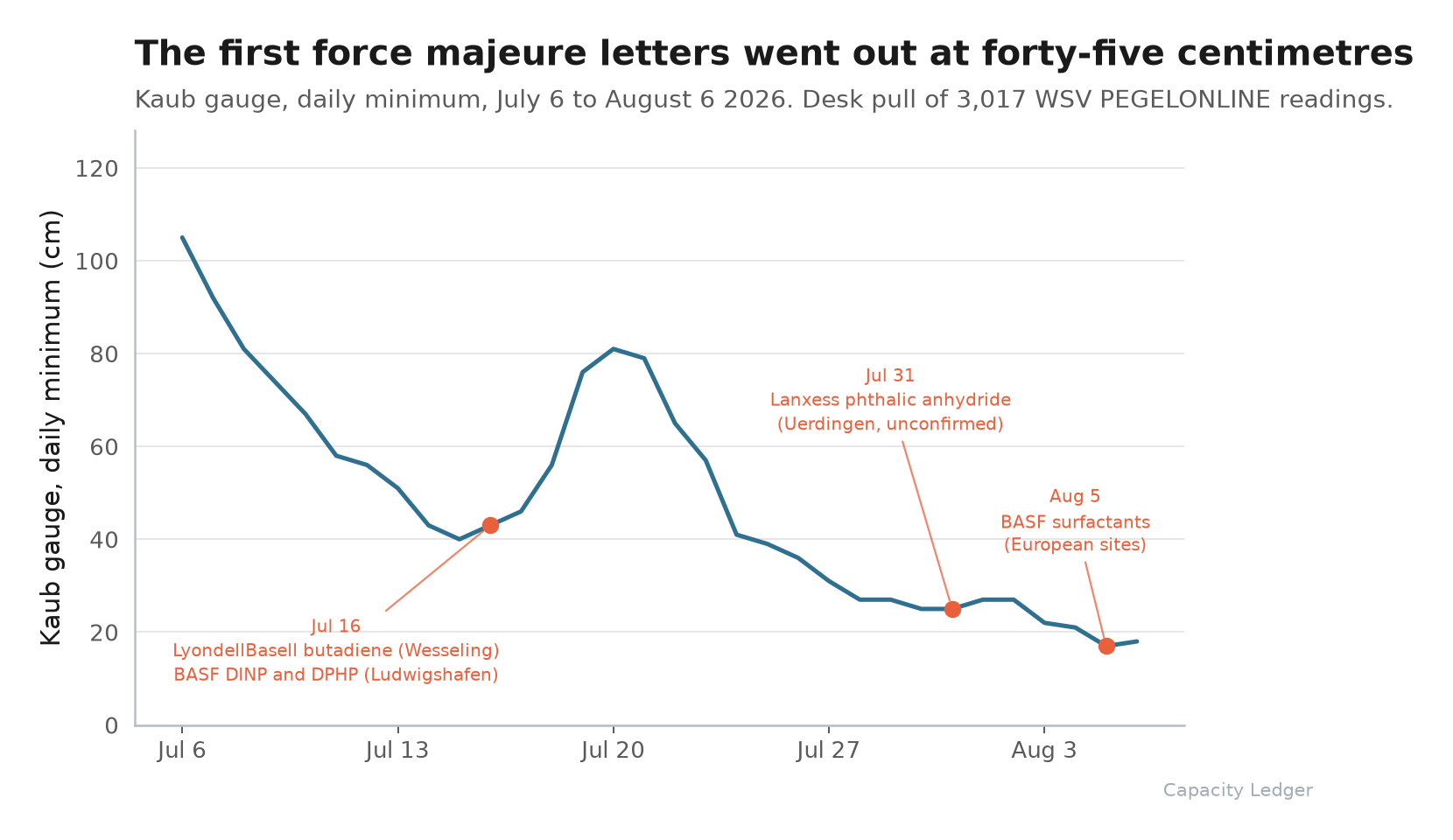
Two letters went out on July 16.
LyondellBasell's, which we wrote up on August 2, put the 170,000 t/yr butadiene extraction unit at Wesseling on force majeure. BASF's, reported the same day, covered DINP and DPHP at Ludwigshafen, citing hot dry weather and Rhine logistics together.
Kaub read 43 to 46 cm that day. On the desk's own depth arithmetic, gauge plus the 1.90 m ideal fairway minus the 0.78 m low-water reference, that is 1.57 m of navigable water.
Four days later the river recovered to 90 cm and the wires moved on.
The record came later and the letters kept coming anyway. Lanxess is reported to have declared on phthalic anhydride at Uerdingen on July 31, at 25 to 30 cm.
BASF's surfactants letter landed August 5, on a day our series bottoms at 17 cm, or 1.29 m of fairway. This morning the gauge is at 20 cm.
So the useful read has nothing to do with the record. The first declarations went out roughly twenty centimetres above it, on a day the river was arguably having a good week.
Anyone whose trigger was set at "record low" started re-planning three weeks late.

The rest of this brief is for subscribers.
The capacity math, the trade-flow read, and what it means for the products you buy.
$50 a month, or $400 a year.
Already a subscriber? Sign in