 Capacity Ledger
Who Still Rebuilds a Carbide Furnace?
Alzchem took an electric arc furnace apart this year, wore roughly EUR 10m to do it, and grew its first-half EBITDA 14% anyway. The furnace sits at the top of a chain that now ends in a US government contract and a site in South Carolina.
If you buy cyanamide, dicyandiamide, guanidine salts or creatine, your supply starts in an electric arc furnace running lime and coke at somewhere between 1,800 and 2,100 degrees C.
There are three of those furnaces, at two sites in Europe, and one company owns all of them.
Alzchem Group runs five production sites in the southeast Bavarian chemical triangle and one in Sundsvall, Sweden, on EUR 554.2m of 2024 sales. What it sells is built on nitrogen-carbon-nitrogen bonds, which is why the company calls its niche NCN chemistry, and every molecule in it traces back to calcium carbide.
One of those furnaces has spent 2026 in pieces.
"What has to be true for a European producer to pull an arc furnace apart on purpose in a year like this one?"
Where the Margin Actually Sits
Alzchem published its first half on July 30. Group sales EUR 303.9m, up 6%, and group EBITDA EUR 64.5m, up 14%, on a margin of 21.2%.
The split is where it gets interesting (chart below).
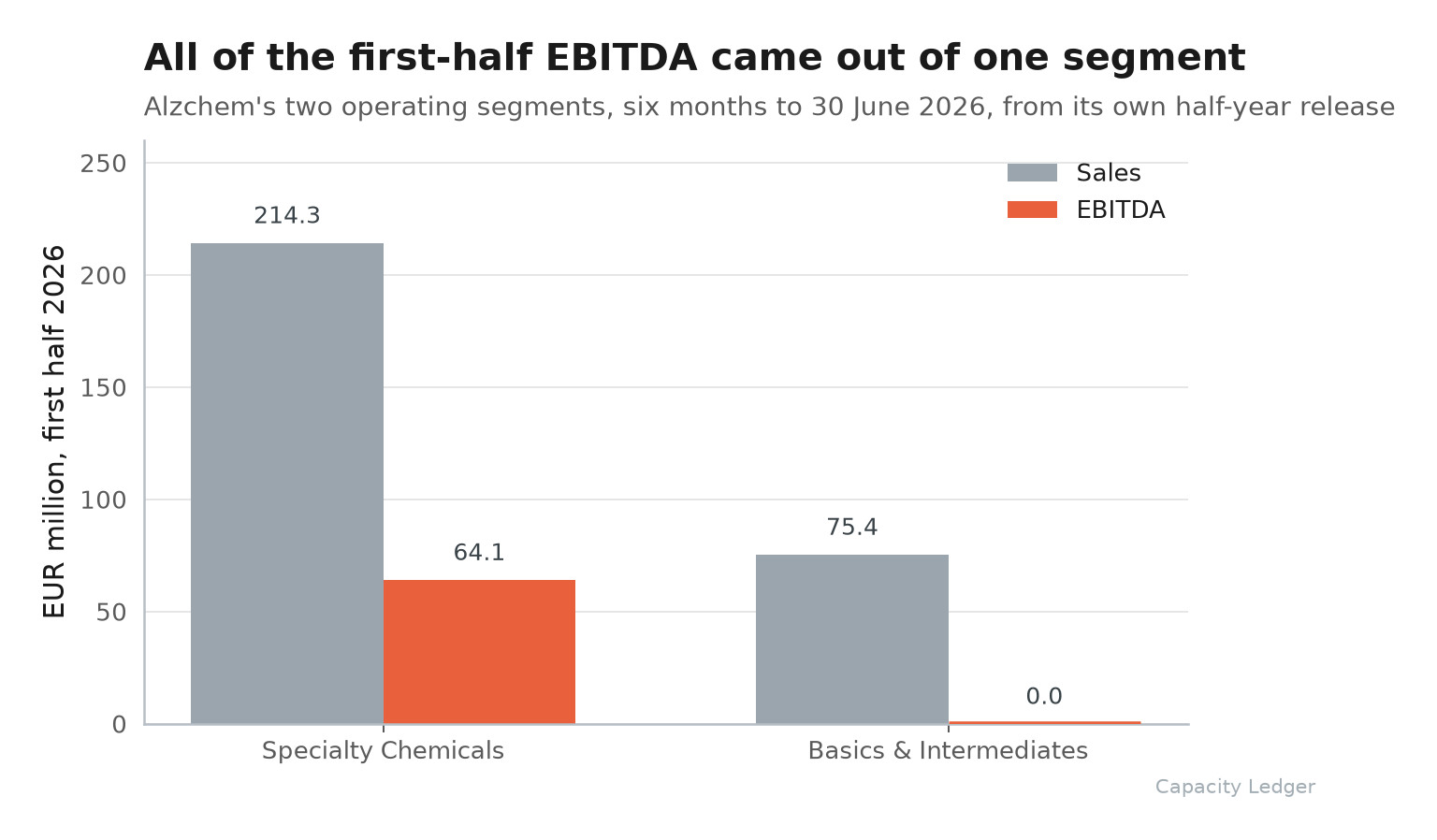
Specialty Chemicals turned EUR 214.3m of sales into EUR 64.1m of EBITDA, a 29.9% margin and 19% more than a year earlier. Basics & Intermediates, which is where the carbide and cyanamide end of the chain sits, turned EUR 75.4m of sales into break-even, against EUR 1.3m last year.
Those are the two operating segments and not the whole company. The remainder sits in other and consolidation.
So the segment that holds the furnace earned nothing in the first half, and the company is rebuilding the furnace anyway.
Why the Furnace Is Down
The half-year release calls it a comprehensive refurbishment scheduled for completion in the second half. On the call the same day, management put the cost at roughly EUR 10m spread across 2026, coming out of energy-regulated costs and idle costs, with recommissioning in the third quarter, one kiln online at first and two expected in 2027.
That is a producer spending about a sixth of its half-year EBITDA to keep an energy-intensive furnace running in Germany, in the same season this desk has spent counting European units that stopped.
Here is why it pencils. The carbide is the gate to everything downstream:
- Limestone burns to lime.
- Lime, coke and anthracite go into the arc furnace and come out as calcium carbide.
- Nitrogen, separated on site, passes through the hot carbide at around 1,100 degrees C and binds to it as calcium cyanamide.
- The cyanamide feeds the NCN portfolio: fertilizer, fine chemicals, feed additives, creatine, guanidine salts.
- One of those branches ends in guanidine nitrate, which is the precursor to nitroguanidine.
Frank and Caro worked out step three in 1895. Who gets paid for owning it changed considerably more recently.
What the Chain Ends In
Nitroguanidine goes into crop protection, into airbag propellant, and into defence, and Alzchem has said since 2024 that defence demand is the piece rising fastest. The build-out behind it:
- EUR 76m committed in spring 2024 for the guanidine nitrate stage, then roughly doubled once a new nitroguanidine plant was added, which the company called the largest investment in its history.
- EUR 34.4m of it funded by an EU ASAP grant awarded in March 2024, after a Europe-wide selection.
- The German plant entered commissioning in the first half of 2026, with capacity arriving in stages through the second half and a revenue contribution management expects in the fourth quarter.
The same October 2024 disclosure carried something else: a USD 150m US Department of Defense commitment toward building a plant in the States, conditional on Alzchem securing a site by the end of 2029.
The Plant in South Carolina
That condition closed on July 8, when Alzchem named Bushy Park, in Berkeley County, South Carolina. Anticipated investment is around USD 150m, with support from the US government, the state and the county, and the output goes to the US market under a government contract.
What the site brings:
- 1,530 acres owned by Pacolet Milliken, with steam, nitrogen, compressed air and process water on the fence line and roughly 35 further services.
- An onsite rail line, a barge slip, and the Port of Charleston close by.
- Ten industrial tenants already there, employing more than 1,200 people.
FEED and permitting are under way now, construction is targeted for 2027, and production for 2029. Management put the finished plant at close to EUR 100m of revenue at full rates.
The detail worth writing down: the intermediates stay in Germany. What gets built in South Carolina is the last step.
Final Thoughts
The addition column in this ledger mostly holds dollars and dates, and August has not been kind to it. Alzchem's entry holds dollars, dates, an EU grant, a US government commitment and a furnace coming apart and then back together, which is a combination we have not logged anywhere else this year. No tonnage, though, for either plant, on any route we could reach, so it lands in the same disclosure gap as everything else on the addition side.
None of it changes where the chain starts. Whatever runs at Bushy Park in 2029, the intermediates will still come out of Bavaria, and there will still be three furnaces at two sites.
If you buy anything carrying an NCN bond, that is the number for your file, and the useful thing about this year is that one of the three came out for a rebuild rather than a decommissioning.
Thanks for reading.