 Capacity Ledger
The Ring and the Tail Come From the Same Shell
COIM USA is building the first US plant dedicated to its cashew nutshell liquid polyol line, at Texarkana, with roughly 100 million pounds a year of planned capacity. The interesting part is that cardanol is an aromatic, which is the one thing bio-based polyols normally cannot offer a rigid foam formulator.
The stiffness in a rigid polyurethane panel comes off an aromatic ring, and that ring is normally a petrochemical.
COIM has been supplying it for long enough that the product line has its own name, Isoexter, aromatic polyester polyol for the insulating panels the construction trade buys by the truckload. Every plant in the group is vertically integrated around polyester polyols as the core technology.
The next COIM plant in the United States gets its aromatic ring out of a cashew shell.
"What has to be true for a bio-based polyol to matter to a rigid foam formulator?"
Aromaticity, mostly. And this one has it.
Sixty-Four Years From Peroxide to Polyester
COIM started in October 1962 at Offanengo, near Milan, when Mario Buzzella and Cesare Zocchi went into methyl ethyl ketone peroxide because Italy was short of it. They sold it as KETANOX and took 50% of the Italian peroxide market with 17 employees.
Monomer plasticizers, unsaturated polyesters, alkyd resins, saturated polyesters and polyurethanes all arrived between 1964 and 1974. The group now runs subsidiaries and affiliates in at least 16 countries.
The American arm bought a technical center at West Deptford, New Jersey in 2004 and had production running there by 2006. It operates two New Jersey plants, West Deptford and Paulsboro.
Two extensions tell you where the money has been going:
- Prepolymer capacity up 2.5x, completed July 2021, aimed at the low free monomer Imuthane and Versathane grades.
- Saturated polyester capacity up 1.7x, production from January 2022, aimed at thermal and acoustic insulation, a market COIM put at 10 to 15% a year.
So the US growth has been an insulation story, inside one molecule family, for five years running.
Where the Ring Comes From
Cashew nutshell liquid sits in the honeycomb structure of the shell and comes out as a byproduct of processing the nut. It is not a food-chain feedstock, and nobody plants a cashew tree for the shell.
The useful molecule in it is cardanol: a pentadecadienyl phenol carrying a long aliphatic side chain of one, two and three double bonds in a linear chain.
Read that structure as two halves, because formulators do.
The ring is a phenol, so it brings the chemical resistance and the fire performance you would otherwise buy from a petrochemical aromatic. The C15 tail brings hydrophobicity, which is the property most bio-based polyols cannot offer at any price.
In rigid foam, medium and high functionality Novolac and Mannich CNSL polyols get specified for thermal stability, low water absorption, fire performance and compression strength. In CASE, the same chemistry is used for bond strength, corrosion protection and hydrolytic stability.
Cardolite has been selling CNSL polyols into coatings, adhesives, foam and elastomers since at least 2015, so the chemistry is well travelled. What is new here is somebody putting up a dedicated US plant for it at polyol scale.
Twenty Acres, Two Start Dates
COIM USA bought a 20-acre rail-served site with a 25,000 square foot building at TexAmericas Center, New Boston, Texas in 2024. On June 18 2026 it said what the site is for: approximately $50 million, and a renewable polyol line made principally from CNSL, complementing the Isoexter portfolio.
The company expects it to be its first and largest US facility dedicated to that line.
The build carries two dates, and only one of them carries volume (chart below).
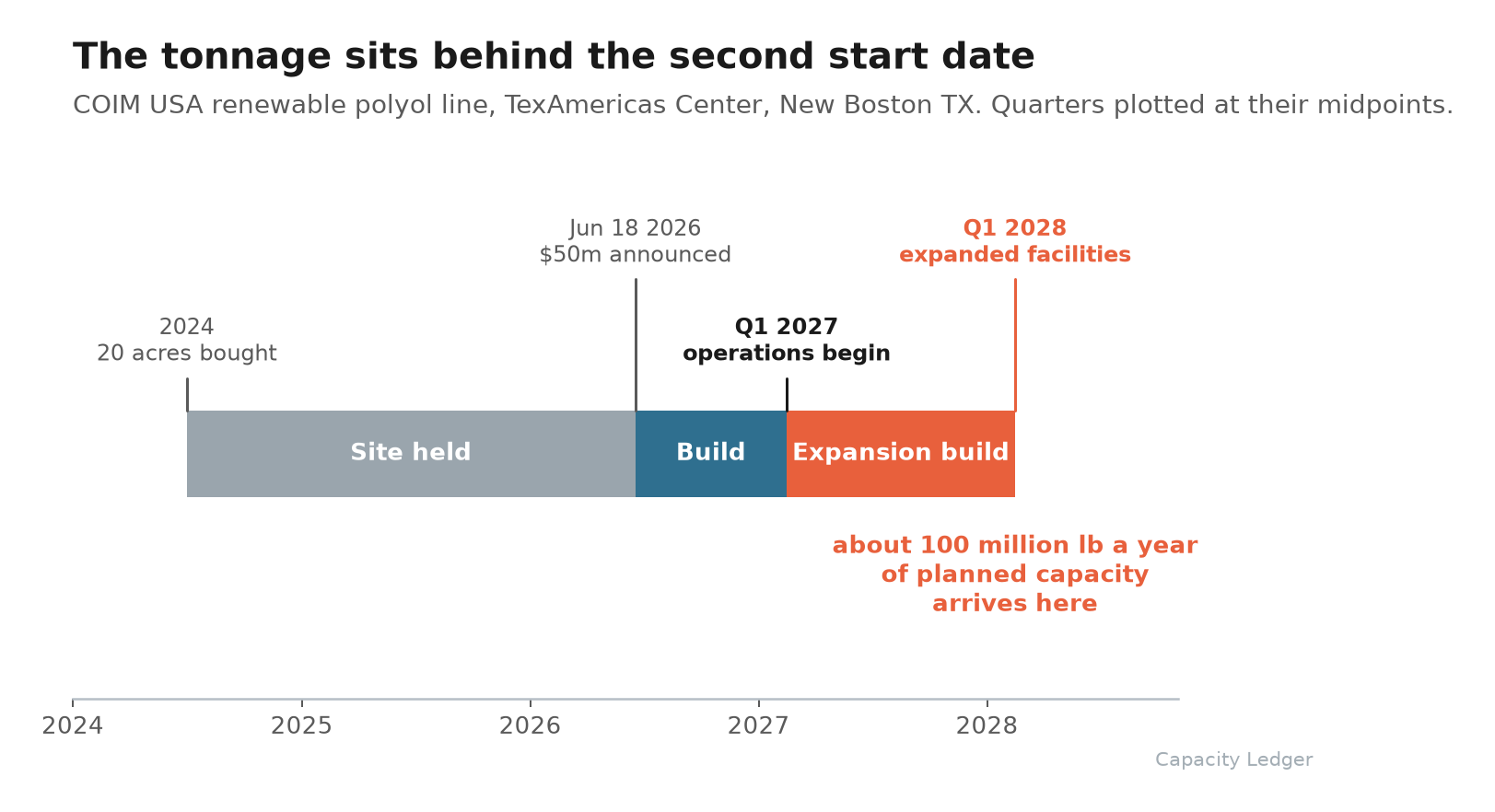
Operations begin in Q1 2027, inside the building COIM already owns.
The expanded facilities land in Q1 2028, and that is where the roughly 100 million pounds a year of planned capacity sits. Call it 45,000 tonnes.
Hiring is already open: director of manufacturing, production manager, maintenance manager, quality control manager, quality control technicians, production operators. Bowie County, Texarkana College and Workforce Solutions Northeast Texas are the named workforce partners.
The rail matters too. The site came with logistics and transload infrastructure, and COIM describes it as the base of a Mid-South manufacturing and distribution platform.
The feedstock is an agricultural byproduct that originates nowhere near Texas, so a rail-served site with transload is a sensible place to land it.
Final Thoughts
Most bio-based polyols ask a formulator to accept an aliphatic backbone and rebuild the formulation around what it costs them. Cardanol asks for less than that, which is how it has held its niche for a decade without a mandate propping up the demand.
What COIM is doing is putting tonnage behind the niche, in Texas, on rail, with two dated milestones you can hold them to.
Q1 2027 tells you whether the line runs at all. Q1 2028 tells you whether the volume is real.
If you buy aromatic polyol, both are worth a calendar entry, and the second one is worth a phone call well before it arrives.
Thanks for reading.