 Capacity Ledger
The Spike Stopped at the Formulator
Petrochemical producer prices are up 23.7% over twelve months and the whole upstream half of chemical manufacturing came with them. Three industries print below last July, and all three of them formulate rather than crack.
In October the producer price index for pesticides and other agricultural chemicals fell 6.9% in a single month.
That is the largest one-month decline in a series BLS has published without a break since June 1982, across 530 prints. It went by without comment, because ag chemical prices sagging into a weak season is the least surprising line in the file.
Then the front end of the chain did something genuinely strange. The petrochemical index went from 132.1 in January to 226.4 in May, a 71% move in four months, with April and May the two largest monthly increases that series has ever recorded.
Over those same four months the pesticide index moved up 0.7%.
"If the intermediates are up double digits and the formulated product is not, who is holding the difference?"
Three lines went the other way
July's PPI, published August 13, has chemical manufacturing as a whole up 5.5% over twelve months. Underneath that headline the six-digit industries sort almost perfectly by position in the chain (chart below).
Petrochemicals +23.7%. Synthetic rubber +11.3%. Plastics materials and resins +9.9%.
All other basic organics, which is where most of a formulator's purchased intermediates actually sit, +10.5%.
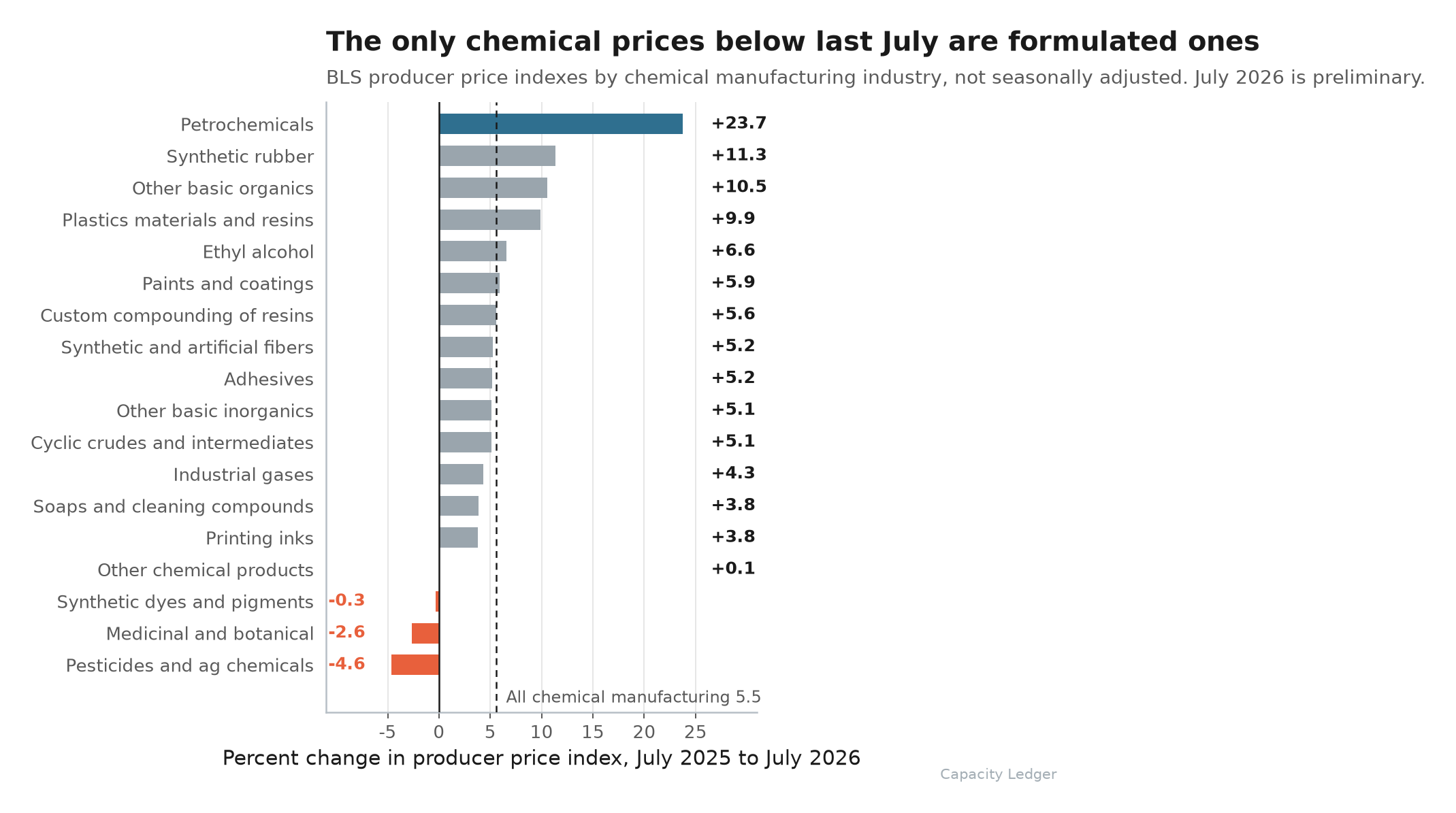
Three industries print below where they were last July, and all three of them formulate:
- Pesticides and other agricultural chemicals, -4.6%, the lowest July since 2021 and 27% under the August 2022 peak
- Medicinal and botanical, the bulk actives and extracts layer, -2.6%
- Synthetic dyes and pigments, -0.3% against last July and down 9.0% just since January
Medicinal and botanical ran its own version of the October step. It fell 4.4% in January 2026, the second-largest single-month decline in that series in forty-four years, and it has printed essentially flat in all six months since.
We traced the upstream half of this move on August 3, when May was still fresh. The desk's read then was that the shock was already fading into the inorganics; what the July file adds is that at the formulated end it never showed up at all.
The producers are saying it out loud
FMC reported its second quarter on July 29 with revenue of $867 million, down 17% year over year. Price fell 7%, which the company attributes to pressure on core legacy products plus planned Rynaxypyr active pricing actions, and volume fell 10%.
Full-year adjusted EBITDA guidance came down to $620-680 million.
Corteva told its August 7 call that first-half crop protection pricing declined low single digits, then moved the second half to a low-to-mid single digit decline, naming competition in Latin America and pre-emergent herbicides in Brazil specifically.
So this is not an index artifact. Two of the largest US crop protection producers describe the same conditions from the inside, and one of them took the year down on it.
What it does to your next quote
If you buy formulated ag chemistry, bulk actives, or pigment, you have had twelve unusually good months and the margin paying for them is not yours.
Three things follow, and none of them wait for a press release:
- Multi-year price protection is worth more right now than it will be in a quarter. The producer holding a 10.5% intermediates increase against your flat contract has one obvious way out of it.
- The volume line matters more than the price line here. FMC took -7% on price and -10% on volume in the same quarter. Price weakness with volume weakness underneath it is the setup for a capacity decision, and a capacity decision is what removes your second source.
- Cheap and shrinking is the pigment pattern. We wrote on August 19 about the Fed's production index for dyes and pigments printing its second-lowest month since 1972. The price index for the same industry is down 9.0% in six months. Falling price on falling output is what rationalization looks like from the buyer's side of the desk.
One honest caveat on all of it: every 2026 month from February onward carries the BLS preliminary flag, and these get recalculated for four months after first publication. April's petrochemical print has already been revised down 2.7% since we last pulled the file on August 3.
Final Thoughts
Feedstock spikes happen, and this one is already two months into unwinding. The 71% will read as noise in a year.
What lasts is the 0.7%, which is what the pesticide index did while its inputs went vertical. Somebody absorbed a four-month feedstock shock without repricing a single quarterly contract, and the July file says it was the formulator.
That is a transfer, and transfers get taken back. Whether it comes back as price in 2027 or as a plant that quietly stops running a grade is the only part still open.
Thanks for reading.