 Capacity Ledger
The Twenty Thousand Tonnes Nobody Has to Build
Eastman's Kingsport methanolysis plant is running above 90% yield, its recycled-polyester revenue doubled in the half, and management says incremental projects take it to 130,000 tonnes. New US capacity arriving without a groundbreaking.
Eastman's molecular recycling plant at Kingsport is running at yields above 90%.
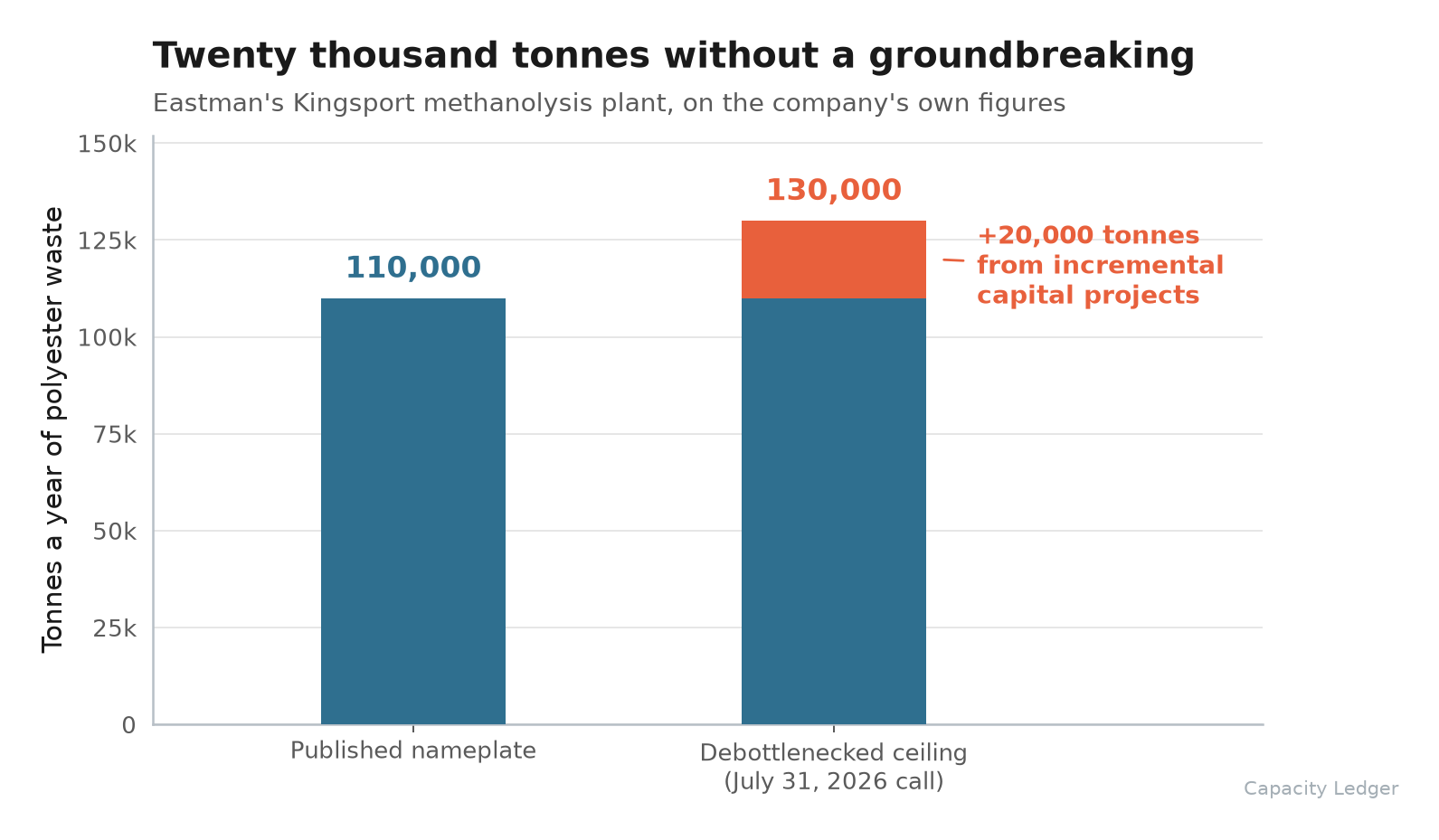
Last year it ran at around 50% utilization. On this morning's second-quarter call, CEO Mark Costa said the company has tested the asset, is confident it can take it to 100% of design rate, and that targeted incremental capital projects can push it to 130,000 tons.
Published nameplate on that plant is 110,000 tonnes a year.
So the most interesting piece of new polyester capacity in North America this quarter is arriving inside a fence that already exists (chart below).
What Is Actually In There
Announced in January 2021: approximately $250 million at the Kingsport site, to take polyester waste back to dimethyl terephthalate and ethylene glycol and build it up again. Initial production and operation at scale landed in March 2024.
The feed is the material that defeats mechanical recycling. Curbside-collected packaging, hard-to-recycle polyester waste headed for landfill or incineration.
The output is monomer. Purify it, re-polymerize it, and what leaves the site as Tritan Renew or Cristal Renew carries the property set of virgin material, because molecularly that is what it is.
There is a pleasing symmetry in the address. Tennessee Eastman was incorporated at Kingsport on July 17, 1920, on thirty-five acres and the buildings of the American Wood Reduction Company, and what it made there first was methanol, by dry distillation of wood, shipped north to Rochester for Kodak's film. A hundred and six years later the site is using methanol to take polymers apart.
In May the Kingsport technology was certified to ISO 59014 by SCS Global Services, valid through March 2029 with annual surveillance audits. Sandeep Bangaru, a vice president and general manager at Eastman, framed the certification as traceability and responsible practice made auditable, which is the language a brand's legal team wants before it puts a recycled-content claim on a label.
Where the Next Tonnes Come From
The capacity arithmetic is the part worth stealing.
Costa's phrasing on the call was "up to 130% of design capacity or 130,000 tons." Eastman publishes the asset at 110,000 tonnes, so the percentage and the absolute figure do not quite reconcile.
Hold the absolute number, since that is the one with engineering behind it.
Either way the increment runs to roughly 20,000 tonnes a year, and it comes out of targeted projects sitting inside a capital budget of about $400 million for the entire company in 2026.
Now the constraint, which Costa named himself and which is the more useful disclosure.
The limit sits downstream of the methanolysis unit, in polymer capacity. "There's still limits to what that PET capacity is," he said, with the company looking at other polymer lines it can optimize to keep making PET.
A recycling asset whose binding constraint is the polymer line behind it is a recycling asset that works.
Somebody Is Buying It
Renew revenue crossed $100 million in the first half, double the same period last year, split roughly evenly between specialty growth and rPET. Costa put the margins above the company average and reaffirmed the target of $200 million of EBITDA from this first asset.
The proof point most readers will have held in their hand arrived on May 27, when PepsiCo and Eastman announced the first Gatorade bottles made with Eastman PET Renew in the US, under a multiyear agreement. Neither side disclosed volumes.
Two things worth doing with this if you buy polyester:
- Ask where you sit in the queue. An asset at 50% utilization has slack for anybody who calls. An asset heading for 100% of design with a brand-owner contract ramping in front of you does not, and the debottleneck tonnes land later than the demand does.
- Price the audit alongside the resin. ISO 59014 with annual surveillance is chain-of-custody documentation your own customers will eventually ask you to produce. Getting it from the supplier is cheaper than assembling it yourself.
Final Thoughts
We have spent this month almost entirely in the subtraction column. Consultations, WARN notices, a capex line running under depreciation, a European TDI market down to two plants.
The addition column takes a different form here. No site announcement, no permit, no 2029 start-up date, no ribbon cutting. Twenty thousand tonnes of capacity that shows up because a plant that was hard to build turned out to run better than its design sheet.
That tonne is the cheapest one in the industry right now, and it appears on nobody's announced-projects list.
Thanks for reading.