 Capacity Ledger
Thirty-Five Days With One TDI Plant
Wanhua took BorsodChem's 250,000 tonne TDI line down for annual maintenance on July 17. Europe used to keep enough spare plants to absorb that, and then it closed 300,000 tonnes of them.
Wanhua told the market on July 15 that its Hungarian subsidiary would start taking units down two days later. MDI, TDI, aniline, nitrobenzene, in stages, on the annual plan.
Thirty-five days.
The filing says Yantai and Ningbo are running at full capacity and the work is "not expected to affect its overall production and operations." For Wanhua, that reads as fair.
For anyone buying TDI in Europe, that sentence is carrying more weight than it looks.
Two Plants, and It Used to Be Three
BorsodChem's Kazincbarcika complex carries 250,000 t/yr of TDI. Covestro's Dormagen plant carries 300,000 t/yr, which Covestro calls Europe's largest.
Put those two together and you have the continent's TDI industry (chart below).
There was a third. BASF started a 300,000 t/yr TDI plant at Ludwigshafen in late 2015 and announced it was closing on February 24, 2023, along with the dinitrotoluene and toluenediamine units feeding it.
Demand, the company said, had "developed only very weakly, especially in Europe, Middle East and Africa."
Europe's nameplate went from 850,000 tonnes a year to 550,000. The spare plant went with it.
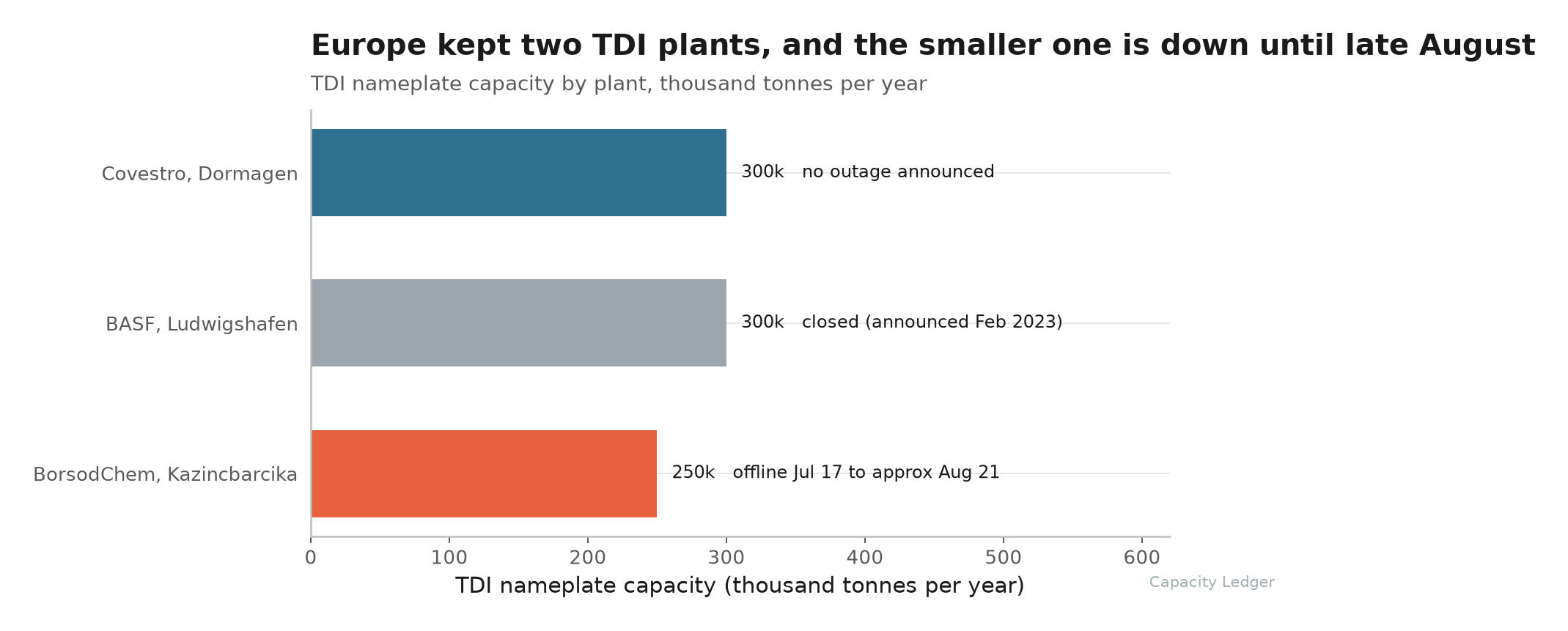
Which is why a scheduled turnaround is worth your attention this year.
At nameplate rate, thirty-five days on a 250kt line is about 24,000 tonnes that do not get made. Spread across three producers, somebody covers it and you never hear about it.
Across two, it is 45% of the remaining European base off at once, and the whole balance sits on one site at Dormagen.
Last July It Was Dormagen That Went
On July 12, 2025, a fire in an external substation at Chempark Dormagen, the site Currenta operates, cut power across part of the complex.
The chlorine plant stopped. TDI stopped with it, because the TDI plant cannot run without the chlorine.
Covestro declared force majeure on July 16, 2025.
It held. As of September 30, 2025, the company had still not cancelled the force majeure on chlorine and TDI, and it put the fiscal-year hit to EBIT in the low triple-digit millions of euros.
Same month, consecutive years, opposite ends of the continent. One of those was an accident and one is a maintenance plan, and the reason both land on your desk is the same: there is no third plant to absorb either.
Where August's Tonnes Come From
BASF did not leave the European TDI market when it shut Ludwigshafen. It told customers they would keep being supplied out of the global network: Geismar, Yeosu, Shanghai.
So the balancing European tonne has arrived by ship for three years now, and August is the month that gets tested.
Three things to check while the Hungarian complex is down:
- Your coverage runs past August 21, plus reload and requalification time on whatever you switch to. Thirty-five days from July 17 gets Kazincbarcika back around then, assuming the turnaround holds its schedule, which turnarounds do until they don't.
- MDI is in the same window. The Hungarian shutdown covers a 400,000 t/yr MDI unit and the aniline and nitrobenzene behind it, not just the TDI line. If you buy any of those from Kazincbarcika, all four trace back to one turnaround.
- Covestro publishes its half-year statement tomorrow. On July 9 it raised full-year EBITDA guidance on preliminary H1 EBITDA of EUR 669 million, crediting higher prices against raw materials that moved up with a lag, and said nothing about Dormagen. Tomorrow morning is the first document that can.
Final Thoughts
Nothing in Wanhua's announcement is unusual. Annual maintenance, filed two days ahead, on a schedule set long before this quarter, and the company is right that its own year barely notices.
The word routine describes the turnaround accurately. Whether it describes the month depends entirely on what else is running, and Europe answered that question in February 2023, in a paragraph about weak demand in EMEA.
Every closure buys a permanent cost saving and sells an option on somebody else's uptime. You find out what the option was worth on a random Tuesday in August.
Thanks for reading.