Which Half of the Paprika Oleoresin Duty Is Live Today?
Commerce finalized both India cases on Friday: 25.42 percent countervailing on Synthite, 5.78 percent dumping. Only the smaller half is being collected right now, and the window shuts when the ITC votes.
Friday's Federal Register carried a table with a column headed "Cash deposit rate (adjusted for subsidy offset(s))," and every number in it was 0.00.
Synthite, 0.00. Mane Kancor, 0.00. All others, 0.00.
Nobody bringing Indian paprika oleoresin through a US port is paying 0.00.
"If Commerce publishes a zero in the cash deposit column, what does the entry actually cost?"
The answer sits three paragraphs below that table in the same notice, and this week it is worth about twenty points of ad valorem duty to anyone with a drum on the water.
The Sole Remaining Producer
The petitioner in both cases is Rezolex, Ltd. Co. of Las Cruces, New Mexico, which filed on June 25, 2025. Commerce's initiation notice records what the domestic industry looks like in one clause: "the petitioner identified itself as the sole remaining producer of the domestic like product; therefore, the Petition is supported by 100 percent of the U.S. industry."
So the entire US capacity base for E160c is one extraction operation in southern New Mexico.
That is the part worth sitting with. The scope covers oleoresin paprika at an ASTA value of at least 500 or 20,000 color units, CAS 68917-78-2 and 84625-29-6, entering mainly under HTSUS 3203.00.8000 and 3301.90.1010. Every kilogram of it a US formulator buys above that color strength comes from Rezolex or from an import.
Rezolex has run this play before.
On March 6, 2001 the same company filed an antidumping petition on the same product from the same country. On April 20, 2001 the ITC found no reasonable indication of injury and killed it at the preliminary stage (Inv. No. 731-TA-923, USITC Pub. 3415).
Twenty-four years later the Commission went the other way, voting affirmative on the preliminary phase in August 2025 and sending both cases to Commerce for a full run.
Two Hundred Eighty-Five Percent, Then Five
The petition arrived alleging dumping margins of 235.82 to 284.83 percent. Commerce initiated on that basis in July 2025, picked Synthite Industries Pvt. Ltd and Mane Kancor Ingredients Private Ltd as mandatory respondents, and spent a year working the numbers down.
Friday's final margins: Synthite 5.78 percent, Mane Kancor 4.24 percent, all others 5.08 percent.
Commerce verified both respondents on site, sales and cost, between April and June, with the sales reports dated June 23 and the cost reports July 6. The Issues and Decision Memorandum still runs a section on adverse facts available and a comment on Synthite's unreported marine insurance expenses, so the verifications were not quiet ones. The margins moved up anyway, from 5.66 and 3.33 at the preliminary.
The subsidy case is where the size is. Final countervailable rates came in at 25.42 percent for Synthite, 18.67 percent for Mane Kancor, and 21.90 percent all others, barely moved from February's preliminary figures of 25.41 and 18.56 (chart below).
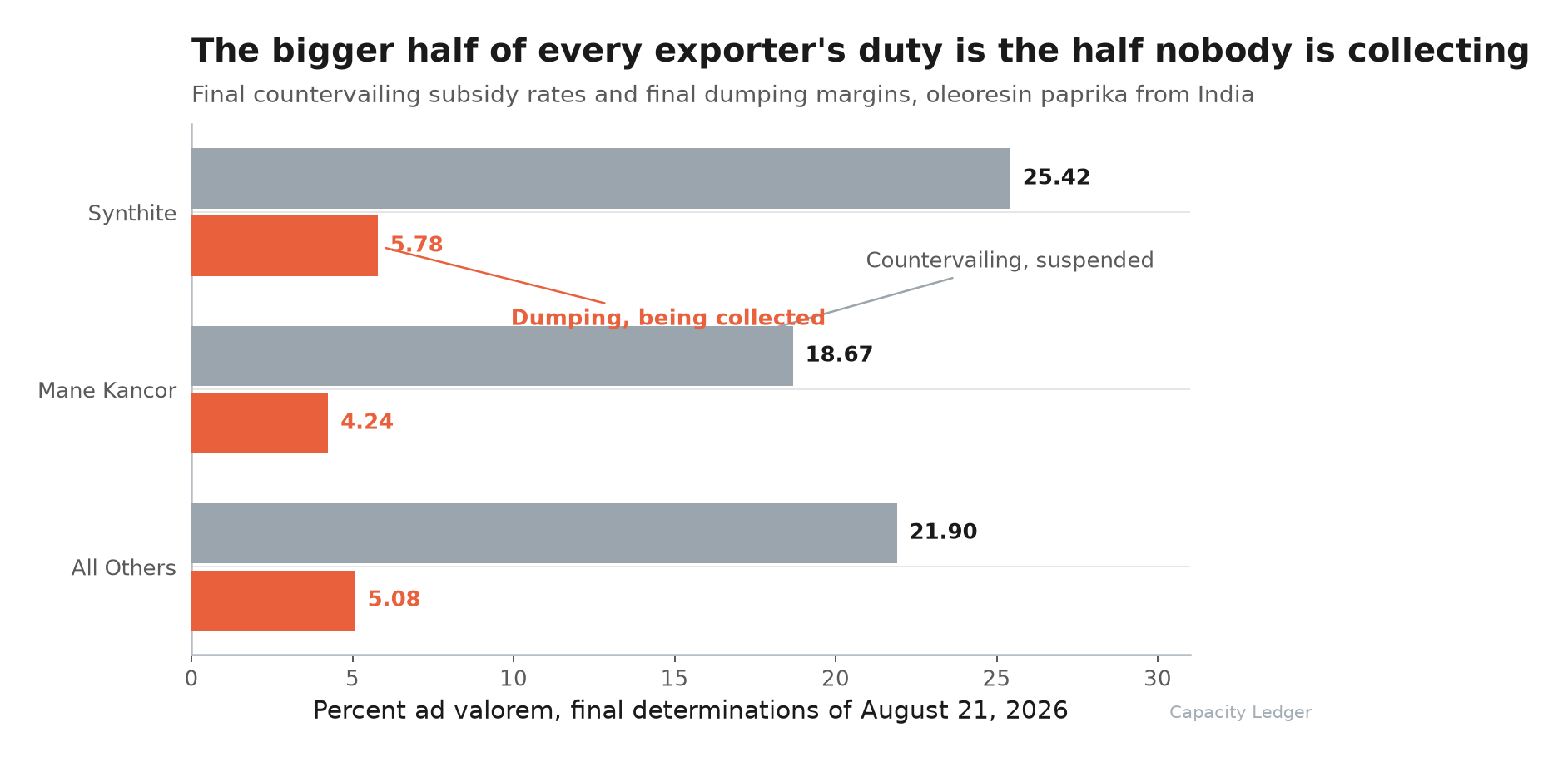
Add the two halves and Synthite's exposure is 31.20 points, Mane Kancor's 22.91, an unexamined Indian exporter's 26.98.
Now, none of that is what a container entering this morning pays.

The rest of this brief is for subscribers.
The capacity math, the trade-flow read, and what it means for the products you buy.
$50 a month, or $400 a year.
Already a subscriber? Sign in