The Hormuz Premium Skipped Mont Belvieu
Crude went from $61 to $118 after February 28 and US propane barely moved. A propane barrel has spent 2026 averaging 36.6 percent of a WTI barrel, the cheapest of the thirty-four annual averages EIA's Mont Belvieu series supports, and every propylene derivative escalator written off crude is now indexed to a feedstock your supplier may not be buying.
A barrel of propane at Mont Belvieu went out on Tuesday at $30.37. A barrel of WTI at Cushing went out the same day at $86.48.
That is 35.1%, and the day was ordinary. Propane has averaged 36.6% of crude across every trading day of 2026, which is the cheapest any year has been in the thirty-four annual averages EIA's Mont Belvieu series supports (chart below).
The old floor was 38.63%, set in 2023.
"If your feedstock stopped tracking crude in March, why does your contract still track crude?"
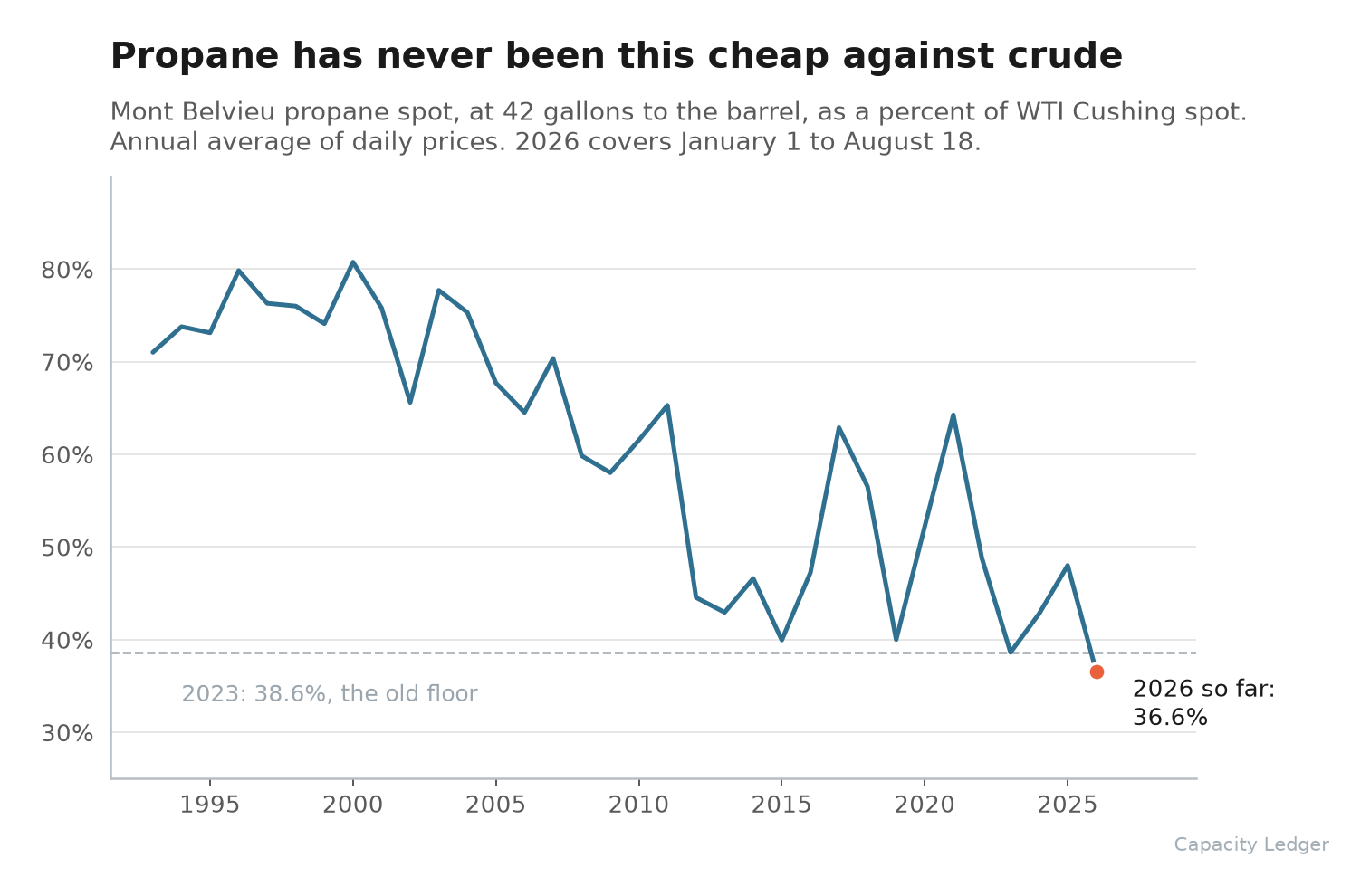
Two prices that used to move together stopped, on a date we can name.
February 28 shows up in one of them
In February, propane averaged $0.614 a gallon and WTI averaged $64.51. The ratio was 40.0%, unremarkable for the shale era.
Then military action in the Middle East on February 28 stopped most shipping traffic through the Strait of Hormuz, and Iraq, Saudi Arabia and the UAE shut in production behind it.
EIA's own accounting has Brent opening January at $61, clearing $100 on March 12, and closing the quarter at $118. The Brent-WTI spread averaged $11 in March, its widest month in over five years.
March propane averaged $0.727. April averaged $0.766.
So propane did move. It moved about 25% while the crude complex moved roughly double that.
The ratio fell to 33.7% in March and 32.2% in April, and it has more or less stayed there. August is running 34.4%.

The rest of this brief is for subscribers.
The capacity math, the trade-flow read, and what it means for the products you buy.
$50 a month, or $400 a year.
Already a subscriber? Sign in